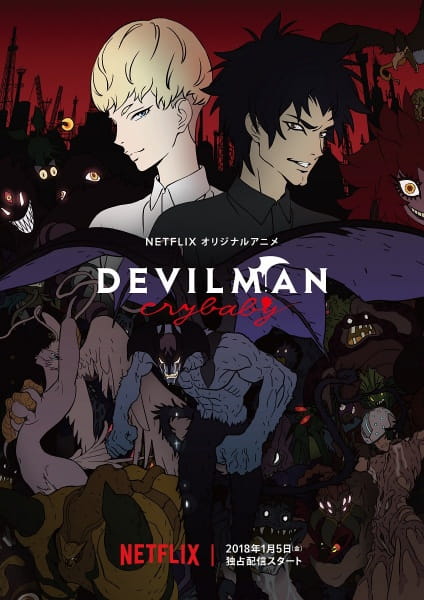
Devilman Crybaby Review: An 8.10 Carried by Themes and Yuasa's Hand, Taxed by Compression
Judged against one consistent rubric, Devilman is best understood by which criteria carry it and which drag it down — not by a single number.
Judged against one consistent rubric, Devilman is best understood by which criteria carry it and which drag it down — not by a single number.
Masaaki Yuasa made the Devilman adaptation no Toei reboot would have greenlit, and the rubric rewards him for exactly that — but it also docks him for the runtime he agreed to. Ten episodes is not enough room for Go Nagai's manga, and the seams show in the first three. The Codex score of 8.10 is not a verdict on whether Crybaby is great; it is a map of where greatness lives in it and where the structural compromises bleed value.
The Crowd Score and Why It Misreads the Show
MyAnimeList puts Crybaby at 7.74. The Codex puts it at 8.10. A 0.36 gap is not a screaming disagreement, but it is directional, and the direction matters: the crowd has marked Crybaby down for the things that are loudest about it — the deliberately ugly character art, the rapper interludes, the sexual frankness — and undercounted the things the rubric weights heavily for a show derived from shonen source material, namely thematic ambition and authored direction. The MAL average reads as a response to surface texture. The Codex score reads the structure underneath.
This is the standard pattern when a stylistically divisive work meets aggregate scoring, and it shows up elsewhere in the catalogue — the same dynamic that puts a 6.5 on Berserk's 1997 animation and forces the rubric to do the work of separating ambition from execution. With Crybaby, the question is reversed: the execution is the strongest argument, and the script underneath it is the part that wobbles.
The Story Earns Its 8.0 in the Back Half, Not the Front
The 8.0 on story is generous to the first three episodes and slightly punitive to the last four. Crybaby compresses a manga that ran from 1972 to 1973 into ten Netflix episodes, and the cost is paid up front — the Sabbath rave, Akira's merging with Amon, the early devil hunts, and the introduction of the track team and Miki's family all arrive at a tempo that does not let any of them settle. When Miko, Kukun, and the rest of the running club die later, the deaths function but do not devastate, because the show did not buy enough screen time to make them people first.
What the back half does is recover the deficit with structural payoff. The witch-hunt episode, in which broadcast media outs devil hosts and ordinary citizens turn on each other, is the show's argument made literal. Ryo's reveal as Satan in the closing two episodes is not a twist for shock; it recontextualizes every flat affect Ryo has displayed since episode one, including the scene at the rave where he kills indiscriminately to trigger Akira's transformation. The final battlefield image — corpses in a landscape that has outlived the conflict — is the nihilistic shonen-adjacent ending that almost no commercial adaptation would risk. The story score sits at 8.0 because the front-loading hurts, not because the destination is wrong.
Character: Akira and Ryo Earn 7.5; the Ensemble Loses It
The 7.5 on character is a weighted average of two excellent leads and a thin bench. Akira's arc — from the weeping pushover of episode one to a killer who still cannot stop crying by the finale — is the emotional spine, and Yuasa stages the contradiction physically: the same character runs the same track in the same posture before and after Amon, and the difference is in the eyes and the speed. Ryo is the standout. His coldness in the early episodes plays as sociopathy and is reframed in the closing two as a love that does not understand itself as love, queer longing that has forgotten its own object. That long-game reveal is among the better executions of its kind in the demographic.
The ensemble does not match the leads. Miki Makimura is given enough material to function as the show's moral center and the target of its most brutal sequence, but the rappers operate as a Greek chorus rather than as characters, and several supporting figures exist to die meaningfully rather than to live convincingly. The rubric registers that imbalance.
Themes at 9.0: The Highest Score, and the One That Carries the Show
Themes is where Crybaby genuinely separates from its peers. The 9.0 reflects a show that treats humanity-as-the-real-monster not as a slogan but as a sustained argument, executed through specific sequences: the mob beating of Miki, the live broadcast that converts neighbors into hunters, the futility of compassion in a world the script has already decided is doomed. The queer reading of Ryo is not subtext smuggled in around the edges; it is the emotional engine of the finale.
What earns the 9.0 rather than something higher is restraint in service of sincerity. The show is brutal, but the brutality is not posturing — the camera does not linger for thrill, and the final image of corpses is composed for grief rather than spectacle. This is the criterion doing most of the lifting in the weighted score, and it is the one the MAL average most clearly fails to price in.
Animation at 9.0: Yuasa and Science SARU as the Authorial Argument
The 9.0 on animation is for direction as much as draftsmanship. Yuasa and Science SARU abandon clean linework in the Sabbath transformations, letting bodies distort, fold, and rupture in a way that conventional production design would smooth out. The neon rave sequence in episode one, the track-running montages, and the apocalyptic finale all use color and editing rhythm — not key-frame density — to do the heavy lifting. The style is divisive and occasionally crude on a frame-by-frame basis. It is also fearless and unmistakably authored, which is what the rubric is measuring.
World-Building at 7.5: The 1972 Source Does Half the Work
The 7.5 on world is honest. The premise — devils need strong-willed hosts, and a sufficiently strong human heart can dominate the demon — is a clean engine, and the Sabbath-to-apocalypse escalation gives the setting coherent logic. But the cosmology around Satan, the ancient devils, and the divine framing is delivered in compressed exposition, and the rules of devil biology never quite firm up. The score reflects that Crybaby coasts on Nagai's 1972 design rather than expanding it. That is a defensible choice for a ten-episode adaptation; it is also a ceiling.
The Counter-Argument: That the Style Sinks It
The strongest case against Crybaby is that Yuasa's aesthetic is not a feature but a tax — that the character designs are ugly, the rap sequences are tonally adrift, and the sexual frankness reads as provocation rather than craft. This is the position the MAL 7.74 encodes. It is not a stupid read. The first three episodes genuinely do strain to accommodate the rapper chorus, and the body horror occasionally tips into crude rather than expressive.
The rubric reads it differently because the question is not whether the style is comfortable but whether it is coherent with the thematic argument. A show about humanity's hidden ugliness rendered in pretty Toei linework would be a contradiction. The score parses style as load-bearing, not as decoration. Compare the rubric's handling of Yuasa-adjacent stylistic risk in works where the production is the message — when the visual language and the thesis align, the criterion rewards it.
Crybaby's 8.10 is a show with two 9.0s holding up two 7.5s and an 8.0 in the middle, with cultural impact at 8.0 leaning on the 1972 source's foundational status. That is the shape of an authored adaptation that knew which fights to pick and which to lose.
Featured in the Codex


More from The Codex
The Seven Deadly Sins Is a 6.60 Wearing a 7.60 Costume: A One-Point Gap Earned by Groping Gags and Convenient Flashbacks
The Seven Deadly Sins scores 6.60 on the Codex against MyAnimeList's 7.60 because the crowd is grading a Netflix breakout and a Ban-and-King friendship, not the 24 episodes A-1 Pictures actually broadcast in 2014.
The 10.0 That Built a Sunday: How Sazae-san's Cultural Score Carries a 6.58 Scorecard
Sazae-san is a case study in how a single criterion — cultural — can define how a show is remembered, and the 10.0 the Codex hands Eiken's 1969 institution is doing every bit of the heavy lifting its other five scores refuse to.
The Sebastian Problem: Why Black Butler Sits 1.10 Below Its MAL Line and the Crowd Refuses to Notice
Black Butler (Kuroshitsuji) posts a 1.10-point gap between MyAnimeList's 7.65 and the Codex 6.55 because the crowd is grading Sebastian's silhouette and a Phantomhive aesthetic, not the anime-original finale A-1 Pictures actually shipped in 2009.
Discussion
Set a display name above to post.
Loading discussion…