The 6.5 That Defines Berserk: How OLM's Animation Budget Decides How a Masterpiece Gets Remembered
Berserk scores 8.53 on the Codex rubric, but the single number that determines its legacy isn't the story or the cultural weight — it's the 6.5 OLM put on screen in 1997.
Berserk scores 8.53 on the Codex rubric, but the single number that determines its legacy isn't the story or the cultural weight — it's the 6.5 OLM put on screen in 1997.
Berserk is the rare anime where five of six rubric axes are pulling toward greatness and one is actively sabotaging the result. The Golden Age arc scores 8.5 on story, 9.0 on character, 9.0 on themes, 8.0 on world-building, and a near-ceiling 9.5 on cultural impact. Then the Berserk animation score lands at 6.5, and that single figure does more to shape how the 1997 series is remembered than any of the others. This is a case study in how one criterion can define a show — and the honest read is neither a hit piece nor a puff piece. Credit the strengths. Name the failures.
The MyAnimeList 8.61 and What the Crowd Is Actually Voting On
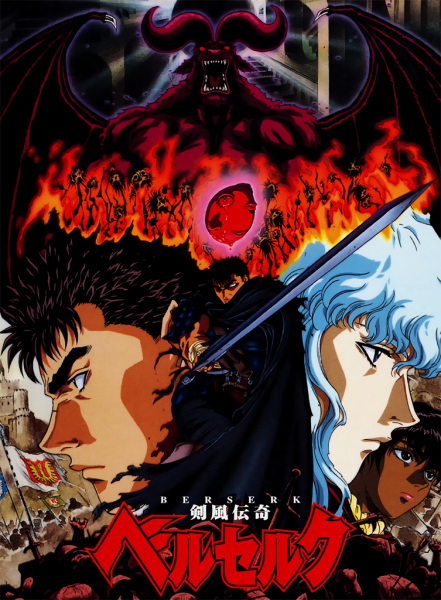
The consensus position is that Berserk (1997) is a near-masterpiece. MyAnimeList scores it 8.61. The Codex lands at 8.53. Those numbers look identical at a glance, and that's the problem — the agreement masks a fundamental disagreement about what's being rewarded. The MAL aggregate is voting on the Eclipse, on Griffith's betrayal, on Susumu Hirasawa's "Forces" playing over the Black Swordsman cold open. It's voting on the memory of having watched Berserk, which is not the same as evaluating the 25 episodes OLM actually produced between October 1997 and April 1998.
The Codex rubric forces a separation the crowd score doesn't. When you weight animation as a discrete criterion — as we do across every entry in the catalogue, and as we've argued elsewhere is the medium's structurally weakest axis — Berserk's production limitations stop being a footnote and become the central fact of the adaptation. The 6.5 isn't a hedge. It's a verdict.
The Specific Failures: Static Panning, Recycled Frames, Rough Linework
OLM's Berserk is not a poorly directed show. It is a poorly animated one, and the distinction matters. Naohito Takahashi's direction makes intelligent compromises with the budget — the muddy desaturated palette, the long-held still frames over Hirasawa's score, the restraint with onscreen violence outside the climactic sequences. These are smart choices. They are also choices made because the alternative was worse.
Watch the mid-series battlefield episodes — the stretch covering the Hundred-Year War campaign and the assault on Doldrey — and the seams show immediately. Cavalry charges resolve into pans across static cels. Sword clashes cut away before the contact frame because there is no contact frame. Character animation in dialogue scenes frequently collapses into talking-head shot-reverse-shot with minimal in-between work. The Falcons in formation are often a single drawing pushed across the screen. This is not stylization. This is OLM, in 1997, producing 25 episodes of seinen on a budget that could not sustain the ambition of the source material.
The court-intrigue stretch in the middle of the run — the same stretch the Codex flags for pacing drag on its 8.5 story score — is where the animation failures and the narrative ones compound. A static medium handles static plotting badly. When Griffith is maneuvering through Midland's nobility, the show has no visual language to compensate for the lack of swordplay, and the limitations become impossible to ignore.
Where the Production Actually Earns Its 6.5
The justification for not scoring lower — and the 6.5 is deliberately not lower — is that the direction does occasionally rise to meet the writing. The Eclipse achieves genuine visceral horror. The apostle designs, the shifting architecture of the God Hand's plane, the specific framing of Griffith's transformation into Femto — these sequences have real authorial intent behind them, and the limited animation works for the horror rather than against it because dread is built through composition, not motion. The cold open with the Black Swordsman, recurring across the prologue framing, establishes a tonal register the rest of the show keeps faith with.
And then there is Susumu Hirasawa. "Forces" and "Guts" are doing structural work that the visual production cannot. The score is the single strongest asset in the entire 1997 adaptation, and it has to be acknowledged that a meaningful portion of what audiences remember as "the atmosphere of Berserk" is actually the atmosphere of Hirasawa cues laid over functional-at-best visuals. Credit where it's earned: the music is why the 6.5 isn't a 5.5.
What the 6.5 Costs the Show
Run the counterfactual. Imagine the same scripts, the same voice direction, the same Hirasawa score, but the production fidelity of a late-90s Madhouse or Production I.G project. Imagine the Eclipse animated by someone with Keiji Gotou's key animation budget extended across 25 episodes rather than concentrated in the finale. The story score stays at 8.5. The character score stays at 9.0. But the cultural score — already 9.5 — would have nowhere left to go but it would carry a different kind of weight, and the world-building criterion, currently 8.0 because the 1997 adaptation "only scratches the surface of Miura's mythology," would almost certainly clear 9.
This is the exact mechanism we've documented in other Codex case studies where a single criterion decides the legacy: a near-perfect work held below its ceiling by one axis. With Mushishi it was cultural impact. With Berserk it is animation, and the gap between what the source material demands and what OLM could deliver is the gap between a great anime and a foundational one.
The Counter-Argument: Limitation as Aesthetic
The strongest defense of OLM's production is that the limitations are the aesthetic — that Berserk's grimness, its sense of inevitability, its refusal to fetishize action, all derive from a visual language that refuses spectacle. There is a real argument that a more fluidly animated Berserk would have been a worse one, that the held frames and muted palette serve Miura's tone better than a Bones-style action showcase would.
The rubric reads this charitably but not credulously. Yes, the restraint serves the tone in the Eclipse and the cold opens. No, it does not serve the tone during the Hundred-Year War battles or the court sequences, where the show clearly wants to deliver scale and clearly cannot. You can't claim every limitation as a choice. Some frames are still because they're authored; most are still because they're cheap. The 6.5 distinguishes between the two.
Verdict
Berserk (1997) is an 8.53 because it is the rare show where story, character, themes, and cultural weight conspire to survive a production that should have sunk them. The 6.5 on animation is the entire reason it isn't a 9.0 entry, and it's the reason the conversation about Berserk has always been a conversation about the manga, the films, and the 2016 attempt rather than the adaptation that actually introduced the world to Guts and Griffith. Strip out Hirasawa and the Eclipse and the production score drops another point. The rubric is fair. The show is great. The animation is the ceiling, and the ceiling is low.
Featured in the Codex



More from The Codex
The Seven Deadly Sins Is a 6.60 Wearing a 7.60 Costume: A One-Point Gap Earned by Groping Gags and Convenient Flashbacks
The Seven Deadly Sins scores 6.60 on the Codex against MyAnimeList's 7.60 because the crowd is grading a Netflix breakout and a Ban-and-King friendship, not the 24 episodes A-1 Pictures actually broadcast in 2014.
The 10.0 That Built a Sunday: How Sazae-san's Cultural Score Carries a 6.58 Scorecard
Sazae-san is a case study in how a single criterion — cultural — can define how a show is remembered, and the 10.0 the Codex hands Eiken's 1969 institution is doing every bit of the heavy lifting its other five scores refuse to.
The Sebastian Problem: Why Black Butler Sits 1.10 Below Its MAL Line and the Crowd Refuses to Notice
Black Butler (Kuroshitsuji) posts a 1.10-point gap between MyAnimeList's 7.65 and the Codex 6.55 because the crowd is grading Sebastian's silhouette and a Phantomhive aesthetic, not the anime-original finale A-1 Pictures actually shipped in 2009.
Discussion
Set a display name above to post.
Loading discussion…