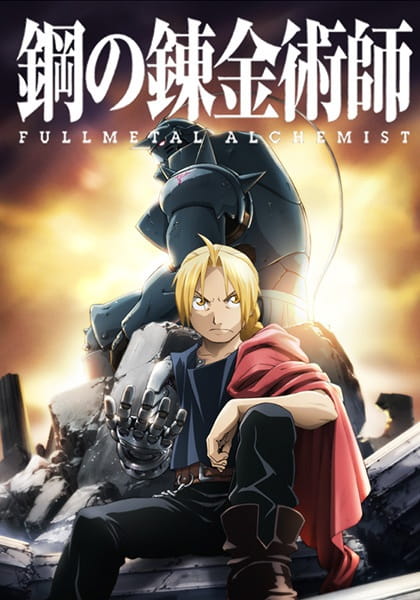
Fullmetal Alchemist: Brotherhood
Is Fullmetal Alchemist: Brotherhood worth watching?
Yes — a standout. Anime Codex rates Fullmetal Alchemist: Brotherhood 9.25 out of 10 — scored on six criteria (story, characters, themes, world-building, animation, and cultural impact), not crowd votes. 1st of 226 on the Codex rubric — top 0% of the catalogue. The Codex rates it Δ +0.14 above its MAL score — more underrated than 88% of the catalogue.
Where to watch
What the data says
Computed from the Codex rubric across the whole catalogue.
Summary
Fullmetal Alchemist: Brotherhood is widely regarded as a high-water mark for shonen precisely because it solves the genre's chronic structural problems: adapting a finished manga lets it foreshadow and resolve a sprawling conspiracy without filler bloat, and its 64 episodes converge on the Promised Day with unusual discipline. Its real distinction is moral seriousness—the Ishvalan genocide, Mustang and Hawkeye's war guilt, and the brothers' grief give it emotional stakes few action shonen attempt, while equivalent exchange ties magic, plot, and theme into a single coherent idea. The ensemble is deep, granting villains and side characters genuine arcs, and Bones renders the action with clarity and weight. Weaknesses are minor but real: the early episodes rush foundational material, tonal shifts between slapstick comedy and atrocity occasionally jar, a few homunculi and minor antagonists stay underwritten, and the animation, while excellent, is polished-conventional rather than stylistically daring. Measured against the best shonen, it is near the ceiling for the demographic—not flawless, but exceptionally complete in story, character, and thematic execution, which explains its enduring status as the standard recommendation for newcomers to the form.
Criterion breakdown
Story & narrative
The narrative benefits enormously from adapting a completed manga, allowing a tightly foreshadowed plot where Father's nationwide transmutation circle, the Ishvalan genocide, and the Promised Day all interlock without filler. Threads like Hughes's murder, Scar's revenge, and Mustang's coup converge cleanly in the final arc rather than sprawling. The opening episodes rush the early material (the Liore and Tucker arcs feel compressed for viewers without the 2003 anime as context), which is the main structural weakness.
Character writing & growth
Edward and Alphonse anchor the show, but its strength is how much interiority it grants the supporting cast: Roy Mustang's guilt over Ishval, Riza Hawkeye's literal back-borne complicity, and Scar's arc from zealot to ally all receive real arcs. Even antagonists like Greed and Hohenheim earn pathos, and Winry's grief over the Rockbells' killer being Scar produces one of the show's most mature non-violent confrontations. A few villains (Gluttony, Wrath's wife) stay thinner than the leads deserve.
Themes & emotional resonance
Equivalent exchange functions as both a magic rule and a moral thesis, tested by the human transmutation taboo and the question of whether sacrifice guarantees reward—Ed ultimately rejecting alchemy itself to reclaim Al is a thematically perfect payoff. The Ishval genocide gives the work genuine weight on war guilt and ethnic cleansing, rare for shonen. Occasional tonal whiplash between comedy and atrocity slightly undercuts the heaviest beats.
World-building & power system
The alchemy system is rigorously consistent, governed by equivalent exchange and the cost of human transmutation, with distinct flavors like Xingese alkahestry and flame alchemy expanding it logically. Amestris as a militarized state founded on hidden genocide gives the geopolitics real texture, and the homunculi as embodiments of Father's expelled sins integrate worldbuilding with theme. The world beyond Amestris (Xing, Drachma) is gestured at more than developed.
Animation & direction
Bones delivers fluid, weighty alchemy combat—Mustang's flame duel against Lust and the Briggs/Sloth sequences stand out—with clean character acting and Akira Senju's score elevating the Promised Day climax. Direction handles a huge ensemble's simultaneous battles with rare clarity. It is excellent rather than visionary; the early episodes are visually flatter, and the style is polished-conventional rather than boundary-pushing like contemporaries such as the same studio's later work.
Cultural impact
Brotherhood sits atop or near the top of nearly every aggregate ranking, functioning as the default 'perfect entry point' recommendation for the medium. Its dual existence alongside the 2003 anime made it a landmark case study in faithful adaptation, and it remains a benchmark shonen cited a decade-plus later.
Synopsis (from MAL)
After a horrific alchemy experiment goes wrong in the Elric household, brothers Edward and Alphonse are left in a catastrophic new reality. Ignoring the alchemical principle banning human transmutation, the boys attempted to bring their recently deceased mother back to life. Instead, they suffered brutal personal loss: Alphonse's body disintegrated while Edward lost a leg and then sacrificed an arm to keep Alphonse's soul in the physical realm by binding it to a hulking suit of armor. The brothers are rescued by their neighbor Pinako Rockbell and her granddaughter Winry. Known as a bio-mechanical engineering prodigy, Winry creates prosthetic limbs for Edward by utilizing "automail," a tough, versatile metal used in robots and combat armor. After years of training, the Elric brothers set off on a quest to restore their bodies by locating the Philosopher's Stone—a powerful gem that allows an alchemist to defy the traditional laws of Equivalent Exchange. As Edward becomes an infamous alchemist and gains the nickname "Fullmetal," the boys' journey embroils them in a growing conspiracy that threatens the fate of the world. [Written by MAL Rewrite]
Ranked nearby
Explore rankings
Discussion
Set a display name above to post.
Loading discussion…