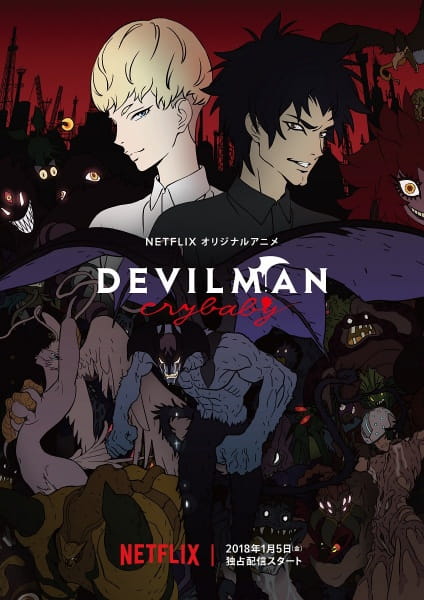
Devilman
Is Devilman worth watching?
Yes, it's worth watching. Anime Codex rates Devilman 8.10 out of 10 — scored on six criteria (story, characters, themes, world-building, animation, and cultural impact), not crowd votes. 47th of 226 on the Codex rubric — top 21% of the catalogue. The Codex rates it Δ +0.36 above its MAL score — more underrated than 95% of the catalogue.
Where to watch
Trailer
What the data says
Computed from the Codex rubric across the whole catalogue.
Summary
Devilman Crybaby is a ferocious, uncompromising adaptation that uses Masaaki Yuasa's elastic, expressionistic direction to drag Go Nagai's 1972 horror classic into the present without softening its nihilism. Within its shonen lineage it stands apart for refusing the genre's typical hope — Akira's journey from weeping innocent to hardened Devilman, paired with Ryo's slow-burn reveal as Satan, builds to one of the bleakest, most thematically committed endings the medium offers. Its strongest asset is theme: the show's vision of humanity as the true monster, dramatized through mob violence and the destruction of the Makimura family, lands with brutal force. The animation is fearless, the soundtrack hypnotic, and the emotional sincerity beneath the shock genuine. Its weaknesses are structural: ten episodes are too few to fully develop a large cast, leaving several supporting characters as thematic devices rather than people, and the early devil-hunting episodes feel rushed and tonally uneven before the apocalyptic momentum takes hold. The crude, divisive art style and explicit content will alienate some. But as a modern realization of a seminal work, executed with rare directorial conviction, it is among the most distinctive dark-fantasy titles of its era.
Criterion breakdown
Story & narrative
Crybaby compresses Go Nagai's sprawling manga into ten episodes that escalate from Sabbath horror to a literal apocalypse, and the structure pays off in the back half — the witch-hunt episode where humanity turns on itself, and Ryo's identity reveal as Satan, recontextualize everything prior. The pacing is the main flaw: the early body-merging and devil-hunting episodes feel rushed and tonally scattered, and some supporting figures (the track team, Miki's family) are introduced too thinly to land their later deaths with full weight. The nihilistic ending, however, is among the boldest in shonen-derived anime.
Character writing & growth
Akira's arc from weeping pushover to hardened killer who still weeps is the spine, and the contrast between his retained 'crybaby heart' and Amon's bloodlust is genuinely tragic by the finale. Ryo/Satan is the standout — his cold detachment is reframed as misunderstood love in the closing two episodes, one of the genre's better long-game character reveals. Weaker is the ensemble: Miki Makimura grows meaningfully into a symbol of human cruelty's victim, but the rapper Greek chorus and several side characters serve theme more than they exist as people.
Themes & emotional resonance
The show's interrogation of humanity-as-the-real-monster is delivered with unusual brutality for the demographic — the mob lynching of Miki and the broadcast of devil identities turn the horror inward devastatingly. Love, queer longing (Ryo's feelings for Akira), and the futility of compassion in a doomed world are handled with emotional sincerity rather than shock for its own sake. The final image of corpses on a battlefield earns its despair.
World-building & power system
The premise that devils require strong-willed hosts and that a human heart can dominate the demon is a clean, evocative engine, and the Sabbath-to-apocalypse arc gives the setting a coherent escalating logic. The mythology of Satan, the ancient devils, and the divine framing is intriguing but delivered in compressed exposition that leaves the rules of devil biology and the larger cosmology somewhat sketchy. It coasts partly on the original 1972 work's foundational design rather than expanding it.
Animation & direction
Masaaki Yuasa and Science SARU deliver fluid, elastic, deliberately ugly-beautiful animation that suits the body-horror — the Sabbath transformations and devil battles abandon clean linework for visceral distortion. The track-running sequences, the neon Sabbath rave, and the apocalyptic finale use bold color and rhythmic editing to elevate the material. The expressionistic style is divisive and occasionally crude, but it is fearless and unmistakably authored direction.
Cultural impact
Crybaby reintroduced Go Nagai's seminal Devilman to a global Netflix audience and became a critical talking point as a rare faithful, uncompromised adaptation of a foundational 1970s work. Devilman's influence on the dark fantasy and apocalyptic genre (Evangelion among its descendants) gives this version added weight as the definitive modern rendering, though its impact rests heavily on the source's legacy.
Synopsis (from MAL)
Devils cannot take form without a living host. However, if the will of an individual is strong enough, they can overcome the demon and make its power their own, becoming a Devilman. Weak and unassuming, Akira Fudou has always had a bleeding heart. So when his childhood friend Ryou Asuka asks for his help in uncovering devils, Akira accepts without hesitation. However, to Akira's surprise, the place they go to is Sabbath: an immoral party of debauchery and degeneracy. Amidst bloodshed and death, demons possess the partiers, turning their bodies into grotesque monsters, and begin wreaking havoc. In a reckless attempt to save his best friend, Akira unwittingly merges with the devil Amon and becomes a Devilman, gaining the power to defeat the remaining demons. Though it grants him great power, this new partnership awakens an insatiable and primeval part of Akira. Having the body of a devil but the same crybaby heart, Akira works alongside Ryou, destroying those that harm humanity and his loved ones. [Written by MAL Rewrite]
Ranked nearby




Explore rankings
Discussion
Set a display name above to post.
Loading discussion…