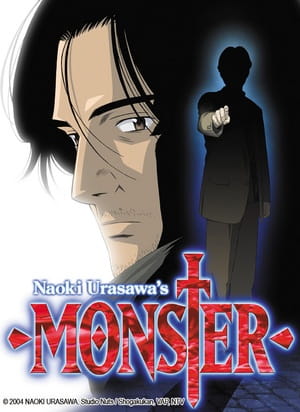
Monster
Is Monster worth watching?
Yes — a standout. Anime Codex rates Monster 9.24 out of 10 — scored on six criteria (story, characters, themes, world-building, animation, and cultural impact), not crowd votes. 2nd of 226 on the Codex rubric — top 1% of the catalogue. The Codex rates it Δ +0.35 above its MAL score — more underrated than 94% of the catalogue.
Where to watch
Streaming availability varies by region — check your local services.
What the data says
Computed from the Codex rubric across the whole catalogue.
Summary
Monster stands among the finest psychological seinen thrillers anime has produced, distinguished by Naoki Urasawa's novelistic command of plotting and character. Free of fantasy trappings, it grounds its terror in a realistic post-Cold War Europe haunted by the legacy of human experimentation, building dread through atmosphere and moral dilemma rather than spectacle. Tenma's transformation and Johan's quiet, faceless evil anchor a sprawling narrative that rewards patience with thematic depth — interrogating the worth of a single life and whether monstrosity is innate or manufactured. Madhouse's restrained direction, muted palette, and Haishima's score serve the somber tone impeccably, even if the animation is rarely showy across its long run. The chief weaknesses are pacing: a generous mid-series stretch of episodic detours dilutes momentum, and the 74-episode length demands commitment. Occasional over-explained villain philosophy slightly undercuts the otherwise masterful subtlety, and Johan's near-supernatural reach into every plot thread can strain plausibility. Still, judged against the best of mature character-driven drama, Monster is a near-definitive example of what the demographic can achieve — a literary, humanist, and morally serious work that elevated anime's reputation as a vehicle for adult storytelling.
Criterion breakdown
Story & narrative
Naoki Urasawa's plot is a masterclass in slow-burn suspense, weaving Tenma's fugitive pursuit across post-Cold War Germany with the layered conspiracy of the Kinderheim 511 and 511 Children's Home experiments. The narrative juggles a sprawling cast and decade-spanning timeline with remarkable cohesion, and the gradual reveal of Johan and Anna's origins at the Red Rose Mansion is meticulously seeded. Its only flaw is a mid-series stretch of episodic detours that test patience before the threads reconverge.
Character writing & growth
Tenma's moral evolution from ambitious careerist to a man willing to abandon the Hippocratic Oath and pull a trigger is among the genre's most convincing arcs. Johan stands as one of anime's most chilling antagonists precisely because his menace is psychological rather than physical, while supporting figures like the haunted Inspector Lunge, the reformed Eva Heinemann, and Nina/Anna receive genuine interior lives. Even one-episode characters are written with novelistic care that reinforces the show's humanist thesis.
Themes & emotional resonance
The series interrogates the value of a single human life, the nature of evil, and whether monsters are born or made, refusing easy answers through Johan's nihilistic experiments and Tenma's stubborn faith. The recurring children's-book motif of 'The Nameless Monster' gives the abstract themes a haunting emotional anchor. It occasionally over-explains its philosophy through villain monologues, slightly blunting subtlety.
World-building & power system
The grounded depiction of reunified Germany, Czech orphanages, and the lingering shadow of authoritarian eugenics programs lends rare verisimilitude for an anime. The premise — a noir thriller with no fantasy elements, anchored in real political history — is highly original within the medium. Minor liberties with geography and the plausibility of Johan's omnipresent influence stretch believability at the margins.
Animation & direction
Madhouse's restrained, realistic character designs and muted European palette perfectly serve the somber tone, with direction that mines tension from silence, lingering close-ups, and Johan's unnervingly calm expressions. The production is consistent across 74 episodes but rarely flashy, and some animation is conservative given the long runtime. Kuniaki Haishima's understated score and the iconic 'Grain' opening elevate the atmosphere considerably.
Cultural impact
Monster is frequently cited as a gateway and benchmark for mature, non-action seinen anime, and Urasawa's reputation as a literary mangaka rests heavily on it. Its influence on perceptions of anime as serious adult drama is significant, though its niche, slow pacing kept it from the mainstream ubiquity of more populist titles.
Synopsis (from MAL)
Dr. Kenzou Tenma, an elite neurosurgeon recently engaged to his hospital director's daughter, is well on his way to ascending the hospital hierarchy. That is until one night, a seemingly small event changes Dr. Tenma's life forever. While preparing to perform surgery on someone, he gets a call from the hospital director telling him to switch patients and instead perform life-saving brain surgery on a famous performer. His fellow doctors, fiancée, and the hospital director applaud his accomplishment; but because of the switch, a poor immigrant worker is dead, causing Dr. Tenma to have a crisis of conscience. So when a similar situation arises, Dr. Tenma stands his ground and chooses to perform surgery on the young boy Johan Liebert instead of the town's mayor. Unfortunately, this choice leads to serious ramifications for Dr. Tenma—losing his social standing being one of them. However, with the mysterious death of the director and two other doctors, Dr. Tenma's position is restored. With no evidence to convict him, he is released and goes on to attain the position of hospital director. Nine years later when Dr. Tenma saves the life of a criminal, his past comes back to haunt him—once again, he comes face to face with the monster he operated on. He must now embark on a quest of pursuit to make amends for the havoc spread by the one he saved. [Written by MAL Rewrite]
Ranked nearby



Explore rankings
Discussion
Set a display name above to post.
Loading discussion…