Is Hajime no Ippo Worth Watching? The Codex Says Yes at 8.33, and Two Criteria Do the Heavy Lifting
Hajime no Ippo earns its 8.33 on character and cultural weight; the 75-episode runtime is the price of admission, and whether you pay it depends on one question about pacing.
Hajime no Ippo earns its 8.33 on character and cultural weight; the 75-episode runtime is the price of admission, and whether you pay it depends on one question about pacing.
Most people just want to know: is Hajime no Ippo worth my time, and for whom? Answer that fast, then back it with the rubric. Yes — if you have any tolerance for sports-shonen pacing and a working interest in how a character study survives 75 episodes of round-by-round play-by-play. No — if you need the kinetic density of a 12-episode prestige run and bounce off comedic detours. The Codex scores Madhouse's 2000 adaptation at 8.33, and the case is decided almost entirely by a 9.0 on character and an 8.5 on cultural impact.
The Consensus Has It Slightly Wrong, in a Specific Direction
The MyAnimeList crowd scores it 8.78 — engage that consensus directly. That number isn't absurd, but it overweights the show's emotional peaks (the Date Eiji bout, the Sendou title fight) and underweights the structural tax of a 75-episode runtime where the recurring "what does it mean to be strong?" interrogation cycles through diminishing returns. The Codex's 8.33 isn't a contrarian downgrade. It's what happens when you make the themes axis (8.0) and the story axis (8.5) account honestly for stalled pacing across lengthy round-by-round sequences and the Takamura comedic interludes that, however beloved, deflate tension between fights.
Where Codex departs from the MAL aggregate is also where it converges with the show's actual strengths. Character writing earns the highest single criterion on the entire card, and that's not flattery — it's what carries the runtime.
The 9.0 on Character Is the Whole Argument
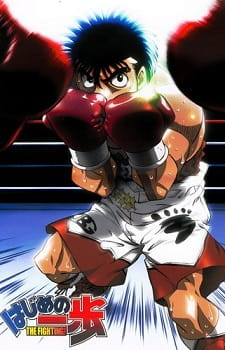
Ippo Makunouchi's arc — bullied fisherman's son into disciplined featherweight — is one of the most earned protagonist trajectories in sports anime, and the reason is mechanical, not emotional. The show grounds his physicality in the labor of his pre-boxing life. His grip strength, his stance, his capacity to absorb body shots: all of it traces back to hauling nets, and director Satoshi Nishimura's staff treat that continuity as load-bearing rather than ornamental. When Ippo wins, the win is paid for with depicted training. When he loses to Date Eiji, the loss reads as a referendum on a specific gap in his game, not as authorial cruelty.
The supporting cast is where the rubric pushes hardest. Mamoru Takamura's mentorship is genuinely double-coded — the clowning masks a fighter chasing belts in his own weight class, and the show refuses to flatten him into comic relief. Ichirou Miyata's counter-puncher pride, which drives him to fight outside the gym so he can face Ippo on equal terms, is the kind of motivation most shonen would resolve in three episodes; here it threads the entire series as a deferred promise. Genji Kamogawa's gruff coaching reads as wisdom because the show invests in his fight IQ rather than his backstory monologues. Even Mashiba — a one-arc antagonist in most series — accumulates enough interiority through his sister and his fighting style that he refuses to leave the show after his bout ends.
This is the same compound interest that pushes character-led series like March Comes In Like a Lion to the top of the rubric: when interiority is the engine, runtime stops being a liability.
The Story Score Is 8.5 Because the Structure Holds, Not Because Every Arc Lands
The serial-bout structure — each opponent gets an arc, each arc gets a backstory — is the genre's most reliable scaffold, and Hajime no Ippo executes it cleanly from the early Miyata practice match through the Sendou Takeshi featherweight title fight. Date Eiji's failed shot at a world championship and his family situation, Sendou's poverty-stricken upbringing: these aren't decorative. They're what convert a sports match into a stakes-bearing narrative event, because the show makes you understand what the opponent loses by losing.
What pulls the story axis down from a 9 is honest: round-by-round commentary stalls when the choreography doesn't have a corresponding character beat to advance, and the Takamura material — funny on its own terms — is often parked between fights where the tonal break drains accumulated momentum. This isn't a fatal flaw. It's a feature of the form, the same way Gintama's tonal whiplash is structural rather than incidental. But it's why the rubric reads 8.5 rather than 9.0.
Madhouse's 8.0 on Animation Is the Year-2000 Budget Working at Capacity
Madhouse's choreography during signature moments — the Dempsey Roll's swirling motion lines, the POV shots that convey speed differentials when Ippo eats a clean counter, the impact frames on body shots — is excellent by 2000 TV standards and remains legible today. The sweat-and-blood detail in late-round sequences is doing real work to communicate physical degradation. Where the seams show is in the recycled crowd shots and held cels during longer rounds, which is the limit of what a weekly TV budget could underwrite at the turn of the millennium.
The 7.5 on world-building is read here as setting depth, and it earns the number through technical fidelity: stances, weight classes, corner strategy, counter timing, the Dempsey Roll as a coherent piece of offense rather than a finisher gimmick. The Kamogawa gym functions as a lived-in hub with its own hierarchy. This is not a series that needs cosmology; it needs the geometry of a ring to be honest, and it is.
Steelmanning the Skeptic
The strongest case against watching Hajime no Ippo in 2024 isn't quality — it's opportunity cost. Seventy-five episodes from 2000, with the comedy/drama tonal split the era favored, against a glut of tighter sports anime that compress the same emotional payoff into a quarter of the runtime. If you've already watched Hikaru no Go and Slam Dunk, the marginal Ippo episode is doing less work for you than a first viewing of Hikaru no Go.
The rubric reads it differently because the 9.0 on character isn't a number you can shop for in 12-episode increments. It's a function of accumulated time with Ippo, Takamura, Miyata, and Kamogawa across enough fights that their reactions to each new opponent carry the weight of remembered history. Cutting the runtime would cut the score. The bargain is honest: pay the 75 episodes, get the character work that justifies them.
Verdict
Watch it if you want the benchmark boxing anime executed with technical fidelity and the strongest character ensemble in the sports-shonen canon — the 9.0 on character and 8.5 on cultural impact are the reason this sits at 8.33 instead of a half-point lower. Skip it if 75 episodes of escalating bouts and Takamura interludes reads as a chore rather than an investment. The rubric won't argue you out of either position; it will only tell you what you're trading.
Featured in the Codex

More from The Codex
The Seven Deadly Sins Is a 6.60 Wearing a 7.60 Costume: A One-Point Gap Earned by Groping Gags and Convenient Flashbacks
The Seven Deadly Sins scores 6.60 on the Codex against MyAnimeList's 7.60 because the crowd is grading a Netflix breakout and a Ban-and-King friendship, not the 24 episodes A-1 Pictures actually broadcast in 2014.
The 10.0 That Built a Sunday: How Sazae-san's Cultural Score Carries a 6.58 Scorecard
Sazae-san is a case study in how a single criterion — cultural — can define how a show is remembered, and the 10.0 the Codex hands Eiken's 1969 institution is doing every bit of the heavy lifting its other five scores refuse to.
The Sebastian Problem: Why Black Butler Sits 1.10 Below Its MAL Line and the Crowd Refuses to Notice
Black Butler (Kuroshitsuji) posts a 1.10-point gap between MyAnimeList's 7.65 and the Codex 6.55 because the crowd is grading Sebastian's silhouette and a Phantomhive aesthetic, not the anime-original finale A-1 Pictures actually shipped in 2009.
Discussion
Set a display name above to post.
Loading discussion…