The 6.5 That Decides Welcome to the NHK: How Gonzo's Animation Caps a Near-Great Seinen at "Cult Classic"
Welcome to the NHK earns 8.7 on themes and 9.0 on character, but a 6.5 on animation is the number that explains why it's remembered as a recommendation, not a landmark.
Welcome to the NHK earns 8.7 on themes and 9.0 on character, but a 6.5 on animation is the number that explains why it's remembered as a recommendation, not a landmark.
Welcome to the NHK is the rare seinen where the writing outruns the production by such a margin that the gap itself becomes the story. The Welcome to the NHK animation is the single criterion on the Anime Codex scorecard that pulls against everything else — character at 9.0, themes at 8.7, story at 8.0 — and the show's final 8.22 is the arithmetic of that argument. Gonzo gave Tatsuhiko Takimoto's hikikomori novel a body it couldn't quite afford, and the consequences are visible in almost every episode.
The MyAnimeList Consensus Misreads the Show It Loves
The MyAnimeList crowd scores Welcome to the NHK at 8.32, and that number does something specific: it absorbs the show's flaws into its sincerity. The aggregate score reads the production limits as charm, the off-model faces as authenticity, the static conversations as restraint. That reading is generous in a way criticism shouldn't be. The Anime Codex 8.22 is ten points lower precisely because the rubric refuses to round up on visual delivery just because the script is doing heroic work elsewhere. Praise the writing — the rubric does, loudly — but don't pretend Gonzo's 2006 production isn't a ceiling.
This isn't a hit piece. The case for Welcome to the NHK as one of the most psychologically honest seinen of its decade is intact and the Codex scores reflect it. The case against treating it as a top-tier work of the form rests on what the camera actually shows you.
What Gonzo Actually Put on Screen
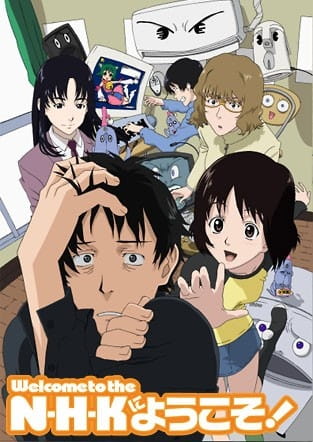
The animation score sits at 6.5, and the justification is structural rather than incidental. Gonzo's 24-episode production is functional, with off-model drift and limited motion that betray a modest budget across the run. Character designs by the production team are appealing in stills — Misaki's silhouette, Satou's slumped posture, Yamazaki's nervous geometry — but they don't hold up in movement. Conversations between Satou and Yamazaki in the apartment frequently devolve into static two-shots with mouth flaps doing nearly all the work, and the in-between count visibly drops in the back half as the budget tightens.
This matters because the show is essentially a chamber piece. When the runtime is largely interior — Satou's apartment, Yamazaki's room, the convenience store at night — the production has nowhere to hide. There are no battle sequences to absorb attention, no setpieces to compensate for a flat dialogue scene. Every flat dialogue scene is the scene. A show this dependent on faces needs faces that don't drift off-model, and Welcome to the NHK doesn't reliably deliver them.
Where the Direction Earns Its Keep
Credit where the rubric extends it: the direction is sharpest exactly where the budget is most strained, in the surreal interludes. Satou's hallucinations — the appliance spirits monologuing at him, the conspiracy visions metastasizing across his ceiling — use distorted palette work and warped framing to externalize psychological collapse in ways that limited animation can absorb without embarrassment. The island episode in the suicide pact arc is the cleanest example: disorienting color, drifting compositions, a soundscape that does more work than the linework. These sequences are why the animation score is 6.5 rather than 5.5.
The decision to lean into stylization when realism would expose the budget is the show's smartest production-level choice. It's also a confession. A better-funded version of this material — imagine what Madhouse circa Paranoia Agent or even contemporary-era Shaft would have done with Satou's interior — would not have needed the workaround. The surrealism is good. It's also a load-bearing structural element compensating for the gaps. This is the same trap Berserk 1997 fell into and the same trap Maison Ikkoku lived with for 96 episodes: a script the production can't fully serve.
The Writing Floor Holds, Which Is the Whole Problem
Here is what makes the animation question genuinely painful rather than academic. The character score of 9.0 is earned through some of the most uncomfortable writing in mid-2000s seinen. Satou's self-justifying conspiracy logic doesn't flatter the audience; it indicts the audience. Yamazaki's arc returning to his family's farm is the kind of small, deflating exit a more sentimental show would have refused to allow. Misaki is revealed to be as codependent and broken as Satou — not a savior figure, not redemption-shaped, but another wreck — and that revelation deepens the dynamic instead of cheapening it.
The themes score of 8.7 follows from the same honesty. The galge-creation arc and the offline-meeting suicide pact treat MMO escapism, NEET despair, and suicidal ideation with a candor that even now reads as unusual. The pyramid scheme arc escalates Satou's economic desperation with grim plausibility. The 7.5 on cultural impact reflects the show's enduring status as the reference text whenever hikikomori discourse surfaces in anime conversation.
All of which means: the writing is good enough to make you wish the show looked like its script reads. The 9.0 on character is doing the work that a 7.5 on character would do in a better-animated production. The audience is being asked to meet the show more than halfway, and the audience that does meet it tends to forgive what should be named.
The Steelman: Maybe the Production Limits Are the Point
The strongest counter-argument deserves a fair hearing. A grimy, low-budget, off-model production is arguably the right visual register for a show about a man rotting in a one-room apartment. Polishing Welcome to the NHK to the standard of a contemporary Production I.G or Bones drama might have aestheticized the squalor in ways that betrayed the material. There's a real argument that Gonzo's flat, slightly worn 2006 look is the texture the story requires, and that a more lavish version would have produced something closer to misery tourism than honest portraiture. The same logic gets applied to Honey and Clover and other interior-focused josei and seinen of the era.
The argument has a ceiling, though. There's a difference between visual restraint as a choice and visual limitation as a constraint, and Welcome to the NHK shows both. The surreal sequences prove the staff could compose deliberately when the storyboards demanded it. The static dialogue scenes prove they couldn't always sustain that deliberateness. The 6.5 isn't punishing the show for being unglamorous. It's marking the gap between the production the show wanted to be and the one Gonzo could afford.
A 9.0 cast trapped in a 6.5 body is the entire shape of Welcome to the NHK's reputation. The 8.22 is exactly the score a show this written and this drawn deserves, and the reason it's recommended rather than canonized is the number on the rubric that no one wants to name.
Featured in the Codex

More from The Codex
The Seven Deadly Sins Is a 6.60 Wearing a 7.60 Costume: A One-Point Gap Earned by Groping Gags and Convenient Flashbacks
The Seven Deadly Sins scores 6.60 on the Codex against MyAnimeList's 7.60 because the crowd is grading a Netflix breakout and a Ban-and-King friendship, not the 24 episodes A-1 Pictures actually broadcast in 2014.
The 10.0 That Built a Sunday: How Sazae-san's Cultural Score Carries a 6.58 Scorecard
Sazae-san is a case study in how a single criterion — cultural — can define how a show is remembered, and the 10.0 the Codex hands Eiken's 1969 institution is doing every bit of the heavy lifting its other five scores refuse to.
The Sebastian Problem: Why Black Butler Sits 1.10 Below Its MAL Line and the Crowd Refuses to Notice
Black Butler (Kuroshitsuji) posts a 1.10-point gap between MyAnimeList's 7.65 and the Codex 6.55 because the crowd is grading Sebastian's silhouette and a Phantomhive aesthetic, not the anime-original finale A-1 Pictures actually shipped in 2009.
Discussion
Set a display name above to post.
Loading discussion…