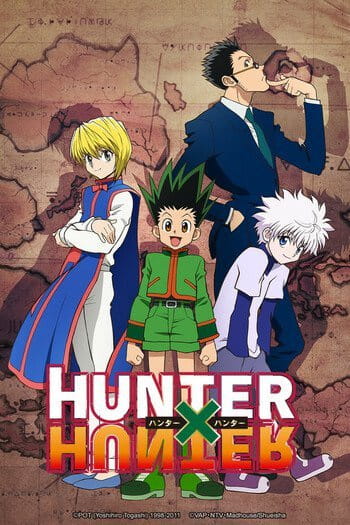
Hunter × Hunter (2011)
Is Hunter × Hunter (2011) worth watching?
Yes — a standout. Anime Codex rates Hunter × Hunter (2011) 9.23 out of 10 — scored on six criteria (story, characters, themes, world-building, animation, and cultural impact), not crowd votes. 3rd of 226 on the Codex rubric — top 1% of the catalogue. The Codex rates it Δ +0.20 above its MAL score — more underrated than 90% of the catalogue.
Where to watch
Trailer
What the data says
Computed from the Codex rubric across the whole catalogue.
Summary
Hunter × Hunter (2011) is a benchmark shonen that repeatedly subverts the conventions of its own demographic. While it opens with familiar tournament-and-friendship beats during the Hunter Exam, it steadily matures into something far darker and more morally complex, peaking with the Chimera Ant arc—a 60-episode tour de force that deconstructs heroism through Gon's self-destructive vengeance and humanizes its villain in Meruem and Komugi's quiet gungi matches. Its greatest strengths are character writing (Killua's autonomy arc is genre-defining), thematic bravery, and the Nen system, whose conditional-vow logic makes combat a battle of strategy rather than escalating power levels. Madhouse's direction shines in atmosphere and key setpieces, even if animation consistency wavers across nearly 150 episodes. Weaknesses are real but minor against its peaks: Leorio is underutilized, the system's complexity invites heavy in-battle narration, and the post-Ant Election arc is a talky, deflating coda. The anime also ends mid-story, hostage to the manga's perpetual hiatuses. Judged against the best of shonen, it stands at or near the summit—ambitious, emotionally fearless, and intellectually rigorous in ways the demographic rarely attempts, while remaining accessible and propulsive throughout its strongest arcs.
Criterion breakdown
Story & narrative
The Chimera Ant arc is one of the most structurally ambitious long-form narratives in shonen, escalating from a survival-horror premise into a meditation on humanity that climaxes with the Meruem-Komugi gungi sequence and the East Gorteau invasion's relentless countdown structure. The Yorknew City arc demonstrates Togashi's range with its noir-tinged mafia conspiracy and the Phantom Troupe's amoral menace, while the Hunter Exam and Greed Island arcs use rules-based tension over raw spectacle. Pacing across 148 episodes is mostly tight, though the Election arc functions as an uneven, talky epilogue that drains momentum after the emotional peak.
Character writing & growth
Killua's arc from groomed assassin to a boy choosing his own loyalties is among the genre's finest character writing, culminating in his separation from Gon and the bond with Alluka. Gon's deconstruction during the Pitou confrontation—where his heroism curdles into self-destructive rage—subverts the standard shonen protagonist trajectory. Kurapika's consuming vengeance and Meruem's late awakening to empathy are equally rich, though Leorio is comparatively underserved and sidelined for long stretches.
Themes & emotional resonance
The Chimera Ant arc interrogates what separates human from monster through Meruem and Komugi far more bravely than most shonen attempt, while the Gon-Pitou climax refuses to reward obsessive idealism. Recurring meditations on the cost of ambition and the unreliability of family (Ging's reunion deliberately deflates catharsis) give it unusual moral weight. It occasionally overstates its points via narrator exposition, slightly undercutting the emotional resonance it otherwise earns.
World-building & power system
Nen is arguably the most rigorously systematized power framework in shonen—six categories, conditional vows that trade restriction for power (Kurapika's chains, Knuckle's IRS), and a clarity that makes battles feel like puzzles rather than power-creep. The wider setting of Hunter associations, the Dark Continent, and Greed Island's game-world logic shows deep internal consistency. The system's complexity occasionally requires heavy in-fight narration, but its originality is exceptional.
Animation & direction
Madhouse delivers strong, mood-driven direction—the muted palette and creeping dread of the Chimera Ant arc, the dynamic choreography of Gon vs. Hisoka, and the harrowing visual transformation of Gon's adult form. Direction excels at tension and stillness over constant motion. However, animation quality is inconsistent across the long run, with some early-arc sequences and budget-conscious episodes looking flat compared to the standout setpieces.
Cultural impact
The 2011 adaptation is widely regarded as one of the gold-standard shonen anime, frequently topping community ranking lists and consistently cited as a benchmark for the genre's potential. Nen has influenced how fans and creators discuss power-system design. Its impact is somewhat constrained by Togashi's notorious manga hiatuses, which have stalled broader franchise momentum and left the anime unfinished.
Synopsis (from MAL)
Hunters devote themselves to accomplishing hazardous tasks, all from traversing the world's uncharted territories to locating rare items and monsters. Before becoming a Hunter, one must pass the Hunter Examination—a high-risk selection process in which most applicants end up handicapped or worse, deceased. Ambitious participants who challenge the notorious exam carry their own reason. What drives 12-year-old Gon Freecss is finding Ging, his father and a Hunter himself. Believing that he will meet his father by becoming a Hunter, Gon takes the first step to walk the same path. During the Hunter Examination, Gon befriends the medical student Leorio Paladiknight, the vindictive Kurapika, and ex-assassin Killua Zoldyck. While their motives vastly differ from each other, they band together for a common goal and begin to venture into a perilous world. [Written by MAL Rewrite]
Ranked nearby
Explore rankings
Discussion
Set a display name above to post.
Loading discussion…