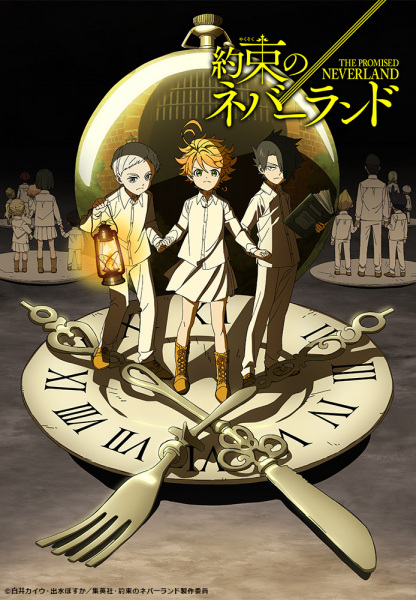
The Promised Neverland
Is The Promised Neverland worth watching?
Yes, it's worth watching. Anime Codex rates The Promised Neverland 8.18 out of 10 — scored on six criteria (story, characters, themes, world-building, animation, and cultural impact), not crowd votes. 42nd of 226 on the Codex rubric — top 19% of the catalogue. The crowd rates it 0.29 higher than the rubric does — the Codex is harder on it than on 34% of the catalogue.
Where to watch
Trailer
What the data says
Computed from the Codex rubric across the whole catalogue.
Summary
The Promised Neverland's first season is one of the strongest psychological thrillers ever to emerge from Weekly Shonen Jump, trading the demographic's usual combat for a tense battle of intellect. Its opening episode reveal — that the idyllic Grace Field orphanage is a livestock farm for demons — is an all-time hook, and the cat-and-mouse war between Emma's children and the maternal antagonist Isabella sustains genuine dread across twelve tightly-plotted episodes. The central trio is well-drawn, with Norman's strategic ruthlessness, Ray's hidden compromise, and Emma's stubborn idealism creating organic conflict, while Isabella's tragic backstory elevates her beyond a stock villain. Mamoru Kanbe's direction wrings horror from framing, color, and an unnerving score. Its weaknesses are mostly limitations of scope: the younger siblings function as stakes rather than characters, the broader world and demon society stay deliberately obscured, and the children's planning occasionally outruns plausibility. As a self-contained season it is near the top of its genre; its reputation suffers chiefly because the adaptation's later continuation abandoned this craftsmanship. Judged on this 12-episode run alone, it is an exceptional, atypical shonen that demonstrates the demographic's range far beyond action spectacle.
Criterion breakdown
Story & narrative
Season 1 is a masterclass in tension-driven thriller plotting rarely seen in shonen, structured as an escape-room battle of wits between Emma's group and Isabella. The reveal in episode 1 — Conny's body and the harvested children — recontextualizes the idyllic premise instantly, and the cat-and-mouse escalation (the tracker discovery, Norman's faked 'shipment') maintains relentless momentum across all 12 episodes. The pacing only occasionally stumbles when the kids' planning outpaces plausible explanation, and the cliffhanger ending leaves the overarching narrative deliberately unresolved.
Character writing & growth
The central trio is sharply differentiated — Emma's idealistic refusal to leave anyone behind, Norman's coldly strategic sacrifice, and Ray's pragmatic, secretly compromised position as Isabella's mole — and their friction drives the plot rather than decorating it. Isabella is an exceptional antagonist whose flashback in the late episodes reframes her as a former livestock child herself, granting genuine tragic depth. Younger siblings beyond the trio remain comparatively thin, functioning more as stakes than as characters.
Themes & emotional resonance
The farm-as-allegory premise interrogates complacency, freedom, and the ethics of survival with surprising weight for Jump, and Emma's insistence on saving everyone gives the escape moral stakes beyond mere self-preservation. Isabella's arc raises uncomfortable questions about complicity within an inescapable system. The emotional resonance is real but somewhat front-loaded, peaking with Conny and Isabella's backstory rather than sustaining across the cast.
World-building & power system
The premise — orphanages as livestock farms for demons — is genuinely original and internally consistent within the season's scope, with clever details like the tracking earpieces and the gate. However, season 1 deliberately withholds the larger world, so the demon society, the 'farm' economy, and the rules outside Grace Field remain teasingly underexplained, which is intentional craft but limits demonstrated depth here.
Animation & direction
CloverWorks delivers strong direction with Mamoru Kanbe emphasizing dread through framing — overhead shots, the recurring number-tattoo motif, and Isabella's unsettling smile shot from low angles. The muted color palette and Takahiro Obata's nerve-fraying score amplify the horror-thriller tone effectively. Some CG and background-character animation is workmanlike rather than spectacular, but the directorial control of suspense is the real achievement.
Cultural impact
The show was a breakout hit that broadened perceptions of what Shonen Jump could publish, proving a non-action psychological thriller could anchor the magazine and the season. Its acclaim was significant, though much of that goodwill was later undercut by the notoriously rushed and divisive second season, which dampened its long-term standing.
Synopsis (from MAL)
Surrounded by a forest and a gated entrance, the Grace Field House is inhabited by orphans happily living together as one big family, looked after by their "Mama," Isabella. Although they are required to take tests daily, the children are free to spend their time as they see fit, usually playing outside, as long as they do not venture too far from the orphanage—a rule they are expected to follow no matter what. However, all good times must come to an end, as every few months, a child is adopted and sent to live with their new family, never to be heard from again. However, the three oldest siblings have their suspicions about what is actually happening at the orphanage, and they are about to discover the cruel fate that awaits the children living at Grace Field, including the twisted nature of their beloved Mama. [Written by MAL Rewrite]
Ranked nearby


Explore rankings
Discussion
Set a display name above to post.
Loading discussion…