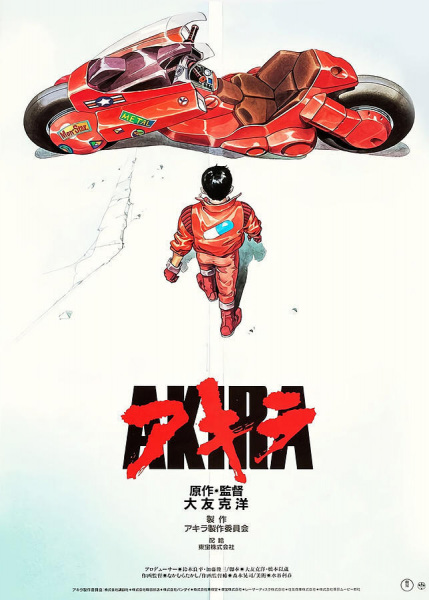
Akira
Is Akira worth watching?
Yes, it's worth watching. Anime Codex rates Akira 7.98 out of 10 — scored on six criteria (story, characters, themes, world-building, animation, and cultural impact), not crowd votes. 52nd of 226 on the Codex rubric — top 23% of the catalogue. The crowd rates it 0.18 higher than the rubric does — the Codex is harder on it than on 26% of the catalogue.
Where to watch
Trailer
What the data says
Computed from the Codex rubric across the whole catalogue.
Summary
Akira is a foundational seinen science-fiction film whose reputation rests overwhelmingly on its world-building, direction, and animation rather than narrative completeness. Otomo's Neo-Tokyo is a richly decayed dystopia of biker gangs, cults, and a collapsing military state, and the film's hand-drawn craft—the iconic bike slide, the grotesque body-horror climax—set a technical standard the medium spent decades catching up to. Its thematic ambitions are serious: nuclear trauma, abandoned youth, and the terror of power outpacing the self, embodied in Tetsuo's transformation from bullied underdog into uncontrollable god-thing. The chief weakness is the adaptation compression. Squeezing a sprawling manga into two hours leaves the Akira mythology, the espers, and the political subplots gestured at rather than explored, and the metaphysical ending will baffle first-time viewers. Kaneda is a thin, static protagonist whose swagger never deepens into growth, and the supporting cast is sacrificed to pacing. Yet Tetsuo's arc carries genuine emotional and psychological weight, and the film's cultural footprint—as the work that introduced anime to much of the world—is nearly unmatched. Judged against the best seinen has offered, it is an essential, visually definitive work held just short of perfection by its narrative opacity.
Criterion breakdown
Story & narrative
The narrative compresses Otomo's sprawling six-volume manga into roughly two hours, and the streamlining shows: the Akira mythology, the role of the espers, and the political machinations of the Colonel and the resistance are gestured at rather than fully developed. What survives is a propulsive arc tracking Tetsuo's transformation from bullied sidekick to apocalyptic force, and the through-line from the cold-open Tokyo explosion to the climactic stadium meltdown is coherent and escalating. The price is opacity—late developments around Akira and the dimensional ending feel rushed and underexplained for first-time viewers.
Character writing & growth
Tetsuo is a genuinely strong study in resentment and inferiority curdling into megalomania—his arc from the kid who can't ride a good bike to a being screaming for recognition is the film's emotional spine. Kaneda, by contrast, is a thinner protagonist: charismatic and propulsive but largely static, defined by swagger rather than growth. Supporting figures like the Colonel and Kei are functional but underwritten, sacrificed to the runtime in a way the manga's leisure avoids.
Themes & emotional resonance
The film resonates as a meditation on postwar Japanese anxiety—nuclear trauma, the bankruptcy of authority, and youth abandoned by a corrupt adult order. Tetsuo's uncontrollable power as a metaphor for adolescence and unchecked growth lands powerfully, especially in the body-horror climax where his flesh literally exceeds his ability to govern it. The emotional core—friendship souring into rivalry between Kaneda and Tetsuo—gives the abstraction a human anchor, though the ending's metaphysics dilute some of the thematic punch.
World-building & power system
Neo-Tokyo is one of anime's most fully realized settings: a neon dystopia of biker gangs, religious cults, student protests, and military coups layered into a city that feels lived-in and rotting from within. The esper premise—government weaponization of psychic children, the withered child-espers Kiyoko, Takashi and Masaru—is original and internally consistent, treating power as escalating catastrophe rather than empowerment. The detail density, from graffiti to the SOL satellite, sets a benchmark for science-fiction world-building.
Animation & direction
A landmark of hand-drawn animation: the 'Kaneda's bike slide,' the prescient use of pre-recorded dialogue for accurate lip-sync, and the over 2,000 shots with an unprecedented color palette make it visually peerless for 1988. Otomo's direction sustains kinetic energy in the bike chases while the climactic body-horror sequence—Tetsuo's mutating, ballooning flesh—remains genuinely disturbing and technically astonishing. Few seinen titles before or since match this craft.
Cultural impact
Akira is arguably the single most influential anime film in introducing the medium to the West, kicking open the door for the 1990s anime boom abroad. Its imagery and aesthetic permeate global pop culture, referenced everywhere from Kanye West to Stranger Things, and the 'Akira slide' is an animation cliché in its own right. Within seinen and sci-fi, its imprint is foundational.
Synopsis (from MAL)
Japan, 1988. An explosion caused by a young boy with psychic powers tears through the city of Tokyo and ignites the fuse that leads to World War III. In order to prevent any further destruction, he is captured and taken into custody, never to be heard from again. Now, in the year 2019, a restored version of the city known as Neo-Tokyo—an area rife with gang violence and terrorism against the current government—stands in its place. Here, Shoutarou Kaneda leads "the Capsules," a group of misfits known for riding large, custom motorcycles and being in constant conflict with their rivals "the Clowns." During one of these battles, Shoutarou's best friend Tetsuo Shima is caught up in an accident with an esper who finds himself in the streets of Tokyo after escaping confinement from a government institution. Through this encounter, Tetsuo begins to develop his own mysterious abilities, as the government seeks to quarantine this latest psychic in a desperate attempt to prevent him from unleashing the destructive power that could once again bring the city to its knees. [Written by MAL Rewrite]
Ranked nearby



Explore rankings
Discussion
Set a display name above to post.
Loading discussion…