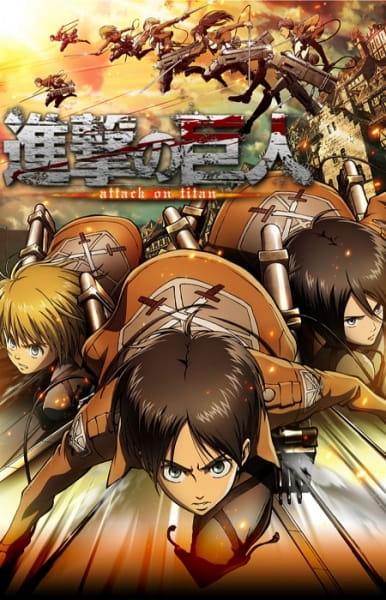
Attack on Titan
Is Attack on Titan worth watching?
Yes, it's worth watching. Anime Codex rates Attack on Titan 8.18 out of 10 — scored on six criteria (story, characters, themes, world-building, animation, and cultural impact), not crowd votes. 43rd of 226 on the Codex rubric — top 19% of the catalogue. The crowd rates it 0.39 higher than the rubric does — the Codex is harder on it than on 40% of the catalogue.
Where to watch
What the data says
Computed from the Codex rubric across the whole catalogue.
Summary
Attack on Titan's first season is a benchmark dark-action shonen that trades the genre's usual escalating power fantasy for relentless dread and the horror of human powerlessness. Its strongest assets are an arresting premise, a brutal willingness to kill named characters, and Wit Studio's spectacular ODM-gear choreography, which together create some of the most tense set pieces in the demographic. The Wall Maria breach, the Trost reclamation, and the Female Titan forest chase are standout sequences elevated by Sawano's thunderous score. Weaknesses are real: Eren is a comparatively flat, rage-driven lead this early, Mikasa is over-defined by her attachment to him, and much of the cadet cast serves as expendable atmosphere. Pacing falters mid-season with recaps and prolonged aftermath episodes, and many central mysteries are withheld rather than meaningfully advanced, leaving the worldbuilding tantalizing but incomplete until later seasons. Even so, the season delivers thematic seriousness, technical excellence, and narrative hooks far beyond typical battle shonen, while its cultural footprint as a global gateway anime is enormous. Judged against the best of its demographic, it is an exceptional, if somewhat front-loaded, opening chapter that sets up a far richer story to come.
Criterion breakdown
Story & narrative
Season 1 excels at sustaining dread and momentum, opening with the Wall Maria breach in episode 1 and building to the Female Titan reveal, while the Trost arc cleverly recontextualizes Eren's apparent death into the Titan-shifting mystery. The pacing sags mid-season with recap-heavy episodes and the protracted Trost recovery, and several mysteries are deliberately withheld rather than developed, but the narrative hooks are exceptionally strong for shonen.
Character writing & growth
Eren is a fairly conventional rage-driven shonen lead in this season, and Mikasa's writing leans heavily on her devotion to him, but the supporting cast carries the weight: Armin's evolution from coward to tactician during the Trost gas-canister gambit is genuinely earned. Levi's introduction and Commander Erwin add gravitas, though many cadets exist mainly as Titan fodder, limiting depth this early.
Themes & emotional resonance
The show interrogates survival, sacrifice, and the cost of powerlessness with unusual brutality for the demographic, exemplified by the suicidal charge of the Survey Corps and the casual, meaningless deaths of named recruits. Eren's helplessness watching his mother eaten frames the recurring theme that resolve alone cannot save anyone, lending emotional weight beyond typical battle-shonen bravado.
World-building & power system
The concentric-wall society, vertical maneuvering ODM gear, and the eerie biology of pleasure-killing Titans form a strikingly original and internally coherent premise. The first season deliberately keeps the wider world opaque, which builds intrigue but leaves much of the setting's logic unexplained, a tradeoff that pays off only in later seasons.
Animation & direction
Wit Studio's ODM gear sequences are kinetic and spatially legible, with standout direction in the Female Titan forest chase and the visceral weight of Titan attacks. Hiroyuki Sawano's bombastic score and the iconic 'Guren no Yumiya' opening amplify the spectacle, though some later episodes show visible quality dips and overreliance on CG-assisted crowd scenes.
Cultural impact
The 2013 premiere was a phenomenon that revitalized mainstream anime interest globally, dominating sales and streaming charts and embedding its opening and Colossal Titan imagery into broader pop culture. It became a gateway series for countless international viewers and a benchmark for dark action shonen.
Synopsis (from MAL)
Centuries ago, mankind was slaughtered to near extinction by monstrous humanoid creatures called Titans, forcing humans to hide in fear behind enormous concentric walls. What makes these giants truly terrifying is that their taste for human flesh is not born out of hunger but what appears to be out of pleasure. To ensure their survival, the remnants of humanity began living within defensive barriers, resulting in one hundred years without a single titan encounter. However, that fragile calm is soon shattered when a colossal Titan manages to breach the supposedly impregnable outer wall, reigniting the fight for survival against the man-eating abominations. After witnessing a horrific personal loss at the hands of the invading creatures, Eren Yeager dedicates his life to their eradication by enlisting into the Survey Corps, an elite military unit that combats the merciless humanoids outside the protection of the walls. Eren, his adopted sister Mikasa Ackerman, and his childhood friend Armin Arlert join the brutal war against the Titans and race to discover a way of defeating them before the last walls are breached. [Written by MAL Rewrite]
Ranked nearby
Explore rankings
Discussion
Set a display name above to post.
Loading discussion…