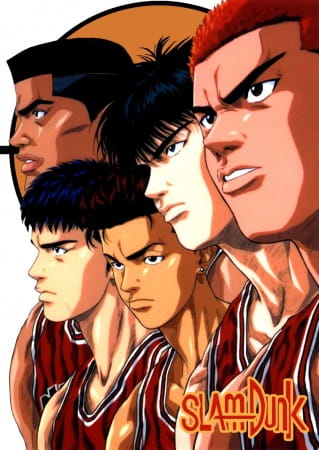
Slam Dunk
Is Slam Dunk worth watching?
Yes, it's worth watching. Anime Codex rates Slam Dunk 8.12 out of 10 — scored on six criteria (story, characters, themes, world-building, animation, and cultural impact), not crowd votes. 46th of 226 on the Codex rubric — top 20% of the catalogue. The crowd rates it 0.44 higher than the rubric does — the Codex is harder on it than on 43% of the catalogue.
Where to watch
What the data says
Computed from the Codex rubric across the whole catalogue.
Summary
Slam Dunk stands as a foundational pillar of the sports shonen genre, distinguished by exceptional character writing that transforms delinquent Hanamichi Sakuragi into a believable, hard-working athlete while granting genuine depth to rivals and teammates alike. Mitsui's redemption and Anzai's mentorship deliver emotional beats that resonate decades later, and the show treats actual basketball with refreshing realism rather than fantastical gimmicks, prioritizing grit and incremental growth over instant power-ups. Its cultural impact is enormous, having ignited basketball's popularity throughout Asia and shaping every sports series that followed. The chief weakness of the anime adaptation is its incompleteness: it concludes mid-tournament before the legendary Sannoh showdown, depriving viewers of the story's intended climax and forcing them to the manga or 2022 film. The 1993 Toei animation is also visibly budget-constrained, leaning on still frames and recycled motion, and the pacing occasionally drags under comedic filler and recaps. Despite these flaws, Slam Dunk remains essential within its demographic, judged against the best sports shonen rather than action titles, its character craft and emotional authenticity comfortably place it among the genre's elite, held back from the very top only by its truncated ending and dated production values.
Criterion breakdown
Story & narrative
The narrative excels at sports drama escalation, building from Hanamichi's reluctant entry to high-stakes matches against Ryonan, Kainan, and Shoyo, with the Inter-High qualifiers delivering genuine tension. However, the anime ends mid-arc before the climactic Sannoh match (covered only in manga and film), leaving the journey notably incomplete and robbing the adaptation of its intended emotional peak. Pacing also sags in stretches with repetitive comedic detours and recap-heavy episodes typical of mid-90s Jump adaptations.
Character writing & growth
Character growth is the show's crown jewel: Hanamichi evolves from a delinquent chasing Haruko into someone who authentically loves basketball, while rivals like Rukawa, the redemption-arc Mitsui (whose return to the team after his gang detour is a standout), and the resilient Akagi all receive meaningful interiority. Even secondary figures like Miyagi and opposing aces like Sendoh feel fully realized rather than disposable obstacles. The ensemble's chemistry and the believable incremental nature of Sakuragi's skill development outclass most shonen protagonists' instant power-ups.
Themes & emotional resonance
The themes of perseverance, teamwork, and finding genuine passion land with surprising sincerity, especially Mitsui's tearful 'I want to play basketball' confession to Coach Anzai, one of anime's most quoted emotional beats. Anzai's gentle mentorship philosophy ('giving up means the game is over') anchors the emotional core without preachiness. It stops short of deeper psychological resonance, keeping its emotional register grounded and uplifting rather than profound.
World-building & power system
Read as setting depth and premise originality, Slam Dunk grounds itself in realistic high school basketball with no fantastical elements, treating the sport's rules, positions, and tactics with genuine fidelity rather than invented gimmicks. Its originality lies in centering a complete beginner protagonist and depicting authentic athletic skill progression, which was relatively fresh for Jump. The world rarely expands beyond gyms and schools, which is intentional but limits scope.
Animation & direction
Toei's 1993 production shows its budget constraints with frequent still frames, recycled motion, and inconsistent character art across its 101 episodes. That said, the direction stages key dunks and fast breaks with effective dynamism and impact framing, and the comedic exaggeration of Sakuragi's antics is well-timed. It is serviceable and occasionally striking but visually dated compared to the 2022 film's fluidity.
Cultural impact
Slam Dunk is credited with single-handedly popularizing basketball across Japan and much of Asia, inspiring a generation to take up the sport and remaining a manga-sales juggernaut. Its influence on the sports anime genre is foundational, setting templates later sports series openly emulate. Few shonen titles can claim such tangible real-world cultural footprint.
Synopsis (from MAL)
Hanamichi Sakuragi, infamous for his temper, massive height, and fire-red hair, enrolls in Shohoku High, hoping to finally get a girlfriend and break his record of being rejected 50 consecutive times in middle school. His notoriety precedes him, however, leading to him being avoided by most students. Soon, after certain events, Hanamichi is left with two unwavering thoughts: "I hate basketball," and "I desperately need a girlfriend." One day, a girl named Haruko Akagi approaches him without any knowledge of his troublemaking ways and asks him if he likes basketball. Hanamichi immediately falls head over heels in love with her, blurting out a fervent affirmative. She then leads him to the gymnasium, where she asks him if he can do a slam dunk. In an attempt to impress Haruko, he makes the leap, but overshoots, instead slamming his head straight into the blackboard. When Haruko informs the basketball team's captain of Hanamichi's near-inhuman physical capabilities, he slowly finds himself drawn into the camaraderie and competition of the sport he had previously held resentment for. [Written by MAL Rewrite]
Ranked nearby
Explore rankings
Discussion
Set a display name above to post.
Loading discussion…