Kids on the Slope at 8.10: The 6.5 Cultural Score That Decides How Watanabe's Jazz Drama Gets Remembered
Shinichiro Watanabe and Yoko Kanno reunited for a 12-episode josei adaptation that earns 9.0 on animation and 8.5 on character — but its 6.5 cultural footprint is the number that keeps it off the canon shelf.
Shinichiro Watanabe and Yoko Kanno reunited for a 12-episode josei adaptation that earns 9.0 on animation and 8.5 on character — but its 6.5 cultural footprint is the number that keeps it off the canon shelf.
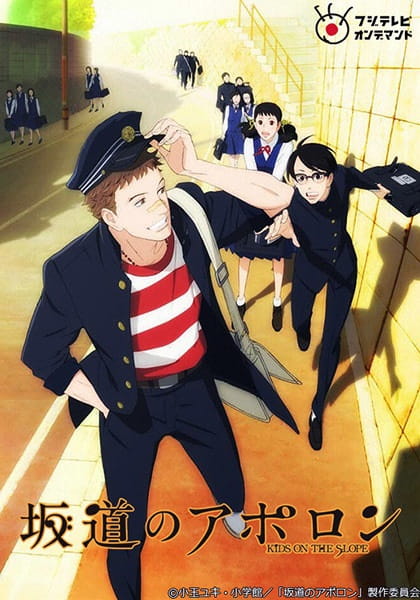
The third Watanabe-Kanno collaboration should have been a landmark. Instead, Kids on the Slope (Sakamichi no Apollon) sits at 8.10 on the Codex rubric — a respectable number that masks a stranger truth: this is one of the most prestigious creative pairings in anime history producing a show that most viewers under thirty have never seriously engaged with. The 6.5 it earns on cultural impact is not a footnote. It is the entire story.
What the Consensus Misreads About Kids on the Slope (Sakamichi no Apollon) Cultural Reach
The MyAnimeList crowd scores it 8.29. That number reflects a real consensus among the people who actually finished the show: the jazz performance rotoscoping is genuinely best-in-class, Kaoru's arc has weight, and the Watanabe-Kanno reunion is not marketing — it is on screen, in every cut from the basement record-shop sessions to the church-bell finale. The 8.29 is earned by viewers who got there. The problem is how few did, and how few have since.
The consensus position treats Kids on the Slope as a quiet masterpiece — a hidden gem flag planted somewhere between Cowboy Bebop and Honey and Clover. That framing is the mistake. A hidden gem is a cultural verdict, not a quality verdict, and the rubric distinguishes between the two. The Codex 8.10 sits below the MAL 8.29 because cultural impact is part of the score, not separate from it. When you measure how a 2012 josei adaptation actually propagated through anime discourse over the following decade, the answer is: barely. That is not a slight on the craft. It is a statement about which shows the form has chosen to remember.
The Animation Is a 9.0 Almost No One Saw
The rotoscoped performance sequences are the single strongest argument for the show's quality. Watanabe insisted on accurate finger placement and drum technique — the "Moanin'" jam in the school festival episode is choreographed as an emotional climax, not a music video, and the animators at Tezuka Productions matched real musicianship to the frame. This is craft almost no music anime attempts, and the rubric reflects it: 9.0 on animation, with the caveat that character animation outside the set-pieces is modest. The performance scenes carry the score.
But animation excellence does not automatically generate cultural weight. Cardcaptor Sakura earns its 9.5 on cultural impact through a quarter-century of magical-girl influence — the single criterion that carries its 8.30 is not its animation but its propagation through the form. Kids on the Slope has the inverse problem: extraordinary craft, negligible afterlife. Watanabe-Kanno collaborations are supposed to bend the medium. This one did not. The rotoscoped jazz never became a reference point the way Bebop's gunplay choreography did, and no subsequent music anime treats it as an obligatory text.
The 12-Episode Compression Hurts the Story, and the Story Hurts the Legacy
Story scores 7.5 because the back half is a structural compromise. Adapting a ten-volume manga into twelve episodes forces a rushed timeskip and an adult reunion in episode 12 that resolves the Kaoru-Ritsuko-Sentarou-Yurika quadrangle almost too neatly. Sentarou's disappearance is abrupt; the church convergence is convenient. The seams of the abridgement show, and they show at exactly the moment a viewer would otherwise be recommending the series forward.
This matters culturally because the shows that propagate are the shows that close hard. The 1960s Kyushu setting, the student protests, Sentarou's Catholicism and mixed heritage — all of it is set up with care, and then the finale trades thematic resolution for narrative tidiness. A josei title that wants to break out the way Honey and Clover quietly did needs a final act that rewards re-engagement. Kids on the Slope's epilogue closes the loop too cleanly to demand it.
Character Writing at 8.5 Is Not Enough Without a Discourse to Carry It
Kaoru's arc from rigid classical perfectionist to someone capable of improvisation — at the piano and in friendship — is the spine of the show, and it works. The jealousy beats around Ritsuko, the reconciliation with Sentarou after the rooftop fight, the way his playing loosens as his interior life does: this is character writing of real specificity. Sentarou's wound around his mixed heritage gives his bravado weight rather than swagger. Ritsuko is not the passive love interest the structure could have made her.
But character writing at 8.5 is not 9.0, and it is the 9.0 character scores that historically carry quiet dramas into the canon. The Codex penalizes the supporting cast — Yurika and Junichi are sketched thinly, used for plot more than growth — and that thinness is part of why the show does not seed the kind of fan engagement that builds cultural weight. There is no Yurika discourse. There is no Junichi reading. The center holds; the periphery does not generate the conversation that turns a good show into a referenced one.
The Counter-Argument: Niche Prestige Is Still Prestige
The strongest defense of Kids on the Slope's standing goes like this: it does not need a mass cultural footprint because it occupies a specific, defensible niche. It is the jazz-anime recommendation. It is the Watanabe-quiet-drama recommendation. It is a gateway josei for viewers who would otherwise never watch one — and the josei map is not monolithic, as the rubric's separate scoring of Chihayafuru and Paradise Kiss demonstrates. Within that niche, the show is essential.
The rubric grants this. The 6.5 cultural score is not a 4.0 or a 5.0 — it credits the niche, credits the Watanabe-Kanno draw that pulled in viewers who would have skipped the synopsis, credits the show's standing as a gateway recommendation. What the rubric refuses to do is inflate niche prestige into broad cultural weight. The Codex 8.10 says: this is a very good show with a small footprint. That is a defensible finding, not a hit piece.
Verdict
Kids on the Slope is a case study in how a single criterion — cultural — can define how a show is remembered. The animation is 9.0, the character writing 8.5, the rubric total 8.10, and the show sits exactly where its cultural reach places it: respected, recommended, rarely revisited. Watanabe and Kanno made something genuinely accomplished, and the form moved on without it.
Featured in the Codex

More from The Codex
The Seven Deadly Sins Is a 6.60 Wearing a 7.60 Costume: A One-Point Gap Earned by Groping Gags and Convenient Flashbacks
The Seven Deadly Sins scores 6.60 on the Codex against MyAnimeList's 7.60 because the crowd is grading a Netflix breakout and a Ban-and-King friendship, not the 24 episodes A-1 Pictures actually broadcast in 2014.
The 10.0 That Built a Sunday: How Sazae-san's Cultural Score Carries a 6.58 Scorecard
Sazae-san is a case study in how a single criterion — cultural — can define how a show is remembered, and the 10.0 the Codex hands Eiken's 1969 institution is doing every bit of the heavy lifting its other five scores refuse to.
The Sebastian Problem: Why Black Butler Sits 1.10 Below Its MAL Line and the Crowd Refuses to Notice
Black Butler (Kuroshitsuji) posts a 1.10-point gap between MyAnimeList's 7.65 and the Codex 6.55 because the crowd is grading Sebastian's silhouette and a Phantomhive aesthetic, not the anime-original finale A-1 Pictures actually shipped in 2009.
Discussion
Set a display name above to post.
Loading discussion…