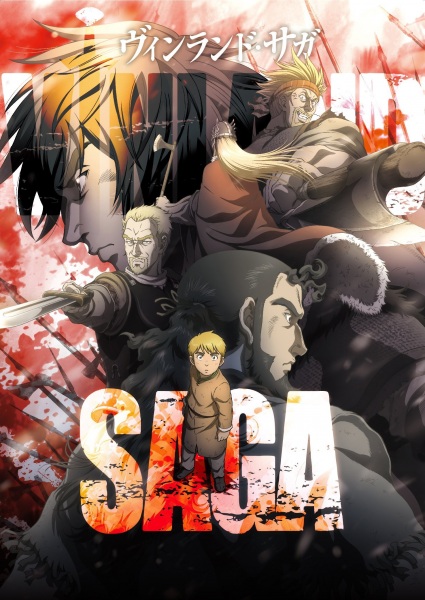
Vinland Saga
Is Vinland Saga worth watching?
Yes — a standout. Anime Codex rates Vinland Saga 8.88 out of 10 — scored on six criteria (story, characters, themes, world-building, animation, and cultural impact), not crowd votes. 10th of 226 on the Codex rubric — top 4% of the catalogue. The Codex rates it Δ +0.10 above its MAL score — more underrated than 87% of the catalogue.
Where to watch
Trailer
What the data says
Computed from the Codex rubric across the whole catalogue.
Summary
Vinland Saga's first season is a masterclass in historical seinen storytelling that subverts its own revenge premise by making the antagonist, Askeladd, the most compelling figure on screen. Set against the Danish conquest of England, it treats Viking-age brutality with documentary seriousness while threading genuine philosophical inquiry—the emptiness of vengeance, the cost of violence, and Canute's startling evolution into a ruthless king—through its bloody political maneuvering. Wit Studio's grounded animation and Yutaka Yamada's score elevate the quiet character beats as effectively as the battles. Its chief weakness is structural: as a deliberate prologue, season one keeps Thorfinn himself a feral, one-note instrument of revenge, the least developed of its major characters until the finale strips away his purpose. The early episodic duels also drag before the geopolitical stakes sharpen. Minor CGI in fleet and crowd scenes occasionally undercuts the otherwise excellent direction. Judged against the best of seinen, it ranks near the top tier—intelligent, uncompromising, and emotionally precise—held just short of definitive status by a protagonist whose payoff is intentionally withheld for later seasons. For viewers who value character-driven historical drama over spectacle, it is essential.
Criterion breakdown
Story & narrative
Season 1 functions as a sustained prologue, using Thorfinn's revenge quest as a frame to explore Askeladd's far more compelling political maneuvering during the Danish invasion of England. The narrative gains real weight in the back half with the Prince Canute arc and the betrayal at Jelling, culminating in Askeladd's calculated death before King Sweyn. The deliberate structuring of Thorfinn as a secondary protagonist to his own enemy is a bold gamble that pays off, though the early duel-of-the-week episodes drag before the larger geopolitical stakes crystallize.
Character writing & growth
Askeladd is the standout—a cynic whose hidden Welsh ancestry and reverence for King Arthur reframe his entire arc, making his final sacrifice to protect Wales devastating. Canute's transformation from a timid, doll-like prince into a hardened king after Ragnar's death is one of the genre's best supporting arcs, sparked by the priest Willibald's nihilist theology. Thorfinn himself is deliberately hollow this season—a feral, single-minded boy—which is intentional setup but does leave the nominal lead the least interesting figure until the finale's collapse of his purpose.
Themes & emotional resonance
The series interrogates the cycle of violence and the emptiness of revenge with unusual rigor, embodied in Thors's pacifist creed 'you have no enemies' echoing hollowly across a world built on slaughter. The Canute-Willibald debate about love, death, and Eden gives the show philosophical heft rare even in seinen. Its emotional resonance peaks when Thorfinn's life-defining goal evaporates with Askeladd's death, leaving a purposeful void—though the thematic payoff is deferred to later seasons.
World-building & power system
The 11th-century Viking and Anglo-Danish setting is grounded in genuine historical figures—Sweyn Forkbeard, Canute, Thorkell—and treats the brutality, politics, and economics of the era with documentary seriousness. Details like slave raids, mercenary contracts, and the strategic value of Wales reflect real research from the Monthly Afternoon source. It lacks the spectacle of a fantasy world but compensates with internal consistency and a refusal to romanticize Viking life, even if some battle logistics stretch plausibility (Thorkell's superhuman feats).
Animation & direction
Wit Studio delivers fluid, weighty combat and excellent character acting, with standout sequences in the Battle of London and Thorkell's clashes. The direction excels in quiet moments—Askeladd's final stand and Canute's silent grief—using restrained framing and Yutaka Yamada's brooding score to maximize impact. Some later episodes lean on noticeable CGI for crowd and ship scenes, a minor blemish on otherwise strong production values.
Cultural impact
The 2019 adaptation significantly broadened Makoto Yukimura's manga readership and is frequently cited among the strongest historical seinen anime of its era. Its reputation grew further with the contentious shift to Netflix and Studio MAPPA for Season 2, sparking wide discourse. While not a phenomenon on the scale of mainstream shonen hits, its critical standing within the seinen space is substantial and enduring.
Synopsis (from MAL)
Young Thorfinn grew up listening to the stories of old sailors that had traveled the ocean and reached the place of legend, Vinland. It's said to be warm and fertile, a place where there would be no need for fighting—not at all like the frozen village in Iceland where he was born, and certainly not like his current life as a mercenary. War is his home now. Though his father once told him, "You have no enemies, nobody does. There is nobody who it's okay to hurt," as he grew, Thorfinn knew that nothing was further from the truth. The war between England and the Danes grows worse with each passing year. Death has become commonplace, and the viking mercenaries are loving every moment of it. Allying with either side will cause a massive swing in the balance of power, and the vikings are happy to make names for themselves and take any spoils they earn along the way. Among the chaos, Thorfinn must take his revenge and kill Askeladd, the man who murdered his father. The only paradise for the vikings, it seems, is the era of war and death that rages on. [Written by MAL Rewrite]
Ranked nearby

Explore rankings
Discussion
Set a display name above to post.
Loading discussion…