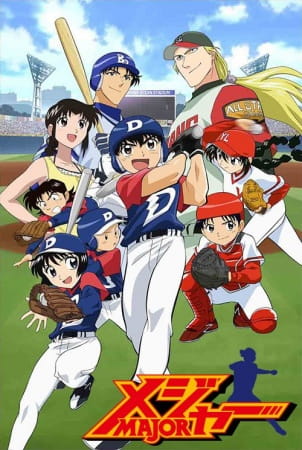
Major
Is Major worth watching?
Yes, it's worth watching. Anime Codex rates Major 8.13 out of 10 — scored on six criteria (story, characters, themes, world-building, animation, and cultural impact), not crowd votes. 45th of 226 on the Codex rubric — top 20% of the catalogue. The crowd rates it 0.09 higher than the rubric does — the Codex is harder on it than on 21% of the catalogue.
Where to watch
Streaming availability varies by region — check your local services.
What the data says
Computed from the Codex rubric across the whole catalogue.
Summary
Major's first season is a quietly ambitious sports drama that distinguishes itself by refusing the usual shonen template. Rather than fast-tracking its hero's glory, it opens on a fading father, Shigeharu, and his switch from pitcher to batter, then delivers an early, devastating loss that reframes Gorou's entire journey as one of inherited dreams and grief. The character writing is its greatest strength: Gorou is allowed to be stubborn and unlikable, Momoko's stepmother role carries genuine weight, and the Toshiya rivalry develops with patience. Thematically it punches above genre weight, exploring obsession, perseverance through injury, and generational legacy with real maturity. Its weaknesses are production-bound — Studio Hibari's animation is inconsistent and the baseball action relies heavily on stills and limited motion, so the athletic spectacle lags behind the emotional storytelling. Pacing across time-skips can feel abrupt, and the early arcs occasionally drift into montage. As the opening cour of a much larger franchise, its scope stays intimate and family-centered. Within the sports-shonen tradition, it earns its place beside Touch and Cross Game as an emotionally serious, character-first work whose narrative courage outweighs its modest technical execution.
Criterion breakdown
Story & narrative
This first season makes the bold structural choice of devoting its early episodes almost entirely to Shigeharu's career twilight and Gorou's childhood rather than rushing to the protagonist's own rise, and the gut-punch of Shigeharu's death recontextualizes the whole arc into one about inherited dreams. The pacing across Gorou's Little League years and the Mifune connection is deliberate and earns its emotional payoffs, though the time-skips can feel abrupt and some episodes coast on training montage rhythms. It is a sports narrative with unusual willingness to dwell on grief and loss before any triumph.
Character writing & growth
Gorou is written across a genuine developmental arc — from worshipful child to stubborn, sometimes abrasive competitor — and the show is unafraid to let him be unlikable in his single-mindedness, which is rare for a shonen lead. Shigeharu's quiet dignity in switching from pitcher to batter, and Momoko's role as the stepmother navigating a grieving child, give the supporting cast real interiority. The relationship between Gorou and Toshiya as childhood rivals/friends is built with patience rather than contrivance.
Themes & emotional resonance
The central theme of carrying forward a parent's unfinished dream, and the cost of obsession, is handled with maturity well above genre norms; Shigeharu's death is not cheap melodrama but the engine of Gorou's entire identity. The show meditates on perseverance through injury and loss in a way that mirrors father and son across generations. It occasionally leans sentimental, but the emotional resonance of the early Honda family material is genuinely affecting.
World-building & power system
Read as setting depth, Major grounds itself in a credible portrait of Japanese baseball culture from sandlot Little League up through second-string pro teams like Blue Ocean, with accurate attention to positions, injuries, and the realities of an aging athlete's body. The premise of tracing a single life across decades is original within sports anime. It lacks the institutional richness of later seasons since this opening cour stays small in scope, focused on childhood and family.
Animation & direction
Studio Hibari's production is functional rather than distinguished — character designs are solid and the baseball mechanics are legible, but animation quality is inconsistent and pitching/batting sequences rely on stills and limited motion. Direction shines in the quieter emotional beats, like the framing of Shigeharu's hospital scenes, more than in athletic spectacle. It is a workmanlike production that serves the story without elevating it.
Cultural impact
Major became a long-running multi-season pillar of baseball anime and is frequently cited alongside Touch and Cross Game in the sports manga canon, with a healthy 8.22 MAL standing. Its influence is real within its niche but did not cross over into broader mainstream consciousness the way the biggest shonen titles did. It remains a respected gateway sports series rather than a medium-defining phenomenon.
Synopsis (from MAL)
Gorou Honda, a little boy obsessed with baseball, has always admired his father, Shigeharu. Wishing to follow in his father's footsteps, Gorou dreams of becoming a professional baseball player. In turn, his son's starry-eyed admiration encourages Shigeharu to keep persevering, despite his late wife's death and his unsatisfying position on the second-string team Blue Ocean. Unfortunately, an elbow injury forces Shigeharu off the team, and he falls into despair. However, after an offhand joke from his childhood friend, Shigeharu reevaluates his choices and decides to keep playing, leaving behind his prime position as pitcher and taking up the bat. Now motivated more than ever, Gorou works hard to carve his way in the Japanese Little League. [Written by MAL Rewrite]
Ranked nearby
Explore rankings
Discussion
Set a display name above to post.
Loading discussion…