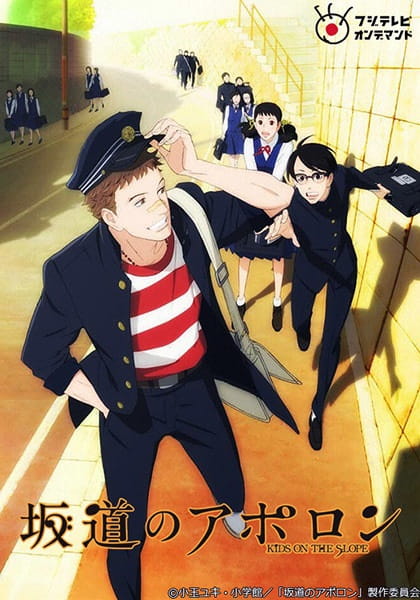
Kids on the Slope (Sakamichi no Apollon)
Is Kids on the Slope (Sakamichi no Apollon) worth watching?
Yes, it's worth watching. Anime Codex rates Kids on the Slope (Sakamichi no Apollon) 8.10 out of 10 — scored on six criteria (story, characters, themes, world-building, animation, and cultural impact), not crowd votes. 49th of 226 on the Codex rubric — top 22% of the catalogue. The crowd rates it 0.19 higher than the rubric does — the Codex is harder on it than on 27% of the catalogue.
Where to watch
Trailer
What the data says
Computed from the Codex rubric across the whole catalogue.
Summary
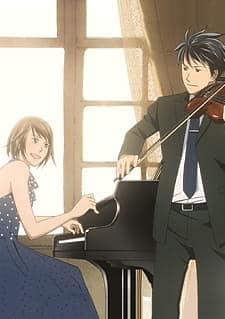
Kids on the Slope stands out as a rare josei-adjacent music drama elevated by an A-tier creative team: Shinichiro Watanabe's direction and Yoko Kanno's score, paired with painstakingly rotoscoped jazz performances, make the jam sessions function as emotional dialogue rather than spectacle. Its strongest asset is character writing — Kaoru's thaw from rigid classical isolation into improvisational openness, and Sentarou's heritage-rooted vulnerability beneath the delinquent shell, give the friendship genuine depth, with Ritsuko avoiding passive love-interest cliché. The 1966 Kyushu setting is richly textured, blending student protests, regional dialect, and period jazz culture into authentic atmosphere. The chief weakness is adaptation compression: squeezing a long manga into 12 episodes forces a jarring timeskip and a tidy, slightly rushed adult reunion that resolves the love quadrangle more conveniently than the careful early episodes earn. Secondary characters serve plot more than growth. Yet within its demographic, it remains a benchmark for how music and emotional interiority can be fused, and its restrained, mature romance distinguishes it from louder coming-of-age fare. For viewers seeking a heartfelt, beautifully scored adult drama, it's a near-essential recommendation despite its hurried finale.
Criterion breakdown
Story & narrative
The narrative gracefully braids a coming-of-age friendship with a love quadrangle (Kaoru-Ritsuko-Sentarou-Yurika) across the politically charged 1960s, anchored by the recurring jam-session motif that lets emotional beats land through music rather than dialogue. The pacing falters in the back half: adapting a multi-volume manga into 12 episodes forces a rushed timeskip and a compressed adult reunion in episode 12 that resolves relationships almost too neatly. Sentarou's abrupt disappearance and the convenient final convergence at the church feel like the seams of an abridged adaptation showing.
Character writing & growth
Kaoru's arc from rigid, isolated classical perfectionist to someone who can improvise — both at the piano and in friendship — is the show's spine and is rendered with real specificity, especially in his jealousy and reconciliation with Sentarou. Sentarou's wound around his mixed heritage and abandonment gives his bravado genuine weight, and Ritsuko avoids the passive love-interest trap by having her own gravitational pull. Secondary figures like Yurika and Junichi are sketched more thinly and serve plot more than they grow.
Themes & emotional resonance
The interplay of jazz improvisation with adolescent emotional spontaneity is a smart organizing metaphor — the unspoken understanding reached in the 'Moanin'' and 'But Not for Me' sessions conveys connection words can't. Themes of belonging, faith (Sentarou's Catholicism), and reconciliation resonate, and the church-bell finale earns its catharsis. The romantic resonance is slightly undercut by how quickly the adult-reunion epilogue ties everything off.
World-building & power system
The 1966 Kyushu setting is evoked with care — the record-shop basement, student protests, the regional dialect, and the specific jazz culture of the era give the premise authenticity rare in school drama. Watanabe's insistence on rotoscoped, accurate jazz performances grounds the world's internal consistency. It's less a deeply expansive setting than a tightly textured one, and the period backdrop is more atmosphere than fully explored substance.
Animation & direction
Shinichiro Watanabe and Yoko Kanno reunite to extraordinary effect: the performance scenes use rotoscoping so the finger placement and drumming match the actual music, a level of craft almost no music anime attempts. Direction favors restrained, expressive framing and the jam sessions are choreographed as emotional climaxes. Tezuka Productions' character animation occasionally looks modest outside the set-pieces, but the soundtrack and musical direction are best-in-class.
Cultural impact
It holds a respected niche as one of the few josei titles to break out to a wide audience, and the Watanabe-Kanno pairing drew anime fans who'd otherwise skip a quiet music drama. It's frequently cited as a gateway recommendation for jazz anime and music storytelling, though its overall footprint remains modest beside its prestigious creative pedigree.
Synopsis (from MAL)
Introverted classical pianist and top student Kaoru Nishimi has just arrived in Kyushu for his first year of high school. Having constantly moved from place to place since his childhood, he abandons all hope of fitting in, preparing himself for another lonely, meaningless year. That is, until he encounters the notorious delinquent Sentarou Kawabuchi. Sentarou's immeasurable love for jazz music inspires Kaoru to learn more about the genre, and as a result, he slowly starts to break out of his shell, making his very first friend. Kaoru begins playing the piano at after-school jazz sessions, located in the basement of fellow student Ritsuko Mukae's family-owned record shop. As he discovers the immense joy of using his musical talents to bring enjoyment to himself and others, Kaoru's summer might just crescendo into one that he will remember forever. Sakamichi no Apollon is a heartwarming story of friendship, music, and love that follows three unique individuals brought together by their mutual appreciation for jazz. [Written by MAL Rewrite]
Ranked nearby

Explore rankings
Discussion
Set a display name above to post.
Loading discussion…