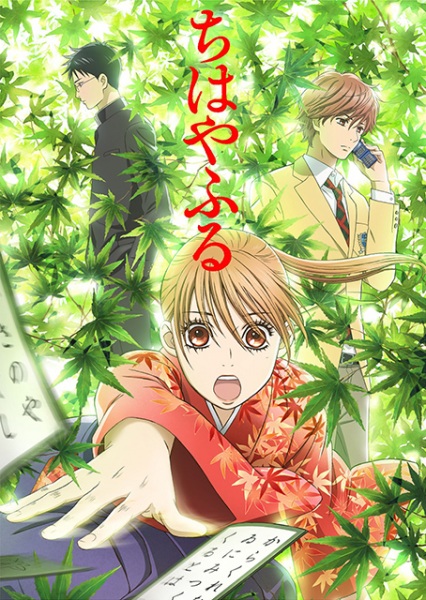
Chihayafuru
Is Chihayafuru worth watching?
Yes, it's worth watching. Anime Codex rates Chihayafuru 8.23 out of 10 — scored on six criteria (story, characters, themes, world-building, animation, and cultural impact), not crowd votes. 39th of 226 on the Codex rubric — top 17% of the catalogue. The Codex rates it Δ +0.06 above its MAL score — more underrated than 85% of the catalogue.
Where to watch
What the data says
Computed from the Codex rubric across the whole catalogue.
Summary
Chihayafuru stands as one of the finest sports dramas anime has produced, distinguished by its unusual subject—competitive karuta—and its grounding in classical Japanese poetry, which lends every match unexpected literary and emotional weight. As a josei work it excels at character interiority, particularly Taichi's quietly tragic self-doubt and Chihaya's atypically obsessive heroine, while refusing to reduce its central trio to a tidy romance. Madhouse's direction under Morio Asaka makes a seated card game genuinely thrilling through kinetic animation, sound design, and recurring poetic imagery. Kanade's role as the club's literary heart ensures the Hyakunin Isshu feels integral rather than decorative. Its weaknesses are modest: the romantic triangle is deliberately stalled to the point of frustration, the middle episodes occasionally over-extend individual matches, and Chihaya herself can feel less developed than the boys orbiting her. Within josei and the sports genre, it is a near-exemplary blend of athletic tension and emotional sincerity, falling just short of definitive only because it leaves its core relationships and Arata's arc unresolved within this single cour. It remains essential viewing and a landmark for the demographic's prestige potential.
Criterion breakdown
Story & narrative
The first season's structure—childhood prologue with Arata and Taichi, then the rebuilding of the Mizusawa club—gives the narrative both emotional grounding and forward momentum toward the national tournament. The team-recruitment arc (Kanade, Tsutomu, Nishida) cleverly justifies each member's role through their relationship to the poems and the game, avoiding filler. It loses some focus in the middle stretch when individual matches stretch across multiple episodes, but the pacing of competitive tension is consistently well-judged for a sports drama.
Character writing & growth
Chihaya is refreshingly written as single-mindedly obsessed rather than romantically passive, and the show resists resolving the Arata–Taichi triangle cheaply. Taichi is the standout: his inferiority complex, the stolen card incident from childhood, and his quiet self-loathing give him more interiority than Chihaya herself at times. Supporting players like Kanade, who frames karuta through classical literature and the meaning of the poems, earn genuine arcs rather than serving as mere club fodder.
Themes & emotional resonance
The show movingly fuses competitive drive with the melancholy and beauty of the Hyakunin Isshu poems, so victory and loss carry literary weight—Kanade's explanations of poem meanings recontextualize matches as emotional acts. The theme of pursuing a passion while drifting from the people who introduced you to it (Arata's withdrawal after his grandfather) resonates strongly. It occasionally leans on sports-anime sincerity that flattens nuance, but the emotional register stays earned.
World-building & power system
Competitive karuta is an inspired and underexplored premise, and the show treats its mechanics with rigor—positioning, memorization, the syllable-by-syllable 'kimariji,' and the physical toll are all explained without condescension. The classical poetry framework gives the setting genuine cultural depth most sports anime lack. Internal consistency is strong: skill progression feels rule-bound rather than arbitrary, with Chihaya's speed and Arata's precision presented as distinct, plausible playstyles.
Animation & direction
Madhouse renders the card swipes with startling kinetic energy, using motion blur, impact frames, and sound design to make a seated card game feel athletic. Director Morio Asaka's use of color and seasonal imagery—cherry blossoms, the visual motif of the 'Chihayaburu' poem—elevates emotional beats. The match choreography clearly differentiates each player's technique visually, a genuine achievement given the static premise.
Cultural impact
The series is widely credited with sparking real-world interest in competitive karuta in Japan and abroad, and remains a flagship josei title that proved the demographic could anchor a long-running, multi-season prestige adaptation. It is frequently cited as a gateway to the Hyakunin Isshu, though its global footprint is narrower than the largest shonen sports franchises.
Synopsis (from MAL)
As a child, Chihaya Ayase had only one dream: to see her elder sister Chitose become Japan's most successful model. However, upon defending her ostracised classmate Arata Wataya from his bully—Chihaya's childhood friend Taichi Mashima—she discovers the world of competitive karuta and soon becomes enamoured with the sport. Based on the Ogura Hundred Poets anthology, this card game where poems are studied requires excellent memory, agility, and a tremendous endurance from the players. Full of hope, Chihaya joins the Shiranami Society together with the newly reconciled Arata and Taichi, embarking on an exciting journey for the title awarded to the top-ranked female player—Queen of Karuta. Since middle school, Chihaya grew distant from a dispassionate Taichi and separated from Arata. However, in order to improve her skills, Chihaya decides to create a karuta club in her high school. With the help of Taichi, another veteran player, and a few spirited newcomers, Chihaya's new-founded Mizusawa Karuta Club aims for victory in the Omi Shrine's national championship. [Written by MAL Rewrite]
Ranked nearby
Explore rankings
Discussion
Set a display name above to post.
Loading discussion…