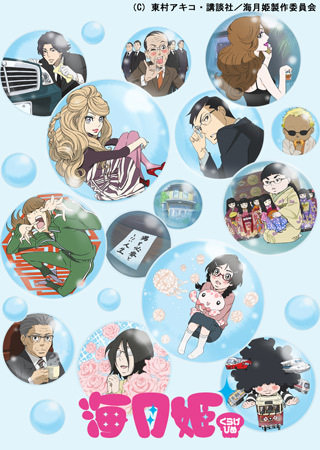
Princess Jellyfish (Kuragehime)
Is Princess Jellyfish (Kuragehime) worth watching?
Yes, it's worth watching. Anime Codex rates Princess Jellyfish (Kuragehime) 7.80 out of 10 — scored on six criteria (story, characters, themes, world-building, animation, and cultural impact), not crowd votes. 62nd of 226 on the Codex rubric — top 27% of the catalogue. The crowd rates it 0.31 higher than the rubric does — the Codex is harder on it than on 35% of the catalogue.
Where to watch
Trailer
What the data says
Computed from the Codex rubric across the whole catalogue.
Summary
Princess Jellyfish stands out in the josei landscape for taking a cast of socially anxious adult otaku women seriously, treating their fixations with affection rather than ridicule. Its great strength is the Tsukimi–Kuranosuke dynamic: a self-doubting jellyfish-obsessed illustrator and a glamorous cross-dressing rich boy whose friendship reframes 'transformation' as self-acceptance instead of conformity. The redevelopment threat to the Amamizukan building grants the slice-of-life premise real stakes, and Brain's Base directs with playful visual wit — the petrification gag, the climactic runway sequence — while linking the jellyfish-as-princess-dress motif to Tsukimi's grief and creative awakening. The supporting Amars risk being one-note, but the show repeatedly humanizes them. Its central weakness is structural: 11 episodes adapt only a slice of the manga, so the romance triangle and the building's fate end abruptly and unresolved, leaving the narrative feeling truncated rather than complete. The animation is expressive but modest, not lavish. Judged against the best of its demographic, it is a warm, thematically generous, and genuinely original work whose incomplete adaptation is the main barrier to greatness — good enough to be widely beloved, flawed enough to leave viewers wanting the story it never finished telling.
Criterion breakdown
Story & narrative
The central plot — the threat of the Amamizukan apartment building being demolished by developers, pushing the Amars to launch a jellyfish-dress fashion line — gives the slice-of-life premise genuine stakes and forward momentum, which many josei dramas lack. However, the 11-episode run adapts only a fraction of the manga, so the redevelopment conflict and the Shoko/Inari subplot end on an unresolved, abrupt note rather than a true climax. The pacing is brisk and charming but the narrative is clearly a partial story that stops rather than concludes.
Character writing & growth
Tsukimi's arc from paralyzed social anxiety to literally walking a runway is earned through small, believable increments rather than a sudden makeover-cures-all shortcut, and Kuranosuke is a rare cross-dressing character written with warmth and depth rather than as a punchline. The Amars (Mayaya, Banba, Chieko, Jiji) risk being one-note gag fixations, but the show repeatedly humanizes them, especially when the building's threat forces them to engage with the outside world. Shu's painfully awkward romantic subplot adds a vulnerable counterweight to his polished younger brother.
Themes & emotional resonance
The show interrogates the otaku-versus-fashionista divide with unusual generosity, refusing to mock either the 'Sisterhood' or Kuranosuke's glamour, and frames transformation as self-acceptance rather than conformity. Tsukimi's jellyfish-as-princess-dress motif ties her childhood grief over her mother directly to her creative awakening, giving the central metaphor real emotional weight. It occasionally leans on the Cinderella fantasy a touch heavily, but it consistently questions what 'becoming beautiful' should actually mean.
World-building & power system
Amamizukan as a no-men-allowed sanctuary for socially anxious otaku women is a genuinely original premise that anchors the entire show's social comedy and conflict. The internal rules — house nicknames, the 'Sisters' identity, the terror of 'stylish' people — are consistent and richly observed, and the contrast with Kuranosuke's wealthy political family broadens the world believably. The jellyfish-illustration and fashion-production details feel specific and researched rather than decorative.
Animation & direction
Brain's Base directs with strong visual wit — the recurring gag of characters 'petrifying' into stone when overwhelmed, and the famous jellyfish-runway transformation sequence in the finale, are memorable directorial flourishes. Character designs cleverly distinguish the deliberately frumpy Amars from the sleek Kuranosuke, reinforcing theme through art. The animation is expressive but not lavish; some episodes rely on simplified backgrounds and static framing, and it never reaches the visual peak of top-tier josei adaptations.
Cultural impact
The series is a beloved and frequently cited josei entry that broadened mainstream visibility for adult female-otaku stories and for sympathetic cross-dressing protagonists. Its passionate fanbase has long lamented the abrupt single-cour ending and absence of a sequel, which limited its lasting reach. It remains a reference point for the 'fujoshi/otaku women' subgenre but did not spawn the franchise footprint of bigger titles.
Synopsis (from MAL)
Ever since her late mother took her to an aquarium when she was young, Tsukimi Kurashita has been obsessed with jellyfish, comparing their flowing tentacles to a princess's white dress. Now living with five other unemployed otaku women, 19-year-old Tsukimi spends her days as a social outcast dreaming of becoming an illustrator. However, her life changes forever when one day, a beautiful woman unexpectedly helps her save a jellyfish in a local pet store. From then on, the stranger—confident, fashionable, and the complete opposite of Tsukimi and her roommates—begins to regularly visit the girls' building. This trendy hipster, though appearing shallow at first, harbors some secrets of her own, starting with the fact that "she" isn't really a girl at all, but a wealthy male college student named Kuranosuke Koibuchi! [Written by MAL Rewrite]
Ranked nearby



Explore rankings
Discussion
Set a display name above to post.
Loading discussion…