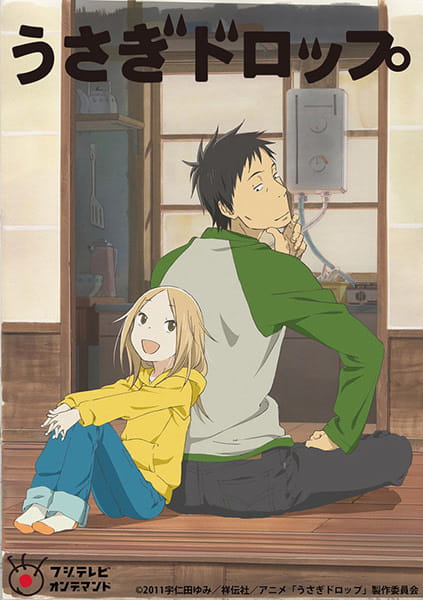
Usagi Drop (Bunny Drop)
Is Usagi Drop (Bunny Drop) worth watching?
Yes, it's worth watching. Anime Codex rates Usagi Drop (Bunny Drop) 8.32 out of 10 — scored on six criteria (story, characters, themes, world-building, animation, and cultural impact), not crowd votes. 31st of 226 on the Codex rubric — top 14% of the catalogue. The Codex rates it Δ +0.01 above its MAL score — more underrated than 82% of the catalogue.
Where to watch
Trailer
What the data says
Computed from the Codex rubric across the whole catalogue.
Summary
Usagi Drop stands among the finest family-centered josei works precisely because of its restraint: by adapting only the childhood arc, it delivers a complete, emotionally honest portrait of unexpected single fatherhood untainted by the source manga's later, controversial direction. Its strengths are character realism—Daikichi's tangible workplace sacrifices, Rin's neglect-shaped guardedness—and a clear-eyed treatment of chosen family, biological abandonment, and the unglamorous logistics of raising a child. Production I.G's picture-book watercolor aesthetic and naturalistic character acting reinforce a gentle, lived-in tone, and the thematic contrasts with Yukari and Masako enrich what could have been a simple feel-good premise. Its weaknesses are inherent to its quiet ambitions: the episodic structure is occasionally slight, the dramatic stakes remain low by design, and the non-stylized TV animation is merely solid outside its memorable transitional sequences. Viewers seeking narrative momentum may find it too placid. Judged against the best of its demographic, it is a near-exemplary slice-of-life family drama—warm, mature, and emotionally precise—held just short of the very top tier by its modest scope. The anime's reputation is also inseparable from the cautionary tale of avoiding the manga's continuation.
Criterion breakdown
Story & narrative
The anime adaptation wisely confines itself to the childhood arc, giving the narrative a clean, self-contained shape that the manga's controversial time-skip later undermined. Episodes proceed through small, grounded incidents—Rin's bedwetting, the search for a daycare, the cherry tree planting at the grandfather's grave, Rin meeting her biological mother Masako—each advancing Daikichi's adjustment to parenthood without manufactured melodrama. The pacing is deliberately quiet and occasionally slight, with little overarching tension beyond everyday logistics, which is the point but also a ceiling on its narrative ambition.
Character writing & growth
Daikichi's transformation from aimless bachelor to attentive single father is rendered with unusual realism, especially in his workplace concessions—requesting transfers, leaving early—that show parenting's actual costs. Rin avoids the precocious-cute-kid trap; her guardedness, her quiet competence born of neglect, and her gradual attachment feel observed rather than written. The supporting cast, particularly Kouki and his overworked single mother Yukari, mirror and contrast Daikichi's situation, deepening the show's portrait of modern caregiving.
Themes & emotional resonance
The series interrogates chosen versus biological family with genuine warmth, dramatized in the contrast between the relatives who reject Rin and Daikichi's instinctive embrace of her. Masako's storyline—a mother who relinquished her child to pursue a career—is handled without easy moral condemnation, a maturity rare even in josei. The emotional resonance peaks in small gestures: Daikichi realizing his own grandfather's choices, or Rin's relief at being wanted.
World-building & power system
The premise—a single bachelor adopting his late grandfather's illegitimate child—is genuinely original and underexplored in anime. The setting depth is strong in its mundane texture: daycare bureaucracy, the rhythms of a working parent's commute, the family home and its rural quiet. Internal consistency is excellent, with the show never cheating its way out of the practical constraints it establishes.
Animation & direction
Production I.G's standout choice is the watercolor, crayon-textured pastel palette in the opening and key transitional sequences, evoking a children's picture book that matches the show's gentle register. Character acting is restrained and naturalistic—Rin's hesitant body language, Daikichi's tired slouch—rather than expressive in a shonen sense. The direction favors soft light and unhurried framing, though the standard-fidelity TV animation outside the stylized inserts is competent rather than dazzling.
Cultural impact
The series became a touchstone for the iyashikei-adjacent family drama and earned a live-action film adaptation, cementing its mainstream reach. Its lasting reputation is double-edged: widely beloved for the anime's childhood arc, it is equally infamous for the manga's later romantic turn, which casts a long shadow over discussions and ironically protects the anime's standing as the definitive version of the story.
Synopsis (from MAL)
Daikichi Kawachi is a 30-year-old bachelor working a respectable job but otherwise wandering aimlessly through life. When his grandfather suddenly passes away, he returns to the family home to pay his respects. Upon arriving at the house, he meets a mysterious young girl named Rin who, to Daikichi’s astonishment, is his grandfather's illegitimate daughter! The shy and unapproachable girl is deemed an embarrassment to the family, and finds herself ostracized by her father's relatives, all of them refusing to take care of her in the wake of his death. Daikichi, angered by their coldness toward Rin, announces that he will take her in—despite the fact that he is a young, single man with no prior childcare experience. Usagi Drop is the story of Daikichi's journey through fatherhood as he raises Rin with his gentle and affectionate nature, as well as an exploration of the warmth and interdependence that are at the heart of a happy, close-knit family. [Written by MAL Rewrite]
Ranked nearby


Explore rankings
Discussion
Set a display name above to post.
Loading discussion…