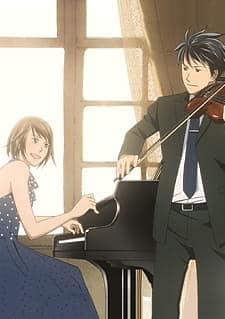
Nodame Cantabile
Is Nodame Cantabile worth watching?
Yes, it's worth watching. Anime Codex rates Nodame Cantabile 7.85 out of 10 — scored on six criteria (story, characters, themes, world-building, animation, and cultural impact), not crowd votes. 57th of 226 on the Codex rubric — top 25% of the catalogue. The crowd rates it 0.40 higher than the rubric does — the Codex is harder on it than on 42% of the catalogue.
Where to watch
Streaming availability varies by region — check your local services.
What the data says
Computed from the Codex rubric across the whole catalogue.
Summary
Nodame Cantabile is one of josei's most beloved music dramas, pairing a perfectionist conductor and a gifted-but-chaotic pianist in a romance that never rushes its emotional beats. Its strengths lie in character writing—Chiaki's growth from icy elitist to engaged ensemble leader, Nodame's genuine anxieties beneath the comedy, and Stresemann's role as provocateur-mentor—and in a conservatory setting rendered with real musical literacy, from repertoire selection to orchestra politics. The fear-of-flying device cleverly externalizes Chiaki's stagnation, and the blend of slapstick and sincerity is well-calibrated. Weaknesses are real: the animation leans on still frames and reaction shots during performances that should soar, the budget undercuts climactic concerts, and the 23-episode run ends as a setup for Europe rather than a self-contained arc, leaving the romance deliberately unresolved. Nodame's recurring regression into pure gag mode occasionally flattens her development. Still, within its demographic it excels at making the labor and joy of music tangible, and its broader cultural footprint—the live-action adaptation, sequels, and its push of classical music into the mainstream—cements its importance. A warm, intelligent, slightly incomplete show that rewards viewers willing to continue into its later seasons.
Criterion breakdown
Story & narrative
The narrative wisely braids a slow-burn romance with genuine professional stakes—Chiaki's conducting ambitions, the formation of the S Orchestra under Stresemann, and Nodame's reluctant path from playing for fun toward serious pianism. The arc structure follows competitions, concerts, and the looming Europe goal effectively, though the back half leans on comedic detours and Nodame's stalled motivation, leaving the season feeling like a prelude rather than a complete journey. It ends on momentum toward Paris rather than resolution, which is honest to the manga but narratively incomplete.
Character writing & growth
Chiaki's arrogance is gradually humanized through his fear of flying, his thawing toward the misfit S Orchestra, and his mentorship under the lecherous-but-brilliant Stresemann, who functions as both foil and catalyst. Nodame is more than comic relief: her terror of leaving the music school cocoon and her ambivalence about competing professionally give her real interiority. Supporting players like Mine, Kiyora, and the violinist's growth keep the ensemble alive, though Nodame occasionally regresses into pure gag mode at the expense of consistency.
Themes & emotional resonance
The show thoughtfully explores the gap between technical perfectionism (Chiaki) and instinctive, joyful musicality (Nodame), and what it costs to turn a passion into a profession. The fear-of-flying motif elegantly literalizes Chiaki's emotional paralysis. However, the romance's emotional payoff is deliberately deferred and the thematic depth sometimes yields to broad comedy, capping the resonance below the genre's most piercing dramas.
World-building & power system
The classical-music conservatory setting is rendered with unusual specificity—correct repertoire choices (Beethoven, Mozart, Rachmaninoff), believable orchestra dynamics, and the politics of conducting and competitions. The premise of a perfectionist conductor and a savant slob pianist is fresh within josei, and the internal logic of musical growth is consistent and credible. Minor weakness: the larger world beyond the school stays thinly sketched until the Europe setup.
Animation & direction
J.C.Staff integrates real performance audio with reasonably synced conducting and fingering, and Kasai's direction lands the comedic timing and chibi gags well. But the actual instrumental animation relies heavily on still frames, pans, and reaction cutaways rather than fluid playing, and the budget shows in concert scenes that should be visual climaxes. Functional and charming rather than visually distinguished.
Cultural impact
Nodame Cantabile is a landmark josei property that drove mainstream interest in classical music in Japan, spawned a hit live-action drama, sequels, and films, and remains a reference point for music-themed anime. Its influence on the 'passion-as-profession' subgenre is tangible, though its anime adaptation's reach is somewhat overshadowed by the manga and drama.
Synopsis (from MAL)
Shinichi Chiaki is a first class musician whose dream is to play among the elites in Europe. Coming from a distinguished family, he is an infamous perfectionist—not only is he highly critical of himself, but of others as well. The only thing stopping Shinichi from leaving for Europe is his fear of flying. As a result, he's grounded in Japan. During his fourth year at Japan's top music university, Shinichi happens to meet Megumi Noda or, as she refers to herself, Nodame. On the surface, she seems to be an unkempt girl with no direction in life. However, when Shinichi hears Nodame play the piano for the first time, he is in awe of the kind of music she creates. Nevertheless, Shinichi is dismayed to discover that Nodame is his neighbor, and worse, she ends up falling head over heels in love with him. [Written by MAL Rewrite]
Ranked nearby

Explore rankings
Discussion
Set a display name above to post.
Loading discussion…