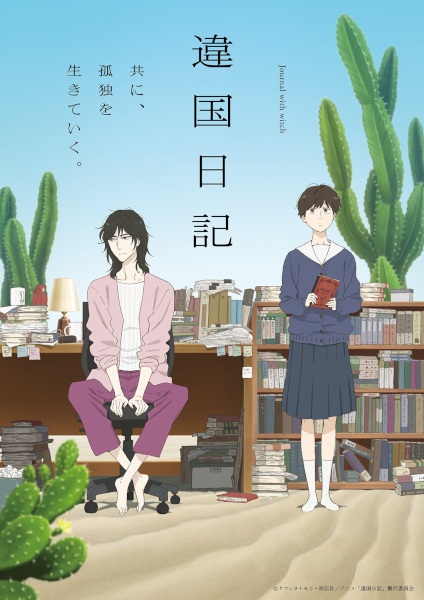
Journal with Witch
Is Journal with Witch worth watching?
Yes, it's worth watching. Anime Codex rates Journal with Witch 8.46 out of 10 — scored on six criteria (story, characters, themes, world-building, animation, and cultural impact), not crowd votes. 24th of 226 on the Codex rubric — top 11% of the catalogue. The crowd rates it 0.27 higher than the rubric does — the Codex is harder on it than on 32% of the catalogue.
Where to watch
Trailer
What the data says
Computed from the Codex rubric across the whole catalogue.
Summary
Journal with Witch is a quietly distinctive entry in josei drama, built on a premise that refuses the genre's sentimental defaults. By opening with Makio's guilt-laced relief rather than grief over her estranged sister's death, it stakes out emotionally honest territory and sustains it through a thirteen-episode cohabitation arc structured around Asa's diary entries. Makio ranks among the more compelling recent josei leads—her ambivalence is never tidily redeemed—and Asa avoids the precocious-orphan trap, most memorably in her episode 9 accusation that her aunt is mining her pain for fiction. Shuka's restrained direction, strong facial acting, and effective use of silence (the morgue scene, the empty dinner table) match the material's understated register. Its weaknesses are real but modest: the mid-season episodes lean on repetitive misunderstanding-and-reconciliation cycles, the supporting cast occasionally serves as mere sounding boards, and the thematic dialogue sometimes over-explains what the imagery already conveyed. Animation is purposeful rather than lavish, with some visibly economized stretches. Judged against the best of its demographic, it falls short of definitive status but stands as a thoughtful, emotionally mature work that treats grief's contradictions with unusual respect.
Criterion breakdown
Story & narrative
The premise smartly subverts grief-drama conventions by opening with Makio's guilt-tinged numbness rather than tears, and the body-identification scene in episode 1 establishes the unsentimental tone that carries the series. The episodic structure—each centered on a diary entry of Asa's—gives the cohabitation arc a clear emotional throughline, though the mid-season episodes (roughly 6-8) stall on repetitive misunderstanding-and-reconciliation beats before the school-festival arc reignites momentum. The refusal to manufacture a tidy resolution to Makio's lingering resentment toward Minori is a genuine narrative strength.
Character writing & growth
Makio is a standout josei protagonist: her ambivalence about Minori's death is allowed to remain unresolved rather than redeemed, and her growth into guardianship is shown through small concessions (rearranging her writing schedule, the awkward grocery-shopping scenes) rather than epiphanies. Asa avoids the precocious-orphan cliché—her anger in episode 9, when she accuses Makio of 'collecting' her for material, is the writing's sharpest moment. The supporting cast, especially Makio's editor, occasionally functions more as a sounding board than a person.
Themes & emotional resonance
The show's insistence that complicated, even relieved feelings about a dead relative are 'valid' is handled with rare honesty for the genre, and the diary motif literalizes the theme of narrating one's own grief without imposing closure. The parallel between Makio's novel-writing and Asa's journaling lands emotionally in the finale's quiet read-aloud scene. It occasionally over-articulates its message through dialogue when the visual storytelling already conveyed it.
World-building & power system
The contemporary urban setting is rendered with lived-in specificity—Makio's cluttered apartment, the publishing-industry texture, the bureaucracy of guardianship paperwork all feel researched and consistent. The premise itself is original within josei, foregrounding chosen family through an estranged aunt rather than romance. It doesn't expand much beyond the two-character core, leaving the wider social world somewhat thinly sketched.
Animation & direction
Shuka delivers restrained, character-focused direction with strong use of negative space and silence, particularly the morgue sequence's muted palette and the recurring framing of the empty dinner table. Facial acting is the standout—Makio's micro-expressions during conversations she'd rather avoid carry scenes that have little dialogue. Backgrounds are functional rather than spectacular, and a few mid-season episodes show visibly reduced motion.
Cultural impact
A strong MAL score (8.73) and 116k members signal solid critical reception for a quiet 2026 josei title, and its frank treatment of ambivalent grief generated discussion as a counterpoint to typical sentimental dramas. However, as a recent, niche-demographic work it has yet to demonstrate lasting genre influence beyond its initial reception.
Synopsis (from MAL)
Thirty-five-year-old novelist Makio Koudai never had a good relationship with her older sister Minori, who always berated her for being different. Due to this, Makio is not stricken with grief upon hearing the news that Minori and her husband died in a car crash. But when Makio is asked to identify their bodies, she runs into her 15-year-old niece, Asa Takumi, whom she has not seen in years. As Asa struggles to process her parents' death, Makio reassures her that her complicated feelings are valid and suggests that the teenager start writing in a diary as a way to cope with the loss. Upon learning that no other relatives wanted to take in Asa, Makio decides to become her guardian despite her lack of experience. In a world full of uncertainty, the novelist and teenager must learn to live with each other while figuring themselves out. [Written by MAL Rewrite]
Ranked nearby

Explore rankings
Discussion
Set a display name above to post.
Loading discussion…