The 10 Best Animated Anime by the Codex Rubric: A Ranked List Judged on Direction, Not Vibes
Most "best anime" lists rank by overall vibe. This one isolates a single axis — animation & direction — and lets the rubric pick the winners.
Most "best anime" lists rank by overall vibe. This one isolates a single axis — animation & direction — and lets the rubric pick the winners.
The best animated anime are almost never the best anime, and pretending otherwise is how aggregator sites end up with Fullmetal Alchemist: Brotherhood at the top of every list regardless of what the list claims to measure. Brotherhood is a 9.25 on the Codex. Its animation criterion is an 8.8. Those are not the same number for a reason, and any ranking that treats them as interchangeable is measuring reputation, not craft.
What "Best Animated Anime" Actually Means Here
MyAnimeList ranks by user average, which conflates everything a viewer felt about a show into a single decimal. Reddit discourse rewards the most recent sakuga clip on the front page. Neither isolates the variable. The Anime Codex rubric scores six criteria — story, character, themes, world-building, animation & direction, cultural impact — and weights them by genre before producing a final score. That means a show with a 9.8 animation score can sit at a 7.98 overall, and a show with an 8.8 animation score can sit at a 9.25 overall. Both are true, simultaneously, and the list below uses only the animation & direction column. The overall Codex number is included as context, not as the rank.
What follows is the top ten anime by animation & direction score alone, in descending order. Ties are broken by Codex overall.
The Ranking
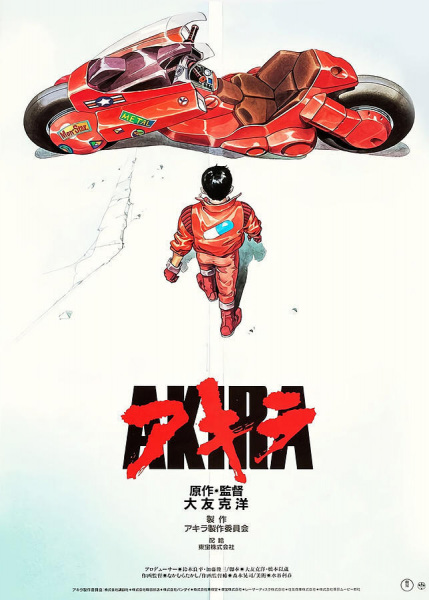
1. Akira — 9.8
Akira sits at the top because nothing else in the medium has matched the per-frame density Tokyo Movie Shinsha put on screen in 1988. Katsuhiro Otomo's single 124-minute feature was animated on twos and threes only when it had to be; the bike-light trails in the opening Neo-Tokyo chase, the prelit neon reflections on wet asphalt, the Tetsuo flesh-mutation sequence in the final act — all of it was drawn before digital compositing was a working pipeline. The Codex overall sits at 7.98 because the story (7.5) and character (7.0) criteria are compressed by the runtime, but the 9.8 animation score and the 10.0 cultural score are doing what they should: marking the ceiling.
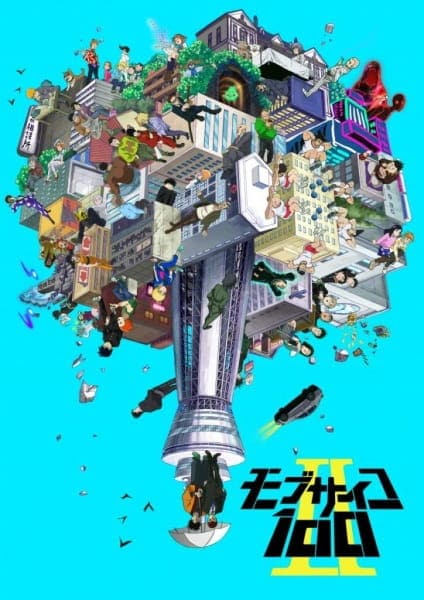
2. Mob Psycho 100 — 9.5
Mob Psycho 100's third season earns a 9.5 because Bones lets the animators direct. Yuzuru Tachikawa's house style — frame-by-frame paint-on-glass aesthetics, deliberate model collapse during emotional climaxes, the explosion-percentage motif treated as compositional logic rather than UI — is the rare case of a studio letting its sakuga department write the visual grammar. The Mogami arc in the prior season set the bar; the confession sequence and the final Mob vs. Reigen-by-proxy confrontation in the 13 episodes of season three clear it. Overall Codex 9.05.
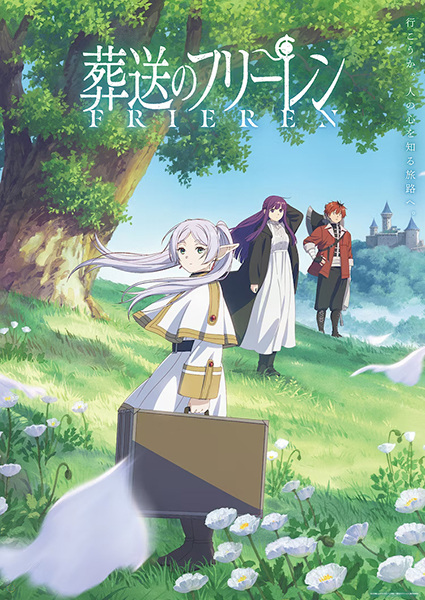
3. Frieren: Beyond Journey's End — 9.2
Frieren's 28-episode run at Madhouse is the most disciplined direction of the post-2020 era. Keiichirō Saitō paces the show on the timescale of its protagonist — slow, observational, with extended silences that most boards would have cut. The first-mage exam arc shifts the visual register without abandoning it; the Aura confrontation is staged in long, static compositions that earn the eventual movement. A 9.2 reflects restraint as much as spectacle. Overall Codex 9.03.
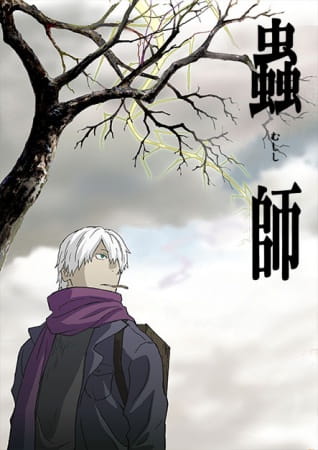
4. Mushishi — 9.0
Artland's 26-episode Mushishi is the most underrated direction job on this list. Hiroshi Nagahama composed nearly every episode around environmental sound and held cuts — wind, water, insect drone — and used limited animation as a deliberate stylistic choice rather than a budget constraint. The 9.5 world-building score and the 9.0 animation score are coupled: the direction is the world-building. Overall Codex 8.68.
5. Made in Abyss — 9.0
Kinema Citrus's 13-episode first season is on this list for Osamu Masuyama's background art and Akihiko Yoshida's character design colliding inside Masayuki Kojima's direction. The Abyss itself is painted with a level of layered atmosphere most studios reserve for theatrical work. The Bondrewd sequences late in the run are where the direction sharpens — the show stops being whimsical and starts staging horror with the same compositional care it gave the surface village. A 9.0 animation score and a 9.5 world-building score do the same coupling Mushishi does. Overall Codex 8.60.
6. Jujutsu Kaisen — 9.0
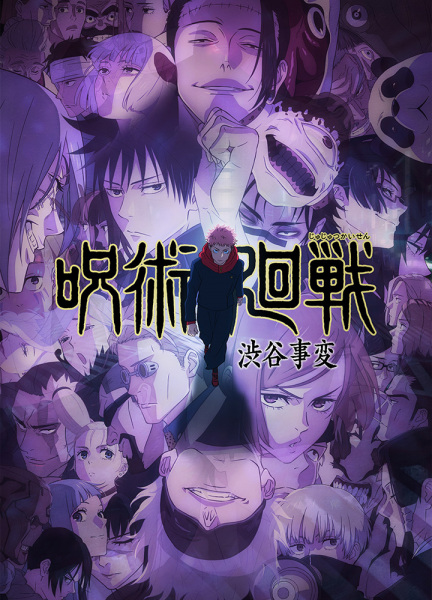
Jujutsu Kaisen's writing is basic — and the 9.0 animation score is the entire reason the show clears 8.23 overall. MAPPA's 23-episode 2023 run, helmed by Shōta Goshozono after Park Sung-hoo's departure, delivers the Shibuya Incident as a sustained piece of action direction unmatched in modern shonen — the Sukuna domain-expansion sequence, the Mahito-Itadori final exchange, Toji's intervention. The cost to MAPPA's staff is its own conversation. The frames are on screen.
7. Attack on Titan — 9.0
Wit Studio's 2013 first season earns 9.0 on the strength of Tetsurō Araki's directorial swing and Arifumi Imai's ODM-gear key animation. The Female Titan chase through the forest in episode 17 remains the cleanest action set piece Wit produced before the studio handed the franchise off. The Codex 8.18 overall is a function of the character criterion (7.0) — the show's later structural problems don't touch the animation column for the season being scored.
8. Kids on the Slope — 9.0
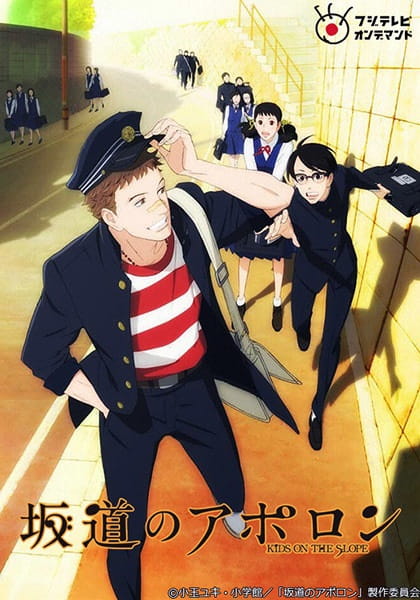
Shinichirō Watanabe directing a Yuki Kodama josei adaptation at Tezuka Productions, with Yōko Kanno scoring, produced the most musically literate animation on this list. The jam sessions are rotoscoped from real jazz performance — Watanabe hired the musicians, recorded the audio, and animated to the take. Twelve episodes, 9.0 animation, 8.10 overall. The story and cultural-impact scores hold it back; the direction does not.
9. Fullmetal Alchemist: Brotherhood — 8.8
Bones' 64-episode Brotherhood is here despite an animation score lower than every show above it, because the rubric is consistent: 8.8 is still elite, and Yasuhiro Irie sustained it across 64 episodes, which Akira did not have to do. The case for Brotherhood as quietly underrated rests partly on this — the consistency tax. Overall 9.25; this list is not where it tops out.
10. Vinland Saga — 8.7
Wit Studio's 24-episode 2019 run, directed by Shūhei Yabuta, scores 8.7 because the Farmland arc setup is staged with the same craft as the early Askeladd raids. The 8.7 is the lowest number on this list and still places above almost every shonen production of the same year. Overall Codex 8.88, and the pacifism the manga earns is reflected in Yabuta's willingness to slow the frame rate when the script slows the action.
The Obvious Counter: Where Are Ufotable, Kyoto Animation, and Studio Ghibli?
The strongest objection to this list is its omissions. Demon Slayer's Mugen Train, Violet Evergarden, and any feature from Ghibli's catalogue would clear 9.0 on most animation rubrics. The Codex reads them differently. Demon Slayer's animation is doing load-bearing work for thin material, and the animation & direction criterion penalises compositing-as-substitute-for-direction. Violet Evergarden's score is high but not top-ten high under the same rubric. Ghibli films are scored as features in a separate column. The list is a TV-and-OVA list with one theatrical exception — Akira — because Akira is the reference point everything else is measured against.
Verdict
The animation & direction column rewards staging, restraint, key-animation density, and directorial coherence — not production budget and not reputation. Akira at 9.8 is the ceiling because nothing has matched its per-frame intent in thirty-seven years; Mob Psycho and Frieren are the modern showrunners closest to that ceiling. Everything else on this list earns its score by doing one specific thing — Mushishi's sound, Made in Abyss's backgrounds, Kids on the Slope's rotoscope — better than the production around it.
Featured in the Codex


More from The Codex
The Seven Deadly Sins Is a 6.60 Wearing a 7.60 Costume: A One-Point Gap Earned by Groping Gags and Convenient Flashbacks
The Seven Deadly Sins scores 6.60 on the Codex against MyAnimeList's 7.60 because the crowd is grading a Netflix breakout and a Ban-and-King friendship, not the 24 episodes A-1 Pictures actually broadcast in 2014.
The 10.0 That Built a Sunday: How Sazae-san's Cultural Score Carries a 6.58 Scorecard
Sazae-san is a case study in how a single criterion — cultural — can define how a show is remembered, and the 10.0 the Codex hands Eiken's 1969 institution is doing every bit of the heavy lifting its other five scores refuse to.
The Sebastian Problem: Why Black Butler Sits 1.10 Below Its MAL Line and the Crowd Refuses to Notice
Black Butler (Kuroshitsuji) posts a 1.10-point gap between MyAnimeList's 7.65 and the Codex 6.55 because the crowd is grading Sebastian's silhouette and a Phantomhive aesthetic, not the anime-original finale A-1 Pictures actually shipped in 2009.
Discussion
Set a display name above to post.
Loading discussion…