Mob Psycho 100 at 9.05: Where Bones' Season 2 Actually Lands on the Shonen Map
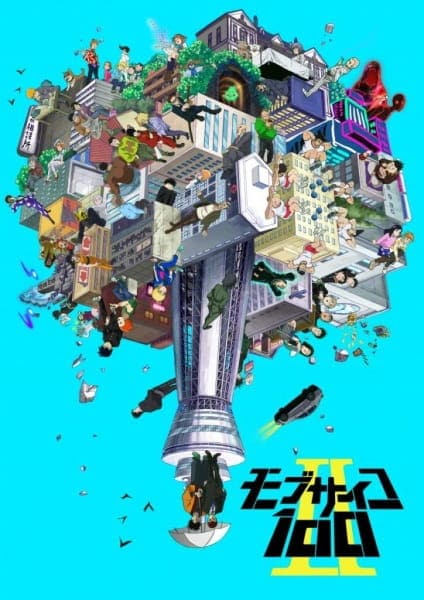
Mob Psycho 100's second season scores 9.05 on the Codex rubric — high enough to sit in the genre's upper tier, but the coordinates matter more than the altitude.
Mob Psycho 100's second season scores 9.05 on the Codex rubric — high enough to sit in the genre's upper tier, but the coordinates matter more than the altitude.
Ranking a show only means something relative to its peers. Place Mob Psycho 100 on the shonen map and explain the coordinates: 9.05 weighted, carried by a 9.7 in character and a 9.5 in animation, dragged earthward by a 7.8 in world-building and an 8.0 in cultural footprint. That spread is the entire argument. It tells you what kind of shonen this is, and which kind it refuses to be.
What the MyAnimeList consensus gets wrong
MyAnimeList scores the 2019 season at 8.78. That number functions as a soft ceiling in mainstream discourse — high enough to call the show "great," low enough to keep it parked below Brotherhood, Hunter × Hunter, and the recent Jujutsu Kaisen surge. The Codex disagrees by a margin of 0.27, which sounds trivial until you notice that 8.78 puts the show in conversation with mid-tier seasonal favorites and 9.05 places it in conversation with Hunter × Hunter's 9.20 and Brotherhood's 9.24. The aggregate score flattens the show because aggregate scores reward genre conformity, and Mob Psycho 100 conforms to almost nothing the demographic is graded on.
That's the consensus error. The MAL crowd is grading Mob against shonen's mechanical traditions — power systems, escalation logic, antagonist hierarchies — and finding it lacking. The Codex grades it against what it's actually doing, which is character work and direction at a register the demographic almost never attempts.
Character work that exceeds most protagonists, let alone supporting casts
The 9.7 in character is the highest score on the card and the spine of the ranking. Shigeo Kageyama's restraint is not a static virtue; the Mogami arc interrogates whether it's actual ethics or learned helplessness, stripping him of his powers and his dignity until the question becomes structurally unavoidable. The arc works because the answer is not given. Mob returns from it changed in ways the show is willing to leave ambiguous, which is not a move most shonen protagonists are permitted.
Reigen's two-episode arc in the back half of the season — the city turning on him, Mob defending him anyway — is the cleanest mentor-student payoff in the demographic in years. The structure is unusual: a con man supporting character is given a fuller redemption than most lead protagonists ever earn, and the show grants him interiority that isn't subordinated to the lead's development. Dimple and Ritsu get the same treatment in smaller doses. Compare this to the functional sidekick economy of My Hero Academia, where Bones built strong character architecture in season one and then watched it ossify across seven more. Mob Psycho's supporting cast deepens. Most shonen casts solidify.
Bones' direction is the second pillar, and it's barely a shonen visual grammar at all
The 9.5 in animation is not a sakuga-counting score. Bones, under Yuzuru Tachikawa's first-season template extended into season two, deploys paint-on-glass, charcoal, and watercolor sequences during Mob's emotional ruptures in a way no other ongoing shonen attempts. The Mogami arc's dreamscapes — Mob trapped in a constructed reality, the visual language degrading as his psyche does — make abstract psychological abuse physically legible. The finale's psychic battles operate on the same principle: the animation isn't decorating the emotion, it's the only honest delivery system for it.
This is a different argument than the one made for Ufotable's Demon Slayer compositing, where the visual layer compensates for thin material. Mob Psycho's animation is doing thematic work — the percentage meter is a feelings gauge, and Bones renders the feelings. Strip the compositing from Demon Slayer and you have a competent shonen. Strip the direction from Mob Psycho and you lose the show's central thesis.
The 7.8 in world-building is not a flaw — it's a deliberate refusal
Here's where the rubric gets honest. Mob Psycho's psychic system is loose by design. Power is a metaphor for emotion, not a combat economy. Claw functions as an antagonist organization without ever cohering into the kind of structural threat that a Pain Invasion or a Marley arc represents. The urban-legend episodic premises — the cracks, the possessions — are clever one-offs that don't expand into lore.
This is why the show's ceiling is 9.05 and not 9.30. World-building is weighted into the shonen rubric because the demographic, at its best, builds systems that reward investigation: nen, alchemy, the Marines' rank structure. ONE is uninterested in that project. The refusal is thematically coherent — making the power system rigid would betray the metaphor — but the rubric still has to register the absence. A shonen that doesn't build a world is a shonen that has narrowed its own scoring range. Mob Psycho narrowed it on purpose. The 7.8 is the cost.
The cultural score is the other ceiling
8.0 in cultural impact reflects something specific: Mob Psycho is the connoisseur's alternative, cited alongside One Punch Man as the ONE bona fides, but it has not penetrated the mainstream the way Demon Slayer or Jujutsu Kaisen have. It influenced anti-power-fantasy discourse. It did not reshape the demographic's commercial center. That distinction matters in a rubric that takes cultural footprint seriously, because being beloved by critics is not the same as being structurally important to the medium.
The strongest case against the 9.05
The honest counter is that the rubric is too generous to a show whose ambitions are smaller than its peers. Mob Psycho 100 is thirteen episodes. It does not attempt the multi-season architectural project of One Piece or the philosophical scope of Hunter × Hunter's Chimera Ant. A 9.05 implies near-parity with works whose canvases are an order of magnitude larger.
The rubric's answer is that scale is not a criterion. Execution within scope is. Mob Psycho 100's second season builds toward the Mogami arc and the Divine Tree confrontation with a control over tonal escalation — mundane requests recontextualizing apocalyptic stakes — that most long-running shonen never achieve across hundreds of episodes. The 9.05 is what the six-criterion method produces when a show executes at the ceiling of what it set out to do. It is not a claim that the show is larger than its competitors. It is a claim that it is more precise.
The coordinates are these: upper-tier shonen, character-and-direction-driven, world-building deliberately undersized, cultural footprint capped by its own refusal to be a mainstream battle property. 9.05 is where that lands, and the MAL 8.78 is the rounding error of a community grading the show against a rubric it was never trying to satisfy.
Featured in the Codex



More from The Codex
The Seven Deadly Sins Is a 6.60 Wearing a 7.60 Costume: A One-Point Gap Earned by Groping Gags and Convenient Flashbacks
The Seven Deadly Sins scores 6.60 on the Codex against MyAnimeList's 7.60 because the crowd is grading a Netflix breakout and a Ban-and-King friendship, not the 24 episodes A-1 Pictures actually broadcast in 2014.
The 10.0 That Built a Sunday: How Sazae-san's Cultural Score Carries a 6.58 Scorecard
Sazae-san is a case study in how a single criterion — cultural — can define how a show is remembered, and the 10.0 the Codex hands Eiken's 1969 institution is doing every bit of the heavy lifting its other five scores refuse to.
The Sebastian Problem: Why Black Butler Sits 1.10 Below Its MAL Line and the Crowd Refuses to Notice
Black Butler (Kuroshitsuji) posts a 1.10-point gap between MyAnimeList's 7.65 and the Codex 6.55 because the crowd is grading Sebastian's silhouette and a Phantomhive aesthetic, not the anime-original finale A-1 Pictures actually shipped in 2009.
Discussion
Set a display name above to post.
Loading discussion…