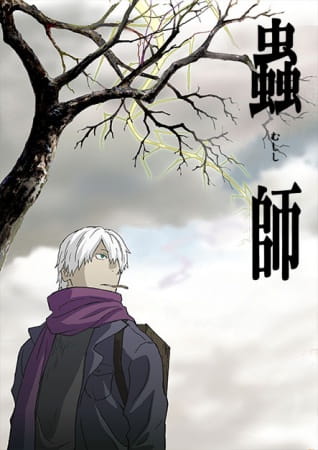
Mushishi
Is Mushishi worth watching?
Yes — a standout. Anime Codex rates Mushishi 8.68 out of 10 — scored on six criteria (story, characters, themes, world-building, animation, and cultural impact), not crowd votes. 15th of 226 on the Codex rubric — top 7% of the catalogue. The Codex rates it Δ +0.03 above its MAL score — more underrated than 83% of the catalogue.
Where to watch
Trailer
What the data says
Computed from the Codex rubric across the whole catalogue.
Summary
Mushishi stands as one of the finest contemplative works in seinen, a near-anthology of folk fables built around mushi — primordial life-forms beyond good and evil — and the wandering researcher Ginko who studies them. Its strengths are extraordinary: an originally conceived, internally consistent world; thematically rich meditations on coexistence with an indifferent nature; and direction that uses silence, mist, and ambient sound to achieve a meditative beauty few shows match. Episodes like 'One-Eyed Fish,' 'Sea of Writings,' and 'Banquet in the Farthest Field' deliver genuine emotional resonance without melodrama, trusting ambiguity over tidy resolution. Its weaknesses are inseparable from its design choices. The strictly episodic structure means there is no overarching narrative momentum, and Ginko, while a compelling observer-catalyst, remains essentially static across all 26 episodes — viewers seeking character growth or cumulative stakes will find them absent by intent. The deliberate, slow pacing rewards patience but can read as monotonous to some. Judged against the best contemplative seinen rather than plot-driven or action work, Mushishi is close to definitive: a masterclass in atmosphere, world-building, and thematic restraint, limited only by the structural and characterological flatness that its anthology form necessarily accepts.
Criterion breakdown
Story & narrative
The episodic, near-anthology structure is Mushishi's greatest strength and its only structural risk: each self-contained tale (the manuscript-devouring mushi in 'Pretense of Spring,' the sound-eating affliction of 'Pillow Pathway,' the river of light in 'Banquet in the Farthest Field') functions as a complete folk fable with setup, mystery, and quiet resolution. There is no overarching plot or escalating stakes, which is a deliberate choice rather than a flaw, but viewers expecting cumulative narrative momentum will find none. The writing's discipline in resisting tidy moralizing — many endings are bittersweet or ambiguous — is exceptional within seinen.
Character writing & growth
Ginko is a superb vehicle: detached yet compassionate, his rootless wandering and white hair (a consequence of his own mushi exposure in 'Cotton Changeling') give him just enough personal stake to anchor the show. However, this is the criterion where the format costs most — Ginko does not arc or grow across the series; he is essentially static, an observer-catalyst. The episodic guest characters are vividly drawn but transient, so sustained character development is intentionally minimal rather than deep.
Themes & emotional resonance
The show's thematic core — coexistence with an indifferent natural order, the impossibility of labeling mushi 'good' or 'evil,' acceptance of loss — is delivered with remarkable consistency and restraint. Episodes like 'One-Eyed Fish' (Ginko's origin) and 'Sea of Writings' achieve genuine emotional resonance precisely because they refuse melodrama, letting grief and wonder coexist. Its Shinto-tinged ecological humility feels distinct from almost anything in the medium.
World-building & power system
Read as setting depth and premise originality, this is near-definitive. The mushi concept — life-forms 'closer to the source of being,' mimicking rainbows, diseases, and sounds — is internally consistent and endlessly generative, supporting 26 wholly different phenomena without repetition. The vaguely Meiji-adjacent, deliberately ahistorical rural Japan reinforces the timeless folklore tone, and the rules of mushi behavior are coherent without ever being over-explained.
Animation & direction
Artland under Hiroshi Nagahama renders mountains, mist, and water with painterly stillness; the deliberate pacing and ambient sound design (insects, wind, dripping water) are central to the atmosphere rather than decorative. The mushi themselves are designed with restrained, ethereal beauty — the luminous Kouki, the writhing tokoyami. Animation is economical rather than flashy, occasionally limited in motion, but direction and Toshio Masuda's spare score elevate every frame.
Cultural impact
Highly respected as a benchmark of atmospheric, contemplative anime and frequently cited in discussions of the 'iyashikei' adjacent mood and meditative seinen, with a faithful 2014 continuation (Zoku Shou) signaling enduring esteem. Its influence is more reverent than broad — it never produced the merchandising or fandom footprint of mainstream hits, remaining a connoisseur's touchstone rather than a mass cultural phenomenon.
Synopsis (from MAL)
Mushi: the most basic forms of life in the world. They exist without any goals or purposes aside from simply "being." They are beyond the shackles of the words "good" and "evil." Mushi can exist in countless forms and are capable of mimicking things from the natural world such as plants, diseases, and even phenomena like rainbows. This is, however, just a vague definition of these entities that inhabit the vibrant world of Mushishi, as to even call them a form of life would be an oversimplification. Detailed information on Mushi is scarce because the majority of humans are unaware of their existence. So what are Mushi and why do they exist? This is the question that a Mushishi, Ginko, ponders constantly. Mushishi are those who research Mushi in hopes of understanding their place in the world's hierarchy of life. Ginko chases rumors of occurrences that could be tied to Mushi, all for the sake of finding an answer. It could, after all, lead to the meaning of life itself. [Written by MAL Rewrite]
Ranked nearby
Explore rankings
Discussion
Set a display name above to post.
Loading discussion…