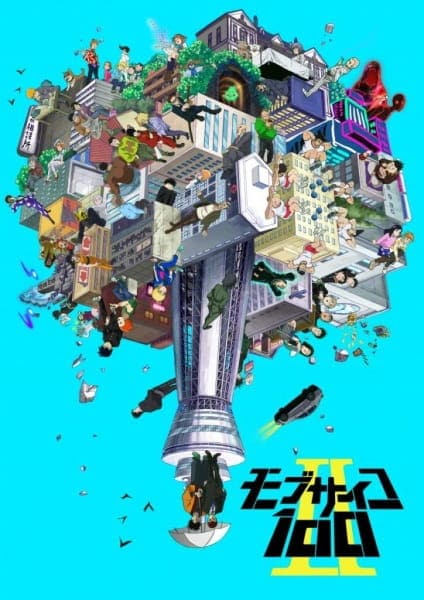
Mob Psycho 100
Is Mob Psycho 100 worth watching?
Yes — a standout. Anime Codex rates Mob Psycho 100 9.05 out of 10 — scored on six criteria (story, characters, themes, world-building, animation, and cultural impact), not crowd votes. 6th of 226 on the Codex rubric — top 3% of the catalogue. The Codex rates it Δ +0.27 above its MAL score — more underrated than 93% of the catalogue.
Where to watch
Trailer
What the data says
Computed from the Codex rubric across the whole catalogue.
Summary
Mob Psycho 100 II represents the franchise at its dramatic peak and stands among the strongest character-driven works in shonen. Where most of the demographic equates growth with power escalation, ONE's premise inverts this: Mob's journey is about valuing himself apart from his psychic gifts, and the season dramatizes this through the harrowing Mogami arc and Reigen's standout redemption, which deepens a former comic-relief con man into one of the genre's best mentor figures. Bones' direction is the technical centerpiece — its medium-bending visual experiments translate abstract emotion into spectacle no rival quite matches. The thematic clarity, earned emotional payoffs, and refusal to celebrate violence give it weight rare for its category. Weaknesses are real but minor: the power system is deliberately loose and offers little systematic intrigue, Claw remains a functional rather than compelling antagonist organization, and the world's lore stays shallow beneath the character work. Some early episodes feel slight before the back half's intensity. None of this undercuts what makes it notable — a shonen that argues kindness and effort matter more than talent, and backs that argument with exceptional craft. It is one of the genre's finest demonstrations that emotional maturity can be its own form of escalation.
Criterion breakdown
Story & narrative
Season 2 is the narrative high point of the franchise, building deliberately toward the Mogami arc and the climactic Divine Tree/Claw confrontation while interweaving low-stakes episodic requests that recontextualize the stakes. The pacing earns its emotional payoffs — Mob's confession arc with Tsubomi and the '???%' explosion are seeded across episodes rather than dumped — though the early Telepathy Club and body-improvement filler beats feel slighter than the back half's intensity. The structure of escalating from mundane to apocalyptic without losing thematic throughline is exceptionally controlled for shonen.
Character writing & growth
This is the season's crown jewel: the Mogami arc strips Mob of his power and dignity to interrogate whether his restraint is genuine virtue or learned helplessness, and the Reigen-centric arc (episodes 8-9) where the city turns on him and Mob defends him is one of the best mentor-student payoffs in the demographic. Reigen's arc — a con man forced to confront his own emptiness and earn Mob's trust back — gives a supporting character a fuller redemption than most shonen protagonists get. Even Dimple and Ritsu are afforded genuine interiority rather than functional roles.
Themes & emotional resonance
ONE's core thesis — that psychic power is irrelevant to being a good person, and that self-worth must come from effort rather than innate gifts — is dramatized rather than stated, especially in Mob's refusal to use violence and his insistence on apologizing. The Mogami arc's exploration of trauma, isolation, and the temptation to lash out lands with unusual weight for a comedy-adjacent shonen. It occasionally undercuts its own gravity with abrupt tonal shifts, but the emotional resonance of the finale is fully earned.
World-building & power system
The psychic system stays loose and intentionally undefined — power is a metaphor for emotion, with Mob's percentage meter functioning as a feelings gauge rather than a rigid mechanic — which is thematically smart but offers little of the systematic intrigue some genre fans want. Claw as an antagonist organization is functional but thinner than the character work surrounding it, and the urban-legend episodic premises (the cracks, possessions) are clever but rarely expanded into deeper lore. Originality of premise is high; depth of setting is moderate.
Animation & direction
Bones delivers some of the most distinctive direction in modern shonen — the fluid shift between minimalist character art and explosive paint-on-glass, charcoal, and watercolor sequences during Mob's outbursts is unmatched. The Mogami arc's nightmarish dreamscapes and the finale's sakuga-dense psychic battles (handled by directors like Yuzuru Tachikawa's team) make abstract emotion physically legible. Only occasional off-model comedic frames keep it just shy of perfect.
Cultural impact
Mob Psycho cemented itself as the connoisseur's alternative to mainstream battle shonen, frequently cited alongside One Punch Man as proof of ONE's range, and Season 2 is widely regarded as the franchise's peak that elevated its critical standing. It influenced discourse around anti-power-fantasy storytelling, though its mainstream footprint remains smaller than juggernaut titles in the demographic.
Synopsis (from MAL)
Shigeo "Mob" Kageyama is now maturing and understanding his role as a supernatural psychic that has the power to drastically affect the livelihood of others. He and his mentor Reigen Arataka continue to deal with supernatural requests from clients, whether it be exorcizing evil spirits or tackling urban legends that haunt the citizens. While the workflow remains the same, Mob isn't just blindly following Reigen around anymore. With all his experiences as a ridiculously strong psychic, Mob's supernatural adventures now have more weight to them. Things take on a serious and darker tone as the dangers Mob and Reigen face are much more tangible and unsettling than ever before. [Written by MAL Rewrite]
Ranked nearby
Explore rankings
Discussion
Set a display name above to post.
Loading discussion…