Demon Slayer Is Coasting on Ufotable: The Codex Verdict on Anime's Most Overproduced Shonen
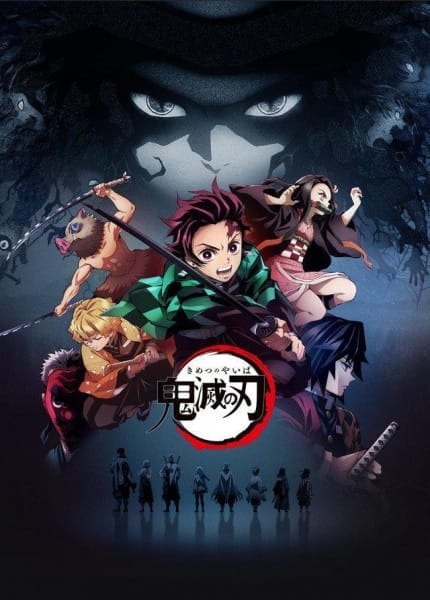
Demon Slayer's reputation rests almost entirely on sakuga and color grading — strip away Ufotable's compositing layer and what remains is a competent but unremarkable shonen with a flat protagonist and a thematically inert villain roster.
Demon Slayer's reputation rests almost entirely on sakuga and color grading — strip away Ufotable's compositing layer and what remains is a competent but unremarkable shonen with a flat protagonist and a thematically inert villain roster.
The strongest argument against demon slayer is also the simplest: nobody is reading the Wikipedia page anymore. 3.5k monthly views for a franchise that, four years ago, was breaking Japanese box office records with Mugen Train. Zero top-week Reddit posts during a period when Frieren, Dandadan, and even legacy Bleach discourse dominates the front page. Demon Slayer has slipped quietly off the trending list, and the silence is itself a verdict.
The Consensus Position and Where It Breaks
MyAnimeList parks the TV series around the 8.5 range, Mugen Train slightly above, and the Entertainment District and Swordsmith Village arcs in the same neighborhood. The fan-aggregated read is that Demon Slayer is a top-tier modern shonen — visually transcendent, emotionally devastating, structurally sound. The Hashira Training and Infinity Castle hype cycle has reinforced this. The film slate ahead will reinforce it again.
Anime Codex's rubric, applied honestly, lands lower. The six-criterion weighting for action-shonen tilts heavily toward story, character, and animation, with themes and worldbuilding as significant secondary axes. Demon Slayer wins decisively on exactly one of those criteria. It posts middling-to-weak numbers on three others. That arithmetic does not produce a top-tier score, no matter how many times Akaza's backstory makes someone cry on TikTok. Where One Piece's 8.58 survives Toei's pacing sins because of structural ambition, Demon Slayer has no equivalent ballast. The animation is the show.
Ufotable Is Doing the Heavy Lifting, and Everyone Knows It
The animation criterion is where Demon Slayer earns its keep, and there is no honest argument otherwise. The Rui fight in episode 19 of the first season — Nozomu Abe's key animation, Yuki Hayashi's compositing, the way the Hinokami Kagura sequence was sold through color rather than choreography — is one of the defining sakuga moments of the late 2010s. The Daki decapitation sequence in Entertainment District, the Gyutaro fight's blood-flag work, the Upper Moon Four battle at the end of Swordsmith Village: Ufotable's pipeline, particularly its in-house digital compositing department, is doing something no other studio is currently matching at this scale and frequency.
But this is the trap. Ufotable's 3DCG-assisted 2D, the bloom, the particle work, the camera that swoops through stylized landscape backgrounds — these are compensating moves. Strip them out and the underlying boarding, by directors like Toshiyuki Shirai and Yuki Hayashi, is frequently static. Fights are won by power-up reveals, not by spatial logic. The "Breathing Form" presentation is essentially a name card plus a particle wash. Compare this to the readable choreography of Hunter × Hunter's Chimera Ant palace invasion, or even the workmanlike fight grammar of Jujutsu Kaisen's Shibuya arc. Demon Slayer's action is beautiful and frequently incoherent.
Tanjiro Is the Problem Nobody Wants to Name
Story and character carry significant rubric weight, and Tanjiro Kamado is the single largest drag on Demon Slayer's score. He is kind. He is determined. He smells things. Across more than fifty episodes and a feature film, he does not develop in any meaningful sense — he accumulates techniques and grief, but his moral center, his decision-making, and his relationship to violence remain identical from the Final Selection arc through Infinity Castle's opening. Gotouge wrote a protagonist whose defining trait is emotional consistency, and Ufotable adapted that consistency faithfully. The result is a lead who functions as a delivery mechanism for fights rather than a character whose arc generates them.
The supporting cast compensates unevenly. Zenitsu's one-note cowardice-into-competence routine is structurally identical across every arc he appears in. Inosuke is genuinely well-handled, particularly in the Mugen Train and Infinity Castle material where his backstory begins to recontextualize the boar-mask shtick. The Hashira are the strongest writing in the franchise — Rengoku's death in Mugen Train lands because Haruo Sotozaki's direction gives the train interior real geography and weight, and because Rengoku is the first character in the series with a coherent philosophical position. That position is then immediately consumed by Akaza, who exists to monologue it back to the audience.
Brotherhood's structural rigor at the top of MAL makes the comparison unkind: Edward Elric changes. Tanjiro accumulates.
Themes That Refuse to Commit
Demon Slayer gestures at thematic substance — the humanity of demons, the cyclical nature of grief, the cost of vengeance — without ever committing to a reading. Every demon gets a sympathetic flashback in their dying moments. This is initially affecting (Rui, Spider Mountain) and then becomes formula (Daki/Gyutaro, the Upper Moons in sequence). By the time Infinity Castle is unspooling its backstory-per-fight rhythm, the device has stopped meaning anything. Sympathy is not a theme. It is a tonal preset.
Contrast this with Hunter × Hunter's apparatus around the Chimera Ant arc, where Togashi forces the question of what humanity actually consists of and refuses to answer it cleanly. Demon Slayer's worldbuilding — the Demon Slayer Corps hierarchy, the Breathing Style lineages, Muzan's blood mechanics — is functional shonen scaffolding. It exists to enable fights. It does not reward investigation.
The Counter-Argument: Emotional Throughput Is a Real Skill
The honest steelman is this: Demon Slayer reaches people. Mugen Train did not become the highest-grossing Japanese film in history by accident. Sotozaki and Ufotable have engineered an emotional pipeline that compresses grief, sacrifice, and beauty into 22-minute units with extraordinary reliability. Whether or not Tanjiro develops, audiences cry when Rengoku dies, when Gyutaro and Daki hold hands in hell, when Tanjiro's father appears in the snow. Manipulating affect at that scale is a craft.
The rubric does account for this — cultural impact is one of the six criteria, and Demon Slayer scores genuinely high there. The Reiwa-era anime boom in Japan is partially its doing. But cultural impact is one axis of six, and a show that wins one axis decisively, ties on a second, and underperforms on four cannot mathematically reach the tier its fans want it in. The Wikipedia traffic decay and the empty Reddit week are the leading indicators of impact regression. The show was a phenomenon. It is becoming a franchise.
Verdict
Demon Slayer is a B-tier shonen with an S-tier animation studio attached, and the Codex score reflects the gap honestly rather than rounding up out of deference to Mugen Train's box office. Ufotable's craft is real and worth defending; the show beneath it is not the masterpiece the 2020 discourse insisted it was. The trending list has already figured this out.
Featured in the Codex


More from The Codex
Slam Dunk at 8.12: The 6.8 on Animation That Decides How Toei's Basketball Landmark Gets Remembered
Slam Dunk earns 9.5 on cultural impact and 9.0 on character, but Toei's 1993 production caps it at 8.12 — and the gap between manga and adaptation is measured in still frames.
The Promised Neverland Review: An 8.18 That Lives on Story and Direction, and Loses Ground on World and Legacy
Judged against one consistent rubric, The Promised Neverland is best understood by which criteria carry it and which drag it down — not by a single number.
Anime Like Re:Zero: 5 the Codex Rubric Says You'll Love
Fans of Re:Zero respond to its strongest criteria — character at 9.0, cultural weight at 9.0, story and themes at 8.5 — and these five picks deliver the same qualities, ranked by how close their critical profile sits to it, not by vibes.
Discussion
Set a display name above to post.
Loading discussion…


