Is Usagi Drop (Bunny Drop) Worth Watching? An 8.32 That Lives or Dies on Two Numbers
Production I.G's 11-episode adaptation is worth the four hours for viewers who want observed parenthood over plotted drama — the Codex puts it at 8.32, and character writing does most of the lifting.
Production I.G's 11-episode adaptation is worth the four hours for viewers who want observed parenthood over plotted drama — the Codex puts it at 8.32, and character writing does most of the lifting.
Production I.G made the only correct structural decision available to a Usagi Drop adaptation: stop at the childhood arc. That single choice is why the 2011 anime sits at 8.32 on the Codex while the source manga is now mostly discussed as a cautionary tale. Everything else — whether the show earns your eleven episodes — comes down to two criteria and a temperament question.
Is Usagi Drop (Bunny Drop) Worth Watching, Briefly
Most people just want to know: is Usagi Drop worth my time, and for whom? Yes, if you came for character observation and a thematic interest in chosen family; no, if you need narrative propulsion, a complicated antagonist, or animation that does more than gesture at a watercolor mood. The Codex rates the 2011 Production I.G adaptation at 8.32. MyAnimeList sits at 8.31. The numbers agree almost to the second decimal, which is rare, and which makes the more interesting question not the verdict but the composition of it.
The MAL consensus reads Usagi Drop as a quiet, beloved josei classic and stops there. That reading is not wrong, but it flattens the show. The 8.31 averages a viewership that often retroactively credits the anime with the manga's later choices it never made, and just as often dismisses the show as "slight" because nothing explodes. Both readings miss where the rubric actually lands the value: a 8.7 on character and an 8.5 on themes, with a 7.0 on cultural impact that quietly caps the ceiling.
The Character Score Is Doing Most of the Work
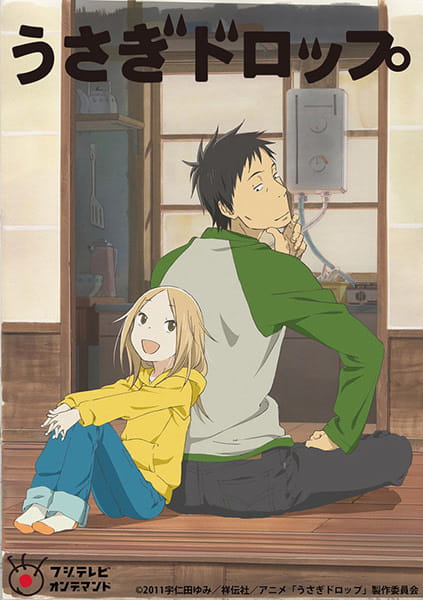
The 8.7 on character is the highest single number on this entry, and it's earned in a register most anime can't operate in. Daikichi is not transformed by an arc; he's reorganized by logistics. The show takes the workplace seriously as a site of parenting cost — his transfer request, the early departures, the visible exhaustion in his posture — and treats these as the actual texture of becoming a parent rather than background detail. There's no scene in which he Decides To Be A Father. He simply keeps showing up to the daycare, and the cumulative weight of that registers.
Rin is the harder achievement. The default failure mode for a six-year-old in anime is the precocious-cute-kid trap, and Usagi Drop avoids it through restraint: she is quietly competent in the way neglected children often are, watchful before she is warm, and her attachment to Daikichi unfolds through small concessions rather than declarations. Kouki and his mother Yukari function as a structural mirror — a working single parent stretched thinner than Daikichi, with a son acting out the strain — and the show uses them to keep its portrait of caregiving from collapsing into a single household's sentimentality. This is the kind of character writing the Codex consistently ranks above flashier work, and it sits in the same neighborhood as Honey and Clover's quiet ensemble precision, if without the same formal ambition.
The Themes Score Is What Separates It From Iyashikei Wallpaper
The 8.5 on themes is the second load-bearing number. The series interrogates chosen versus biological family without rigging the contest. The relatives who refuse to take Rin are not caricatured; they're tired, embarrassed, practical. Daikichi's instinctive yes is not framed as heroism but as temperament. The Masako storyline is where the maturity becomes legible: a mother who gave up her child to pursue work as a manga artist, presented without the moral condemnation a lazier script would deploy on autopilot. The show lets her be a person with a defensible if costly choice, and lets Daikichi register that without resolving it.
The thematic peak isn't an episode but a recognition: Daikichi reading his grandfather's life through the fact of Rin's existence and finding, in the old man's choices, a permission for his own. This is the iyashikei-adjacent family drama operating at the upper end of what the form can do — and it's why the show belongs in the conversation with the emotionally precise seinen and josei the Codex ranks highest on themes, even if it doesn't crack that tier.
The Ceiling: Story at 8.0, Animation at 8.2, Cultural at 7.0
The case against blanket recommendation is also in the rubric. Story sits at 8.0 because the show is, by design, structurally slight: incidents accumulate — the bedwetting, the daycare hunt, the cherry tree at the grandfather's grave, the meeting with Masako — but no overarching tension builds. This is the point of the form and a real ceiling on it. Viewers who require narrative propulsion will find the eleven episodes pleasant and inert.
Animation at 8.2 is more interesting than the number suggests. Production I.G's signature choice — the watercolor and crayon-textured pastel palette in the opening and the transitional inserts — is genuinely beautiful and tonally exact, evoking a picture-book register the rest of the show then declines to sustain. The standard-fidelity TV animation outside those stylized sequences is competent, restrained, occasionally lovely in its character acting (Rin's hesitations, Daikichi's slouch) and never dazzling. The direction favors soft light and unhurried framing and trusts the writing to carry weight, which it does.
The 7.0 on cultural impact is the structural cap. The show landed a live-action film the same year it aired and became a touchstone for the gentler family drama, but its lasting reputation is permanently entangled with the manga's later romantic turn — a shadow the anime didn't earn but can't escape in discourse. That dynamic ironically protects the adaptation's standing as the definitive version of the story, but it also explains why a show this well-written doesn't crack the 9-tier on cultural weight the way a comparable seinen landmark like Mushishi does.
The Strongest Case Against Watching It
The fair counter is that 8.0 on story, in an eleven-episode show with no plot to speak of, makes Usagi Drop a mood piece in a market full of better-directed mood pieces. If you already have your iyashikei slot filled, the marginal value of Usagi Drop over a more formally ambitious quiet show is small. The rubric concedes the point: this is not a top-tier work on story, animation, or cultural weight, and a viewer optimizing for any of those three is correctly served elsewhere.
What the rubric reads differently is the load-bearing capacity of the 8.7 character score in a show this short. Four hours is a low entry cost for character writing this controlled, and the time-skip the manga later commits is the one thing the adaptation refuses to do. That refusal is the show's defining authorial choice, and it's why the score holds.
Worth watching for the character and themes axes, at the four-hour runtime, with no expectation of plot. The 8.32 is real, and it is almost entirely Daikichi, Rin, and the decision to end on time.
Featured in the Codex




More from The Codex
The Seven Deadly Sins Is a 6.60 Wearing a 7.60 Costume: A One-Point Gap Earned by Groping Gags and Convenient Flashbacks
The Seven Deadly Sins scores 6.60 on the Codex against MyAnimeList's 7.60 because the crowd is grading a Netflix breakout and a Ban-and-King friendship, not the 24 episodes A-1 Pictures actually broadcast in 2014.
The 10.0 That Built a Sunday: How Sazae-san's Cultural Score Carries a 6.58 Scorecard
Sazae-san is a case study in how a single criterion — cultural — can define how a show is remembered, and the 10.0 the Codex hands Eiken's 1969 institution is doing every bit of the heavy lifting its other five scores refuse to.
The Sebastian Problem: Why Black Butler Sits 1.10 Below Its MAL Line and the Crowd Refuses to Notice
Black Butler (Kuroshitsuji) posts a 1.10-point gap between MyAnimeList's 7.65 and the Codex 6.55 because the crowd is grading Sebastian's silhouette and a Phantomhive aesthetic, not the anime-original finale A-1 Pictures actually shipped in 2009.
Discussion
Set a display name above to post.
Loading discussion…