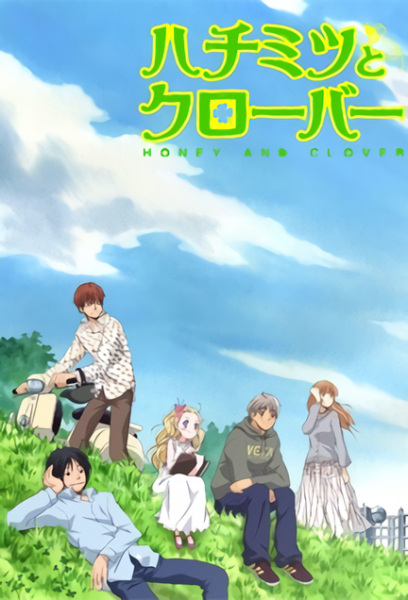
Honey and Clover (Hachimitsu to Clover)
Is Honey and Clover (Hachimitsu to Clover) worth watching?
Yes — a standout. Anime Codex rates Honey and Clover (Hachimitsu to Clover) 8.66 out of 10 — scored on six criteria (story, characters, themes, world-building, animation, and cultural impact), not crowd votes. 16th of 226 on the Codex rubric — top 7% of the catalogue. The Codex rates it Δ +0.68 above its MAL score — more underrated than 100% of the catalogue.
Where to watch
Streaming availability varies by region — check your local services.
What the data says
Computed from the Codex rubric across the whole catalogue.
Summary
Honey and Clover is among the finest works its demographic has produced, trading plot momentum for the bittersweet texture of young adulthood at an arts college. Its greatest strength is character writing: the unrequited-love web—where Takemoto, Yamada, Mayama, and Morita all yearn for someone who looks elsewhere—is rendered with unusual emotional honesty, and Morita's evolution from comic relief to grief-stricken genius is a masterstroke. The themes of talent, purpose, and one-sided love give it a melancholy that lingers, anchored by Takemoto's self-discovery bicycle journey. Direction blends manga-faithful gag whiplash with genuinely poignant seasonal imagery, though the character art is visibly dated and some episodes betray budget constraints. Its main weaknesses are pacing—the Mayama-Rika-Nomiya thread meanders and feels overlong against the more vital central cast—and a hermetic world that rarely extends beyond the friend group. Still, the refusal to deliver tidy romantic resolutions is a mature, deliberate choice that distinguishes it from lesser josei romances. As a foundational, award-winning title that helped codify the creative-coming-of-age genre, it remains a respected touchstone. It is not flawless, but it is definitive of what thoughtful josei storytelling can achieve.
Criterion breakdown
Story & narrative
The narrative wisely abandons a conventional plot for the rhythm of college life, where the unrequited love chains (Takemoto→Hagu, Yamada→Mayama, Mayama→Rika) drive structure without ever resolving neatly. The bicycle journey arc, where Takemoto rides north to find himself, is a standout structural choice that externalizes internal aimlessness. It occasionally meanders and the Mayama-Rika-Nomiya subplot drags compared to the central five, but the refusal to grant tidy emotional payoffs is a strength, not a flaw.
Character writing & growth
This is the show's crown jewel: Takemoto's anxiety about purpose, Yamada's painful loyalty to Mayama, and Hagu's tension between her gift and her humanity are rendered with rare honesty. Morita's manic comedy is gradually peeled back to reveal grief and obsession over his late father, transforming a gag character into the series' most tragic figure. Hagu's injury arc and her dependence on Shuu forces every relationship into a mature reckoning that few josei works attempt.
Themes & emotional resonance
The series captures the ache of youth, unrequited love, and the terror of choosing a future better than almost any of its peers. The recurring motif of one-sided love that never aligns—nobody loves the person who loves them—gives the show a melancholy that resonates deeply. Its meditation on talent versus effort, embodied in Takemoto watching Hagu and Morita's genius, is quietly devastating.
World-building & power system
The arts-college setting is depicted with specific texture: pottery kilns, sculpture studios, the architecture-firm internship, and the seasonal life of a Tokyo campus all feel lived-in and internally consistent. Umino's premise—rooting a romance ensemble in the precarity of creative careers—is original within josei. It loses a little for keeping the wider world fuzzy, with the cast somewhat hermetically sealed in their friend group.
Animation & direction
J.C.Staff's direction leans on whimsical, watercolor-soft visuals and frequent fourth-wall-breaking gag inserts that match the manga's tonal whiplash between comedy and sorrow. The seasonal imagery—cherry blossoms, the clover field, snow on the bicycle trip—is used with real emotional intent rather than decoration. The character art is dated and some episodes show budget limits, but the soundtrack and montage editing during emotional peaks elevate the whole.
Cultural impact
Honey and Clover is widely regarded as a foundational josei anime and helped define the 'arts-college coming-of-age' template, influencing later works. It spawned a sequel, live-action film, and drama adaptations, and Chica Umino's manga won the Kodansha Manga Award. Its reach is more critical and respected than mainstream-massive, but within its demographic it is a touchstone.
Synopsis (from MAL)
Yuuta Takemoto, a sophomore at an arts college, shares a cheap apartment with two seniors—the eccentric Shinobu Morita, who keeps failing to graduate due to his absenteeism, and the sensible Takumi Mayama, who acts as a proper senior to Takemoto, often looking out for him. Takemoto had not given much thought to his future until one fine spring day, when he meets the endearing Hagumi Hanamoto and falls in love at first sight. Incredibly gifted in the arts, Hagumi enrolls in Takemoto's university and soon befriends the popular pottery student Ayumi Yamada. Ayumi is already well acquainted with the three flatmates and secretly harbors deep feelings for one of them. Hachimitsu to Clover is a heartwarming tale of youth, love, soul-searching, and self-discovery, intricately woven through the complex relationships between five dear friends. [Written by MAL Rewrite]
Ranked nearby
Explore rankings
Discussion
Set a display name above to post.
Loading discussion…