Is Paradise Kiss Worth Watching? The Codex Puts It at 8.15, and Two Criteria Decide It
A 12-episode josei worth the four hours for viewers who want a thorny romance dismantled rather than resolved — character writing and Madhouse's editorial-magazine direction do the work.
A 12-episode josei worth the four hours for viewers who want a thorny romance dismantled rather than resolved — character writing and Madhouse's editorial-magazine direction do the work.
Most people just want to know: is Paradise Kiss worth your time, and for whom? Yes — if you can sit with a romance that ends because two ambitions don't fit, and if you came for Yukari Hayasaka's interiority rather than for plot velocity. The Codex puts the 2005 Madhouse adaptation at 8.15, and the case is almost entirely carried by character (8.5) and animation (8.5). Everything else is decoration.
The Consensus Position, and Where It Falls Short
The MyAnimeList crowd scores Paradise Kiss 7.88. That number reads the show as a competent josei curiosity — Ai Yazawa's name attached, a pre-NANA footnote, the Noitamina slot doing some heritage work. It is a number that treats the show as a recommendation with caveats, not a serious entry in the demographic's canon. The Codex departs by 0.27, and the gap is not affection. It is a refusal to penalize Paradise Kiss for what it deliberately is not: it is not melodrama, it is not a tidy romance, and it is not interested in resolving every thread Yazawa's manga set up. The 7.88 reads those absences as flaws. The rubric reads most of them as choices.
The angle the consensus tends to miss is that George Koizumi is not written as a love interest to swoon over. He is written as a person whose magnetism is also his cruelty, and the show is structurally hostile to the reading that Yukari should have ended up with him. A 7.88 is what you get when you partially mistake the genre for the one next door.
The Character Score Is Doing the Heavy Lifting
The 8.5 on character is where the show earns its admission. Yukari's arc — from rote study-machine to a working model who chooses her own work — is rendered with friction the demographic rarely allows its protagonists. She is petulant, possessive, insecure in ways that read as ugly rather than charming. Her dependence on George is treated as a problem to grow out of, not a romantic destiny. That is the architecture of the season.
George himself is the rarer achievement. Charismatic, controlling, emotionally withholding — and the show critiques this rather than romanticizing it. The breakup lands because the script has been quietly assembling its case for eleven episodes: their ambitions are incompatible, and loving him is not the same as being able to share a life with him. The timeskip epilogue, where Yukari meets him years later as an established model rather than a lover, is the kind of maturely earned anticlimax that a tidier show would have refused. Compare this to how the Codex reads NANA's central pair — both adaptations descend from Yazawa's gift for romances that don't reward the audience's first instinct, and both punish the viewer who wants the obvious ending.
The Atelier ensemble is where the score stops short of 9.0. Miwako, Arashi, and Isabella feel lived-in but get less interiority than the central pair. Isabella's backstory in particular is compressed in ways that betray the truncation from Yazawa's five-volume manga.
Madhouse's Direction Is the Other Reason to Watch
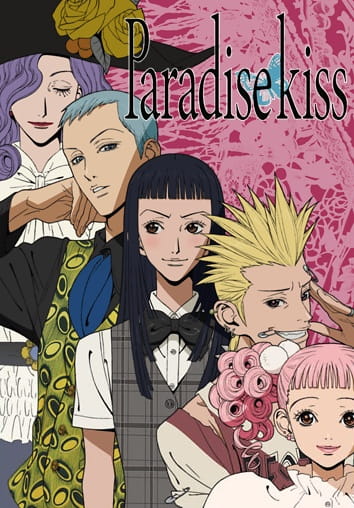
The 8.5 on animation is not generic praise for a respected studio. It is specifically about how Osamu Kobayashi directs this material. The character designs preserve Yazawa's elongated, fashion-illustration line. Live-action photography backdrops are integrated into the frame. Motion graphics and stark color blocking mimic the editorial logic of the Zipper magazine the manga originally serialized in. The ED, "Lonely in Gorgeous," is one of the more confidently designed sequences of its year.
This matters for the verdict because the visual identity is not separable from the show's thesis. Paradise Kiss is about fashion as labor and self-construction, and the direction treats fabric, drape, and runway choreography as worth animating with tactile attention. Take that away — give the same script to a workhorse production — and the show loses a full point. The animation is the argument, not the wrapping. This is the inverse of the situation Welcome to the NHK finds itself in, where Gonzo's production caps a brilliant script at "cult classic." Madhouse and Kobayashi do for ParaKiss what Gonzo could not do for NHK.
Where the Show Actually Loses Points
Story scores 8.0, not higher, and the reason is structural compression. The 12-episode count is tight for a coming-of-age arc, and the show pays for it on the periphery. Arashi and Miwako's relationship is treated as background texture rather than developed material. Isabella's interiority is sketched rather than written. The central pair gets the runway they need; the ensemble gets less.
World-building at 7.5 is honest accounting. The Yazawa Art Academy and the Atelier itself are richly observed — the precarity of an independent label, the texture of fashion-school subculture, the Harajuku aesthetic rendered with specificity rather than shorthand. But this is a small, realistic setting. The rubric weighs world-building partly on scope, and ParaKiss has none. That is not a flaw; it is a ceiling.
Cultural impact at 7.0 is the lowest score on the card and the correct one. ParaKiss helped popularize Harajuku fashion abroad and gave Western josei readers a touchstone before NANA arrived. Its handling of Isabella as a trans woman was unusually dignified for 2005 television. But its footprint is smaller than NANA's by an order of magnitude, and the rubric reflects that.
The Strongest Case Against
The honest counter-argument is that Paradise Kiss is short, emotionally narrow, and structurally lopsided. Twelve episodes do not give the supporting cast room to breathe, the fashion-industry backdrop is a niche the viewer either cares about or doesn't, and the central romance — by design — does not deliver catharsis. A viewer who wants a satisfying love story should watch something else. A viewer who wants ensemble josei should watch Honey and Clover, which the Codex rates higher precisely because its ensemble is its spine.
The rubric reads the show differently because what Paradise Kiss is trying to do — dismantle a romance honestly, in twelve episodes, with editorial-magazine visual confidence — it does as well as any josei of its era.
Verdict
Paradise Kiss is worth the four hours if you want a romance the show is willing to take apart, rendered by a director who treats fashion as worth animating. The 8.15 is carried by character and animation, taxed by compression and a small cultural footprint, and the 7.88 consensus undercounts the first two. Watch it for Yukari and Kobayashi; skip it if you needed George to be the answer.
Featured in the Codex



More from The Codex
The Seven Deadly Sins Is a 6.60 Wearing a 7.60 Costume: A One-Point Gap Earned by Groping Gags and Convenient Flashbacks
The Seven Deadly Sins scores 6.60 on the Codex against MyAnimeList's 7.60 because the crowd is grading a Netflix breakout and a Ban-and-King friendship, not the 24 episodes A-1 Pictures actually broadcast in 2014.
The 10.0 That Built a Sunday: How Sazae-san's Cultural Score Carries a 6.58 Scorecard
Sazae-san is a case study in how a single criterion — cultural — can define how a show is remembered, and the 10.0 the Codex hands Eiken's 1969 institution is doing every bit of the heavy lifting its other five scores refuse to.
The Sebastian Problem: Why Black Butler Sits 1.10 Below Its MAL Line and the Crowd Refuses to Notice
Black Butler (Kuroshitsuji) posts a 1.10-point gap between MyAnimeList's 7.65 and the Codex 6.55 because the crowd is grading Sebastian's silhouette and a Phantomhive aesthetic, not the anime-original finale A-1 Pictures actually shipped in 2009.
Discussion
Set a display name above to post.
Loading discussion…