Anime Like One Piece: 5 the Codex Rubric Says You'll Love
Fans of One Piece respond to its strongest criteria — world-building, character, cultural weight — and these five picks deliver the same qualities, ranked by how close their critical profile sits to it.
Fans of One Piece respond to its strongest criteria — world-building, character, cultural weight — and these five picks deliver the same qualities, ranked by how close their critical profile sits to it.
The reason One Piece works isn't the rubber arms or the pirate hats. It's that Eiichiro Oda built a world dense enough to reward twenty-five years of attention, populated it with a crew whose loyalty you can trace to specific childhood traumas, and gave the whole thing political stakes — the Ohara genocide, Fisher Tiger's Sun Pirates — that most Jump titles wouldn't touch. Anime Codex scores it 8.58, with a 9.5 on world-building, a 9.0 on character, an 8.7 on themes, and a perfect 10.0 on cultural impact. The 6.5 Toei has put on screen across more than a thousand episodes is the only thing keeping it out of the 9s.
What the consensus gets wrong about anime like One Piece
The standard "if you like One Piece" list is a vibes exercise. It hands you Fairy Tail because there's a guild, Black Clover because there's shouting, Bleach because the protagonist has a sword. MyAnimeList's 8.73 on One Piece is real, and so is the audience it represents, but the recommendation discourse downstream of it treats genre tags as a substitute for criterion analysis. Pirates plus found family plus power system does not equal Oda. What equals Oda — partially, in different ratios — is a specific combination of long-form world-building, ensemble character work earned through backstory, and thematic ambition that survives the runtime.
This is the part the rubric clarifies. Fans of One Piece respond to its strongest criteria; these picks deliver the same qualities, ranked by how close their critical profile sits to it — not by vibes. That means the order below is not the order of which show is the most fun. It's the order of which show's Codex profile most resembles One Piece's. The same logic drives our Naruto and My Hero Academia recommendation lists, and it produces orderings the recommendation algorithms can't.
The closest critical profile in shonen: Hunter × Hunter (2011)
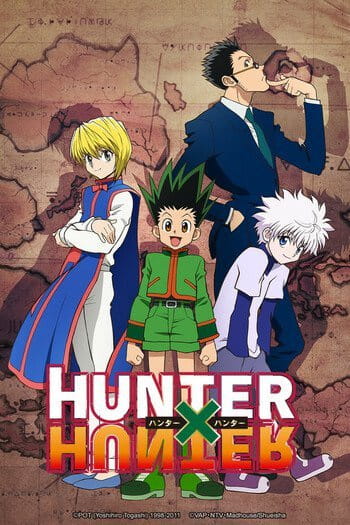
Start with the obvious answer, because the obvious answer is correct. Hunter × Hunter (2011) sits at a Codex 9.23 — the highest score on this list by a wide margin — and the criterion breakdown is the closest match One Piece has in the medium. Madhouse's 148-episode adaptation pulls a 9.5 on story, a 9.5 on character, a 9.5 on world-building, and a 9.0 on themes. Those are the exact axes that carry One Piece, hit harder.
What Togashi shares with Oda is a willingness to let arcs reshape the show's center of gravity. Chimera Ant is a structural inversion of every shonen instinct, and it works the same way Marineford works in One Piece — by spending years of accumulated character investment in a single sustained emotional payload. Madhouse's MAL 9.03 is not an accident; it's what happens when world-building this elastic meets a studio willing to keep up. If you want the One Piece feeling at a higher technical floor, this is the answer. The catalogue agrees enough that we made a separate recommendations post just for HxH fans.
Toei doing Toei: Dragon Quest: The Adventure of Dai
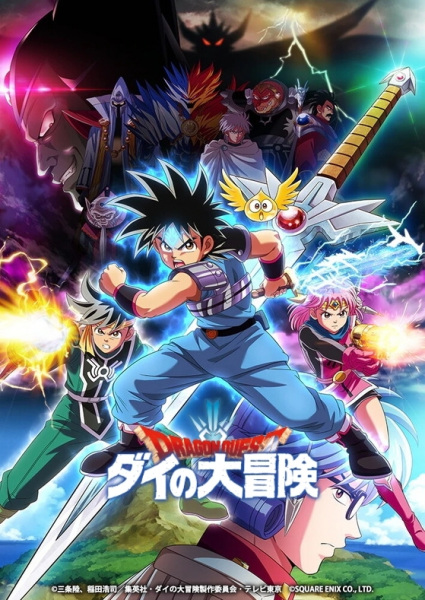
Dragon Quest: The Adventure of Dai at Codex 7.40 is the most interesting pick on this list precisely because it's the same studio. Toei Animation's 2020 reboot, 100 episodes, MAL 7.73 — and the criterion shape rhymes with One Piece in a way that few other shonen do. An 8.0 on character, a 7.5 on story, a 7.3 on themes. The world (6.8) is the JRPG framing, which doesn't scale to Grand Line ambition, but the party-as-found-family dynamic is purer here than almost anywhere else in the genre.
Dai himself is a Luffy-shaped protagonist: static in conviction, gravitational by design, the kind of hero whose certainty about what's right pulls the rest of the cast into orbit. Toei's production discipline on this reboot is also tighter than what they typically bring to the One Piece weekly grind — fewer reaction-shot extensions, cleaner battle choreography. If you've ever wanted to know what One Piece looks like when Toei isn't trying to stretch a chapter into three episodes, this is the closest experiment available.
The guild as crew: Fairy Tail
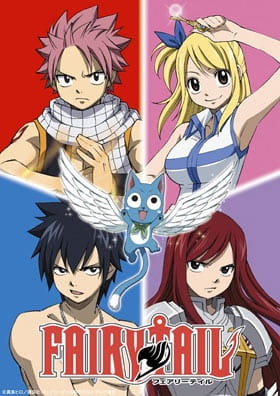
Fairy Tail at Codex 6.25 is the lowest score on this list, and the placement is honest. Satelight's 175-episode run lands a MAL 7.57 and a 6.0 on story from the rubric. Hiro Mashima is not Oda — the long-game plotting that makes Alabasta's foreshadowing land in Dressrosa simply isn't there in Magnolia. What is there, and what earns Fairy Tail its place here over technically stronger shows, is the guild structure.
Natsu, Erza, Gray, Lucy — the unit functions on the same operating principle as the Straw Hats. Loyalty is the load-bearing emotional beam, dreams are the growth engine, and the recurring image of someone refusing to abandon a crewmate carries the same charge as Luffy stretching his arm out to Nami in Arlong Park. The world is thinner, the political stakes are softer, the animation is workmanlike. But if what you love about One Piece is the crew-as-family register specifically, Fairy Tail delivers that frequency at sustained volume.
The world-building pick: Magi: The Labyrinth of Magic
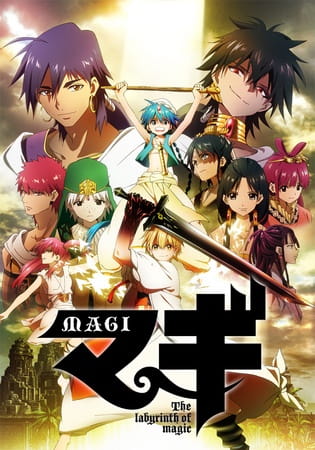
Magi: The Labyrinth of Magic is on this list for one number: the 8.5 on world-building. The Codex puts the 25-episode A-1 Pictures production at 7.40 overall, MAL 8.01, with a 7.5 on story, a 7.0 on character, a 7.5 on themes, and a 7.0 on animation. Those middle numbers are fine. The world score is the reason it's here.
Shinobu Ohtaka's setting — dungeons as geopolitical objects, Djinn as economic weapons, a Silk Road–coded map where every kingdom has trade logic — is the closest any shonen has come to the Grand Line's combination of expansive scale and internal consistency. Sinbad's voyages function as a structural echo of Luffy's, with the politics foregrounded rather than buried. If One Piece's 9.5 on world-building is the criterion you'd point to first, Magi is where you go to scratch the same itch in a quarter of the runtime.
The thematic cousin: The Seven Deadly Sins
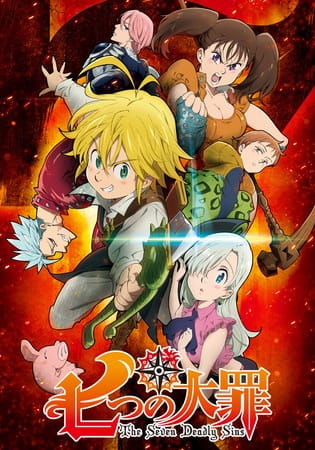
The Seven Deadly Sins at Codex 6.60 closes the list. A-1 Pictures' first season, 24 episodes, MAL 7.60, with the rubric reading 6.8 on story, 6.5 on character, 6.0 on themes, 6.3 on world, 7.2 on animation, and 7.0 on cultural. That animation number is the highest on this list outside Hunter × Hunter, and A-1's color work in the early Liones arcs is genuinely lush.
What Nanatsu no Taizai shares with One Piece is the wandering-band-of-outcasts shape — a crew of named, reputation-loaded figures gathered around a deceptively simple protagonist, moving through a continent's worth of political grievance. Meliodas is not Luffy, and the show's later seasons have animation problems we are not adjudicating here. But the first cour's combination of party-assembly structure and kingdom-scale stakes is the closest tonal cousin to East Blue this list contains.
The case against ranking by criterion overlap
The honest objection: a 6.25 ranks above plenty of shows people would pick first. Black Clover, Toriko, Radiant — each of those gets recommended into the One Piece conversation constantly, and a vibes-based ordering would surface them ahead of Fairy Tail. The steelman is that genre adjacency captures something the criterion math misses, that the felt experience of watching shonen is not reducible to six numbers.
The rubric reads it differently because the rubric is asking a narrower question: which shows share the specific critical strengths that make One Piece work? A 9.0 character score and a 9.5 world-building score are not generic shonen virtues — they are the load-bearing pillars of this particular show. Recommendations that ignore them are recommending the demographic, not the title.
Hunter × Hunter (2011) at 9.23 is the strongest match One Piece has in the medium. Adventure of Dai is the Toei sibling. Magi is the world-building proxy. Fairy Tail is the crew-bond proxy. Seven Deadly Sins is the wandering-party proxy. None of them are One Piece; nothing is. But each of them isolates one of the criteria that gets One Piece to 8.58, and that's the only honest way to build this list.
Featured in the Codex

More from The Codex
The Seven Deadly Sins Is a 6.60 Wearing a 7.60 Costume: A One-Point Gap Earned by Groping Gags and Convenient Flashbacks
The Seven Deadly Sins scores 6.60 on the Codex against MyAnimeList's 7.60 because the crowd is grading a Netflix breakout and a Ban-and-King friendship, not the 24 episodes A-1 Pictures actually broadcast in 2014.
The 10.0 That Built a Sunday: How Sazae-san's Cultural Score Carries a 6.58 Scorecard
Sazae-san is a case study in how a single criterion — cultural — can define how a show is remembered, and the 10.0 the Codex hands Eiken's 1969 institution is doing every bit of the heavy lifting its other five scores refuse to.
The Sebastian Problem: Why Black Butler Sits 1.10 Below Its MAL Line and the Crowd Refuses to Notice
Black Butler (Kuroshitsuji) posts a 1.10-point gap between MyAnimeList's 7.65 and the Codex 6.55 because the crowd is grading Sebastian's silhouette and a Phantomhive aesthetic, not the anime-original finale A-1 Pictures actually shipped in 2009.
Discussion
Set a display name above to post.
Loading discussion…