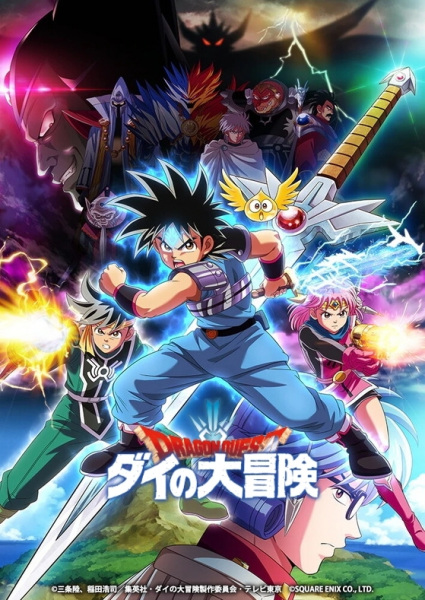
Dragon Quest: The Adventure of Dai
Is Dragon Quest: The Adventure of Dai worth watching?
Worth a look. Anime Codex rates Dragon Quest: The Adventure of Dai 7.40 out of 10 — scored on six criteria (story, characters, themes, world-building, animation, and cultural impact), not crowd votes. 98th of 226 on the Codex rubric — top 43% of the catalogue. The crowd rates it 0.33 higher than the rubric does — the Codex is harder on it than on 36% of the catalogue.
Where to watch
Trailer
What the data says
Computed from the Codex rubric across the whole catalogue.
Summary
The 2020 Adventure of Dai is the definitive adaptation of a foundational Jump fantasy manga, and its chief achievement is completion: 100 episodes that finally tell the entire story with confident pacing and clean Toei production. Its standout strength is character writing — Popp's evolution from coward to the heart of the series, and the redemption arcs of Hyunckel, Crocodine, and the tragic father-figure Baran, give the show emotional substance beyond standard shonen fare. The remake honors Dragon Quest's iconic spells and design language while modernizing the visuals. Its weaknesses are those of its era's template: the central good-versus-evil structure offers little thematic ambiguity, the midgame settles into a predictable general-of-the-week rhythm, and the world-building, while charming, is bounded by its video-game origins rather than building something wholly original. Direction is polished but rarely bold. Judged against the best shonen of its kind, Dai is a high-quality, sincere, well-constructed classic-style adventure that excels in character payoffs but stops short of genre-redefining innovation. It is a near-essential watch for fans of traditional fantasy shonen and an excellent gateway for those curious about the franchise's roots.
Criterion breakdown
Story & narrative
The 2020 remake's greatest narrative strength is its pacing — by adapting the full manga in 100 episodes, it avoids the 1991 anime's premature cutoff and delivers complete arcs like the Hadlar resurrection, the Six Generals, and the climactic Vearn's Palace assault. The structure is classic escalating-threat shonen with little subversion, and the early island arc moves briskly, but the middle stretch (the Great Demon King's Army campaign) occasionally falls into a repetitive miniboss-of-the-week cadence. Standout plotting comes in reversals like Hadlar's evolution from disgraced villain to honorable rival and the Kill arc twists.
Character writing & growth
Dai's growth from naive island boy to self-doubting hero is solid if conventional, but the supporting cast is where the writing excels: Popp's arc from cowardly mage who flees battle to the series' true emotional anchor is one of the best-executed coward-to-brave transformations in shonen. Hyunckel and Crocodine's redemption arcs from enemy generals to loyal allies are earned rather than rushed, and even antagonists like Hadlar and Baran (Dai's father) receive genuine motivation and dignified ends.
Themes & emotional resonance
The show earns real resonance through Popp's repeated theme that courage is acting despite fear, dramatized in his decision to face Baran. Baran's tragedy — a father whose love curdles into genocidal grief — gives the midgame surprising weight. However, the core themes of heroism, friendship, and self-sacrifice are delivered earnestly but without much nuance or ambiguity, staying firmly within comfortable shonen moral territory.
World-building & power system
The setting faithfully translates Dragon Quest's iconic spells (Megante, Giga Break, the Avan Strash) and bestiary into a coherent battle framework, and the magic-vs-physical-vs-spirit-energy distinctions stay internally consistent. The world is charming and nostalgic for DQ fans but is fundamentally a video-game-derived fantasy with limited original geography or political depth. The 'true magic' and Dai's Dragon Knight heritage add some uniqueness, though the power system rarely surprises strategically.
Animation & direction
Toei delivers clean, consistently high production over 100 episodes with strong key fights — the Hyunckel duels and the Baran confrontation feature fluid choreography and impactful spell effects. The modernized character designs and vivid color work serve the material well. However, the direction is competent rather than distinctive, with conventional shot composition and some reliance on CGI for larger-scale magic that doesn't always blend seamlessly.
Cultural impact
As an adaptation of a beloved 1989 manga tied to one of Japan's most important RPG franchises, Dai carries significant nostalgic weight, and the 2020 remake successfully introduced the property to a new generation alongside a tie-in game. Its influence on the broader shonen landscape is modest, however, as it arrived decades after the originals it inspired and never reached the global ubiquity of its Jump contemporaries.
Synopsis (from MAL)
A long time ago, there was a valiant swordsman who came to be known simply as "the hero." There was a demon who has caused people suffering. The hero and his companions arrived to challenge the demon to a battle and by combining their powers, the battle was brought swift conclusion. With no one around to cause trouble, the island became a quiet place where everyone could live together in peace. Several years later, the demon is revived. Our present-day protagonist, Dai, lives on a remote island in the southern seas and dreams of becoming a great hero. When he hears about the demon's revival, Dai and his friends take it upon themselves to stop him and the evil force that revived him. Along the way, Dai discovers the identity of "the hero," the truth behind the evil force who revived the demon, and Dai's own hidden powers that surface in times of peril. (Source: MU, edited)
Ranked nearby

Explore rankings
Discussion
Set a display name above to post.
Loading discussion…