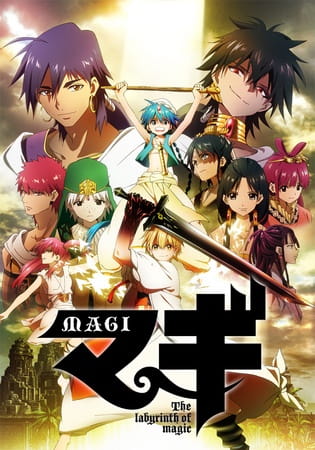
Magi: The Labyrinth of Magic
Is Magi: The Labyrinth of Magic worth watching?
Worth a look. Anime Codex rates Magi: The Labyrinth of Magic 7.40 out of 10 — scored on six criteria (story, characters, themes, world-building, animation, and cultural impact), not crowd votes. 99th of 226 on the Codex rubric — top 44% of the catalogue. The crowd rates it 0.61 higher than the rubric does — the Codex is harder on it than on 54% of the catalogue.
Where to watch
Trailer
What the data says
Computed from the Codex rubric across the whole catalogue.
Summary
Magi: The Labyrinth of Magic stands out among shonen for trading the usual school or warrior setting for a richly realized Arabian Nights world, anchored by an original metaphysical system of Magi, king-candidates, and djinn-granting dungeons. Its strongest asset is thematic ambition: the Balbadd arc tackles slavery, sovereign debt, and class revolt with genuine tragedy, and Alibaba's strained friendship with Cassim gives the season real emotional and moral weight rare for its magazine. The worldbuilding is among the best of its demographic, suggesting a vast geopolitical canvas. Its weaknesses are structural. As a 25-episode first season it functions partly as setup, and the momentum built in Balbadd dissipates in the later Sindria and Zagan material. Aladdin's deliberate mystery limits his growth, the large supporting cast serves the setting more than character development, and A-1's animation, while colorful, is inconsistent with occasional budget-saving. Action is solid but not genre-defining. Overall it is a strong, intelligent shonen adventure that punches above its category in concept and theme while falling short of the polish and self-contained payoff of the very best, leaving its fullest ambitions for later installments to realize.
Criterion breakdown
Story & narrative
The first season's structure—dungeon-capturing leading into the Balbadd political arc—shows real ambition, pivoting from adventure-of-the-week to a story about slavery, debt, and the Fog Troupe insurgency. The Balbadd arc with Cassim is the narrative high point, grounding fantasy in genuine class tragedy. However, the pacing stumbles in the back half as it shifts toward the Sindria/Zagan dungeon material, feeling like setup for a sequel rather than a self-contained payoff.
Character writing & growth
Alibaba carries the strongest arc—his cowardice, royal guilt, and the friendship-turned-conflict with Cassim give him a credible emotional core that pays off in Balbadd. Aladdin is appealing but kept deliberately mysterious, which limits his growth within these 25 episodes, and Morgiana's slave-to-free-agent journey is solid if underdeveloped. The supporting cast (Sinbad, the Eight Generals) is colorful but largely functions as worldbuilding texture rather than characters with internal change.
Themes & emotional resonance
The show engages seriously with slavery, colonial exploitation, and the corrupting weight of kingship—rare thematic ambition for a Shonen Sunday title. Cassim's resentment and the Balbadd debt crisis give the 'what makes a worthy king' question real teeth rather than treating it as a slogan. The resonance occasionally dilutes when the show retreats to lighter adventure beats, but the central tension between idealism and systemic injustice lands.
World-building & power system
The Magi/King-candidate/Djinn framework is genuinely distinctive: a metaphysical political ecosystem where magicians elect kings and dungeons grant power, layered over an Arabian Nights aesthetic that few shonen draw from. The Rukh, the concept of 'falling into depravity,' and household vessels create internal consistency and intriguing scope. It's one of the strongest worldbuilding premises in its demographic, even if the show only begins to exploit its full geopolitical canvas.
Animation & direction
A-1 Pictures delivers vibrant color design and strong djinn-equip transformations, and the Amon flame effects in Alibaba's fights are a visual highlight. Direction handles the Balbadd emotional climax with appropriate weight. However, animation quality is inconsistent—some dungeon sequences and crowd scenes show noticeable budget conservation, and the action choreography is competent rather than exceptional by genre standards.
Cultural impact
Magi was a notable hit that boosted Shogakukan's profile and earned a second season plus a spin-off (Sinbad no Bouken), with strong international streaming popularity. Its Arabian Nights reimagining gave it a recognizable identity in a market saturated with Japanese/Western fantasy settings. It never reached the cultural footprint of the era's top-tier shonen, however, and its presence has faded somewhat over time.
Synopsis (from MAL)
A Magi is a magician whose inclination toward magic is so immense that they can be said to shape the world. With their significant influence, each Magi chooses a worthy candidate to become a king, then helps them conquer strange labyrinths called "Dungeons" and acquire the power of mythical djinns within. Above all else, the Magi supervises their elected representative as they build a country that might one day bring the world to its knees. Aladdin is a young Magi wandering the world in search of his true self. However, his journey is not a lonely one, as he is accompanied by his friend and mentor Ugo—a djinn he summons using his flute. In his travels, Aladdin also befriends Alibaba Saluja and guides him to a nearby Dungeon. With this newfound friendship, they begin an epic adventure across the world, witnessing various irregularities that seem more frequent than ever. [Written by MAL Rewrite]
Ranked nearby




Explore rankings
Discussion
Set a display name above to post.
Loading discussion…