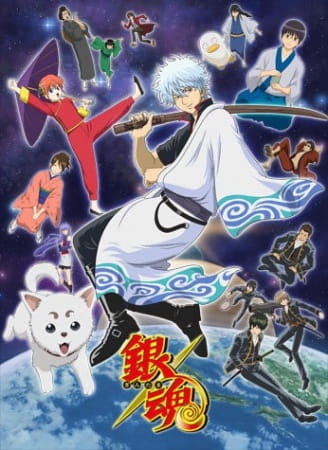
Gintama
Is Gintama worth watching?
Yes — a standout. Anime Codex rates Gintama 8.51 out of 10 — scored on six criteria (story, characters, themes, world-building, animation, and cultural impact), not crowd votes. 21st of 226 on the Codex rubric — top 9% of the catalogue. The crowd rates it 0.42 higher than the rubric does — the Codex is harder on it than on 42% of the catalogue.
Where to watch
What the data says
Computed from the Codex rubric across the whole catalogue.
Summary
Gintama is one of shonen comedy's most ambitious and rewarding works, built on a genre-bending premise—samurai surviving in an alien-occupied Edo—that lets it pivot from meta-comedy and crude parody to genuinely affecting drama. Its greatest strength is character: Gintoki and the sprawling supporting cast, from the Shinsengumi to the Joui rebels, are written with patience so that arcs like Benizakura, Yoshiwara in Flames, and the Shogun Assassination deliver emotional payoffs earned over hundreds of episodes. The tonal range is its signature trick, weaponizing established gags for sincere weight. Its weaknesses are real, however: the early episodes are uneven and slow to establish stakes, the animation is a budget-conscious workhorse outside of its standout arcs, and the relentless tonal whiplash occasionally undercuts its own dramatic gravity. Its humor's dependence on dense Japanese and anime-industry references also limits accessibility. Judged against the best of shonen, Gintama is not the most polished production, but its combination of comedic invention, surprising emotional depth, and extraordinary cast cohesion places it among the demographic's elite. It rewards commitment more than almost any series of its kind, demanding patience that ultimately repays itself many times over.
Criterion breakdown
Story & narrative
Gintama's structure is its boldest gamble: it oscillates between absurd self-aware gag episodes (the recurring 'we'll get cancelled' meta-jokes, the Owee/parody arcs) and devastatingly serious multi-episode arcs like Benizakura, Yoshiwara in Flames, and the Shogun Assassination/Farewell Shinsengumi arcs. The payoff is enormous when the comedic foundation is suddenly weaponized for emotional stakes, but the early episodes are uneven and the show takes a long time before its serialized plotting (the Joui war backstory, the Amanto power struggle) gains real momentum. The slow-burn reward structure means newcomers face a genuinely flabby first stretch.
Character writing & growth
The cast is the show's crown jewel: Gintoki's lazy-deadbeat exterior concealing the trauma of the Joui war is revealed with remarkable patience, and side characters like Katsura, Takasugi, Hijikata, Okita, and the Shinsengumi receive arcs that would carry lesser series alone. Kagura and Shinpachi grow from comic relief into genuinely capable members whose loyalty is earned, not assumed. The genius is that nearly every recurring joke character (even Sa-chan, Hasegawa/Madao, Kyubei) eventually gets a moment of real dimensionality.
Themes & emotional resonance
Beneath the toilet humor lies a sincere meditation on holding onto one's principles ('bushido') in a world that has rendered them obsolete, embodied in samurai stripped of swords under alien occupation. The Yoshiwara and Shinsengumi arcs land genuine emotional weight on found family, regret, and dying with your convictions intact. It loses a fraction because the tonal whiplash occasionally undercuts its own gravity, and the thematic depth is inconsistent across the gag-heavy filler.
World-building & power system
The alt-history premise—Edo-period Japan colonized by aliens, samurai banned, sci-fi tech grafted onto a feudal aesthetic—is original and internally consistent, supporting both parody and serious geopolitical intrigue around the shogunate and Joui rebels. The setting is more backdrop than rigorously explored system, and much worldbuilding (the Amanto hierarchy, the broader galaxy) stays vague until late arcs, prioritizing character over lore. Still, it's a far more imaginative sandbox than most comedy shonen bother to build.
Animation & direction
Sunrise's 2006 production is functional and expressive for comedy—exaggerated facial reactions and snappy timing serve the gags well—but baseline episode animation is modest and clearly budget-conscious across 201 episodes. The serious arcs (Benizakura film-tier sequences, the Shogun Assassination fights) show marked improvement in choreography and direction, proving the staff could elevate when it mattered. Overall it's a workhorse production rather than a visual showcase.
Cultural impact
Gintama achieved cult-classic status and remained a Jump fixture for over a decade, beloved for its dense, often untranslatable Japanese pop-culture and anime-industry parody that made it a touchstone for hardcore fans. Its consistently elite MAL rankings and devoted fanbase reflect rare longevity, though its impenetrable density and reliance on referential humor limited its mainstream Western crossover compared to its shonen peers.
Synopsis (from MAL)
Edo is a city that was home to the vigor and ambition of samurai across the country. However, following feudal Japan's surrender to powerful aliens known as the "Amanto," those aspirations now seem unachievable. With the once-influential shogunate rebuilt as a puppet government, a new law is passed that promptly prohibits all swords in public. Enter Gintoki Sakata, an eccentric silver-haired man who always carries around a wooden sword and maintains his stature as a samurai despite the ban. As the founder of Yorozuya, a small business for odd jobs, Gintoki often embarks on endeavors to help other people—though usually in rather strange and unforeseen ways. Assisted by Shinpachi Shimura, a boy with glasses supposedly learning the way of the samurai; Kagura, a tomboyish girl with superhuman strength and an endless appetite; and Sadaharu, their giant pet dog who loves biting on people's heads, the Yorozuya encounter anything from alien royalty to scuffles with local gangs in the ever-changing world of Edo. [Written by MAL Rewrite]
Ranked nearby
Explore rankings
Discussion
Set a display name above to post.
Loading discussion…