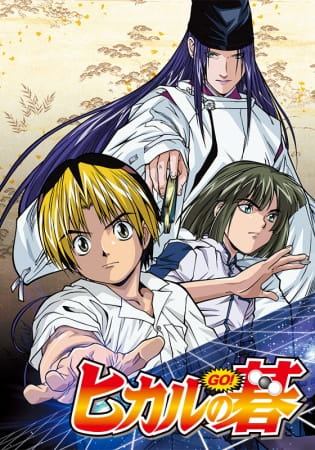
Hikaru no Go
Is Hikaru no Go worth watching?
Yes — a standout. Anime Codex rates Hikaru no Go 8.65 out of 10 — scored on six criteria (story, characters, themes, world-building, animation, and cultural impact), not crowd votes. 17th of 226 on the Codex rubric — top 8% of the catalogue. The Codex rates it Δ +0.57 above its MAL score — more underrated than 99% of the catalogue.
Where to watch
What the data says
Computed from the Codex rubric across the whole catalogue.
Summary
Hikaru no Go stands as one of shonen's finest non-action achievements, proving that a board game can carry stakes as gripping as any tournament battle. Its genius lies in the Sai relationship — a Heian-era ghost channeling his passion through a reluctant boy — which transforms a competitive sports framework into a moving study of legacy, mentorship, and finding one's own voice. The Hikaru-Akira rivalry is among the genre's best, sustained by psychology rather than spectacle, and Sai's fading is a genuinely devastating narrative pivot rarely matched in mainstream Jump fare. The show's authenticity about professional go culture lends it real texture, and its measurable impact on the game's popularity is almost unique in anime. Its weaknesses are real: the post-Sai arcs struggle to recover the emotional gravity of his presence, the anime's later stretch feels incomplete owing to the source's pacing, and Pierrot's animation is serviceable rather than striking, leaning on framing, sound, and silence to generate drama. It also asks patience of newcomers, refusing to dumb down the game. Yet within its demographic, it remains a benchmark for how to make an intellectual, low-spectacle premise emotionally essential — definitive proof that shonen excellence need not involve a single punch.
Criterion breakdown
Story & narrative
The narrative transforms an esoteric board game into genuine tension, with the Sai arc building toward the devastating turning point of the 'Sai vs. Toya Koyo' internet game and Sai's eventual fading — one of shonen's most affecting structural pivots. The post-Sai pro exam and pro-debut arcs risk losing momentum without their emotional anchor, and the manga's abrupt ending leaves the anime's later stretch (the Hokuto Cup / Korea material) feeling less resolved than the Sai years. Still, the long-game payoff of Hikaru searching for Sai within his own play is masterfully seeded.
Character writing & growth
Hikaru's growth from a bored kid mouthing Sai's moves to a player with his own go is charted with remarkable patience, and his rivalry with Akira Touya — built on a single mistaken-identity match — sustains the entire series with real psychological stakes. Sai's arc from joyful obsession to quiet despair at being unable to play directly is heartbreaking, and supporting figures like Waya, Isumi, and Ogata feel like distinct competitors rather than filler. Even Hikaru's grief-driven withdrawal after Sai's disappearance is handled with unusual maturity for the demographic.
Themes & emotional resonance
The show's central metaphor — that Sai lives on through Hikaru's go, and that the pursuit of the 'Divine Move' transcends a single lifetime — gives it an unexpectedly poignant meditation on mentorship, legacy, and continuity across generations. The Heian-era framing and the bond between teacher and vessel resonate far beyond the game. It occasionally states its themes more plainly in the later arcs, slightly dulling the subtlety achieved during Sai's presence.
World-building & power system
As a show with no power system, it builds an internally consistent and authentic depiction of the professional go world — insei classes, pro exams, the Oteai league, and the etiquette of formal matches — that feels researched rather than invented. The Heian-spirit premise is genuinely original, grounding a sports/competition framework in supernatural pathos. It demands patience from viewers unfamiliar with go, and rarely simplifies for accessibility, which is both a strength and a barrier.
Animation & direction
Pierrot's production is functional and clean rather than spectacular, relying on close-ups of faces, stone placements, and reaction shots to generate tension since the 'action' is two people sitting at a board. The direction earns its drama through framing and pacing — the slow zooms and silence during pivotal moves like the Sai-Toya match — but character animation is modest and some later episodes show visible budget constraints. The evocative soundtrack and the famous OP/ED do more heavy lifting than the visuals.
Cultural impact
The series triggered a documented surge in go's popularity among Japanese youth, boosting enrollment in go schools and is widely credited with introducing a generation to the game. Its influence extended internationally and it remains the definitive example of an anime making a traditional intellectual pursuit broadly compelling. Few shonen titles can claim such a measurable real-world effect on their subject matter.
Synopsis (from MAL)
While searching through his grandfather's attic, Hikaru Shindou stumbles upon an old go board. Touching it, he is greeted by a mysterious voice, and soon after falls unconscious. When he regains his senses, he discovers that the voice is still present and belongs to Fujiwara no Sai, the spirit of an ancient go expert. A go instructor for the Japanese Emperor in the Heian Era, Sai's passion for the game transcends time and space, allowing him to continue playing his beloved game as a ghostly entity. Sai's ultimate goal is to master a divine go technique that no player has achieved so far, and he seeks to accomplish this by playing the board game through Hikaru. Despite having no interest in board games, Hikaru reluctantly agrees to play, executing moves as instructed by Sai. However, when he encounters the young go prodigy Akira Touya, a passion for the game is slowly ignited within him. Inspired by his newfound rival, Hikaru's journey into the world of go is just beginning. [Written by MAL Rewrite]
Ranked nearby
Explore rankings
Discussion
Set a display name above to post.
Loading discussion…