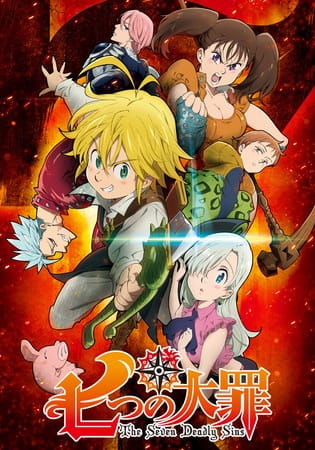
The Seven Deadly Sins
Is The Seven Deadly Sins worth watching?
Worth a look. Anime Codex rates The Seven Deadly Sins 6.60 out of 10 — scored on six criteria (story, characters, themes, world-building, animation, and cultural impact), not crowd votes. 169th of 226 on the Codex rubric — bottom 26% of the catalogue. The crowd rates it 1.00 higher than the rubric does — the Codex is harder on it than on 73% of the catalogue.
Where to watch
Trailer
What the data says
Computed from the Codex rubric across the whole catalogue.
Summary
The Seven Deadly Sins' 2014 debut season is a well-paced, accessible shonen fantasy whose chief strength is its outcast ensemble. The episodic recruitment of each Sin—Ban, King, Diane, and Gowther—lets their tragic backstories and distinctive abilities (Snatch, Chastiefol, Full Counter) carry the show, with Ban and King's history over Elaine providing its most genuinely affecting material. A-1 Pictures' clean, colorful animation and the brisk Vaizel festival and Kingdom-infiltration arcs make it a smooth, entertaining watch. Its weaknesses are real, however. Meliodas's persistent groping of Elizabeth undercuts both his charm and her agency, reducing the narrative's nominal lead to a passive victim. The plotting relies on convenient flashbacks and the repeated reveal that the heroes are secretly overpowered, which saps tension, while the justice-versus-tyranny themes stay morally tidy and are frequently deflated by mistimed comedy. The power system is creative in its abilities but loose in its rules. Judged against the best of its demographic, it sits comfortably in the upper-middle tier: a polished, popular crowd-pleaser with strong character chemistry and a likable cast, held back from genre excellence by tonal misjudgments, low-stakes pacing, and conventional thematic depth. Its Netflix-driven global reach gives it notable commercial footprint.
Criterion breakdown
Story & narrative
The first season's structure—Elizabeth recruiting each Sin one by one (Diane, Ban, King, Gowther) while uncovering the Holy Knights' coup—gives the 24 episodes a clean quest momentum, and the Vaizel Fighting Festival arc effectively escalates stakes by introducing Hendrickson and the Demon-blood threat. However, the plotting leans heavily on convenient flashback reveals and the recurring 'a Sin is secretly far stronger than shown' twist (Meliodas's true power, Ban's immortality), which drains tension since the heroes are rarely in credible danger. The Kingdom infiltration climax with Helbram and the resurrection plot is satisfying but tips toward standard shonen tournament-and-invasion beats.
Character writing & growth
The ensemble is the show's strongest asset: Ban and King's tragic history over Elaine, King's guilt-ridden arc, and Gowther's emotionless oddity add texture beyond archetypes. Meliodas, though, is a tonal liability—his charm and capability are undercut by relentless groping gags that flatten Elizabeth into a perpetual victim of harassment rather than a developed lead, stunting her agency despite her being the narrative engine. Diane's one-note crush on Meliodas and Elizabeth's passivity mean the genuine growth is concentrated in the male Sins rather than distributed.
Themes & emotional resonance
The show gestures at justice versus tyranny, found-family among outcast 'sinners,' and atonement—Ban and King embody the redemption-through-loyalty thread most convincingly. But these themes stay surface-level; the 'unjust world' framing rarely complicates its clean good-Sins/bad-Knights morality, and the emotional resonance is repeatedly punctured by ill-timed comedy. The Elaine flashback and King's self-forgiveness are the rare moments that land with real weight.
World-building & power system
The pseudo-Arthurian Britannia setting with Holy Knights, magic, and the looming Demon Clan offers a serviceable fantasy backdrop, and the 'power level' (combat class) numbering plus distinct ability types—Ban's Snatch, King's Chastiefol spirit spear, Meliodas's Full Counter, Diane's Creation magic—give fights individuality. The system lacks rigorous internal rules, however; power levels feel arbitrary and Full Counter borders on plot-convenient invincibility. The premise is familiar medieval-fantasy fare elevated mainly by character ability creativity rather than setting originality.
Animation & direction
A-1 Pictures delivers consistently bright, clean character animation with fluid combat highlights—the Meliodas vs. Guila and Vaizel festival bouts move with energy, and the color palette keeps the fantasy world vivid. Direction is competent and brisk but rarely ambitious; fights favor flashy impact frames over choreographic depth, and quieter scenes are staged conventionally. It's polished and reliable rather than visually distinctive among the genre's best.
Cultural impact
The series was a sizable commercial hit—the manga among Kodansha's best-sellers and the Netflix global distribution making it one of the platform's early breakout anime, expanding the franchise into multiple sequel seasons and a film. Its 2.2 million MAL members reflect broad mainstream reach. It did not, however, redefine the genre or leave a lasting craft influence the way landmark shonen do.
Synopsis (from MAL)
In a world similar to the European Middle Ages, the feared yet revered Holy Knights of Britannia use immensely powerful magic to protect the region of Britannia and its kingdoms. However, a small subset of the Knights supposedly betrayed their homeland and turned their blades against their comrades in an attempt to overthrow the ruler of Liones. They were defeated by the Holy Knights, but rumors continued to persist that these legendary knights, called the "Seven Deadly Sins," were still alive. Ten years later, the Holy Knights themselves staged a coup d’état, and thus became the new, tyrannical rulers of the Kingdom of Liones. Based on the best-selling manga series of the same name, Nanatsu no Taizai follows the adventures of Elizabeth, the third princess of the Kingdom of Liones, and her search for the Seven Deadly Sins. With their help, she endeavors to not only take back her kingdom from the Holy Knights, but to also seek justice in an unjust world. [Written by MAL Rewrite]
Ranked nearby


Explore rankings
Discussion
Set a display name above to post.
Loading discussion…