The 6.5 That Buries Journal with Witch: Why Shuka's Best 2026 Drama Will Be Forgotten Before 2028
Journal with Witch scores 8.46 on the Codex rubric and 8.73 on MyAnimeList — but a 6.5 on cultural impact is the number that decides whether this josei survives the decade.
Journal with Witch scores 8.46 on the Codex rubric and 8.73 on MyAnimeList — but a 6.5 on cultural impact is the number that decides whether this josei survives the decade.
The cultural ceiling on Journal with Witch was set the moment Shuka green-lit it as a quiet 13-episode josei in a season fighting for oxygen against louder shonen. A 6.5 on the Codex's cultural axis isn't a failure of craft — it's a structural prediction, and the show's other five criteria can't lift it out. The Journal with Witch cultural problem is not that the series is bad. It's that the series is good in a register the medium has historically refused to remember.
The Journal with Witch Cultural Question, Stated Plainly
The MyAnimeList crowd scores it 8.73 across roughly 116,000 members, and several critics, per the show's Wikipedia lead, named it best of its season. That consensus reads the show as an arrival — a Tomoko Yamashita adaptation finally given the restrained anime treatment her manga deserved, directed with the kind of negative-space discipline Shuka has been quietly perfecting since the studio was founded. The argument from the 8.73 crowd is: this is a landmark josei, and landmark status will compound over time.
The Codex disagrees, and the disagreement isn't about quality. It's about the difference between being good and being load-bearing for the genre that follows. Yamashita's manga ran from 2017 to 2023; a live-action film already shipped in 2024; the anime is the third adaptation in a chain. Nothing in that timeline suggests the 2026 Shuka cut will reorient how josei is made, the way Honey and Clover did — and the Codex case for Umino's series hinges on exactly the kind of downstream influence Journal with Witch has not had time, and may not have the demographic reach, to generate.
What the 8.46 Is Actually Carrying
The rubric scores story at 8.4, character at 9.0, themes at 8.7, world at 7.5, animation at 8.0, and cultural at 6.5. The character score is the spine. Makio Koudai is permitted to remain ambivalent about her sister Minori's death across all thirteen episodes — the show never engineers a catharsis that would let the audience off the hook, and her growth is metered in concessions like a rearranged writing schedule and the awkward grocery runs rather than in epiphanies. Asa Takumi, at fifteen, gets the series' sharpest line of writing in episode 9, when she accuses Makio of collecting her for novel material. That accusation is structural: the series knows what it is doing to its own protagonist.
Story at 8.4 is held up by the episode-1 body-identification scene — Kouhei Kiyasu's script opens on guilt-tinged numbness rather than tears and never retreats from that register — and undermined by episodes 6 through 8, which loop the same misunderstanding-and-reconciliation beat until the school-festival arc finally re-engages the momentum. Themes at 8.7 is the diary motif working honestly: the parallel between Makio's novel-writing and Asa's journaling pays off in the finale's read-aloud scene without forcing closure on the grief.
Animation at 8.0 is Shuka doing what Shuka does. Director-level restraint, character-focused framing, the morgue sequence's muted palette, the repeated empty-dinner-table composition that does more thematic work than any line of dialogue. Facial acting carries scenes that are functionally silent — Makio's micro-expressions during conversations she's actively trying to avoid are the series' most reliable instrument. The backgrounds are functional; mid-season motion is visibly reduced. This is restrained craft, not spectacle.
Why None of That Reaches the Cultural Axis
Cultural impact, in the Codex rubric, is not a measure of how good a show is. It's a measure of whether the medium changes shape around it afterward. Mushishi scores at or above 9.0 on four criteria and still sits at 8.68 because its 7.0 cultural score caps the ceiling. Journal with Witch is in worse shape: it's a 6.5, not a 7.0, and the criteria it leads on — character, themes — are precisely the criteria that don't generate cultural gravity in anime.
The medium remembers world-building (Made in Abyss, Hunter × Hunter), animation landmarks (Akira, the Mob Psycho fight cuts), and shonen tonnage. It does not remember quiet josei character studies, no matter how well written. NANA is the cautionary tale here — Madhouse's adaptation is canonized as a top-tier character study with structural scars, but its cultural footprint is contained to its demographic. Journal with Witch is doing the same thing NANA did, in a smaller package, eighteen years later, against a manga that already had a live-action film. The path to genre-defining status is closed.
The 116k MAL members number tells the same story from the other direction. That's solid for a 2026 quiet josei. It is not the audience base from which lasting cultural impact gets manufactured. The show generated discussion as a counterpoint to sentimental grief-drama conventions, which is real and worth the 6.5 — but discussion-as-counterpoint is a snapshot, not a trajectory.
The Steelman: That Cultural Lag Is a Measurement Problem, Not a Quality Problem
The strongest case against the 6.5 is that cultural impact is a lagging indicator the Codex is measuring too early. Yamashita's manga is a decade-long body of work; the anime aired in early 2026; the demographic that responds to it most strongly — adult women in or near Makio's life stage — is the demographic that anime metrics have always systematically undercounted. By this read, the 6.5 reflects measurement infrastructure rather than the show's actual reach, and the Codex is replicating the same blind spot it identifies in MAL.
This argument has weight, and the Codex acknowledges it. The justification on the cultural score is explicit that the show has yet to demonstrate lasting genre influence — not that it cannot. But the rubric scores what is observable now, not what might emerge. And the structural conditions — third adaptation in a chain, niche demographic, no follow-on production announced, Shuka not a studio with the marketing footprint of MAPPA or Ufotable — argue against the cultural curve bending upward. The 6.5 is a forecast that takes the present seriously.
Verdict
Journal with Witch is the show the Codex was built to grade honestly: a 9.0-character, 8.7-themes josei that the rubric still can only rate at 8.46, because the cultural axis refuses to lie about what the medium remembers. Kiyasu's script and Shuka's direction deserve every point on the craft criteria. The 6.5 is not an indictment of the show — it's an indictment of the conditions a quiet josei in 2026 has to survive to matter in 2036.
Featured in the Codex
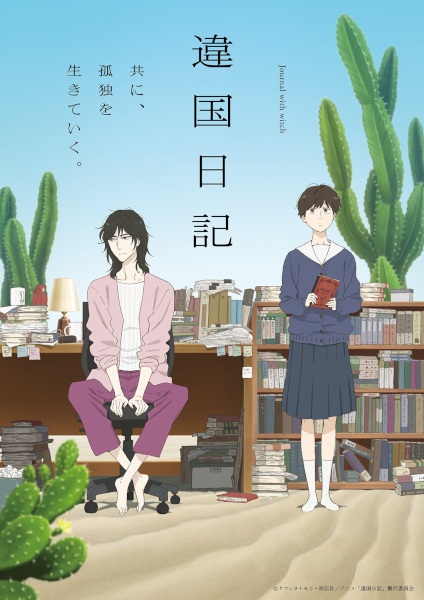




More from The Codex
The Seven Deadly Sins Is a 6.60 Wearing a 7.60 Costume: A One-Point Gap Earned by Groping Gags and Convenient Flashbacks
The Seven Deadly Sins scores 6.60 on the Codex against MyAnimeList's 7.60 because the crowd is grading a Netflix breakout and a Ban-and-King friendship, not the 24 episodes A-1 Pictures actually broadcast in 2014.
The 10.0 That Built a Sunday: How Sazae-san's Cultural Score Carries a 6.58 Scorecard
Sazae-san is a case study in how a single criterion — cultural — can define how a show is remembered, and the 10.0 the Codex hands Eiken's 1969 institution is doing every bit of the heavy lifting its other five scores refuse to.
The Sebastian Problem: Why Black Butler Sits 1.10 Below Its MAL Line and the Crowd Refuses to Notice
Black Butler (Kuroshitsuji) posts a 1.10-point gap between MyAnimeList's 7.65 and the Codex 6.55 because the crowd is grading Sebastian's silhouette and a Phantomhive aesthetic, not the anime-original finale A-1 Pictures actually shipped in 2009.
Discussion
Set a display name above to post.
Loading discussion…