The 5.0 That Keeps Hataraki Man a Footnote: How Cultural Weight Caps a 7.10 Josei Scorecard
Hataraki Man's cultural score of 5.0 is the reason a genuinely sharp workplace josei with an 8.0 on themes gets remembered, when it gets remembered at all, as a Moyoco Anno footnote.
Hataraki Man's cultural score of 5.0 is the reason a genuinely sharp workplace josei with an 8.0 on themes gets remembered, when it gets remembered at all, as a Moyoco Anno footnote.
Hataraki Man is one of the most thematically adult shows of its 2006 cohort, and almost no one under thirty-five has seen it. That gap — between what the rubric grades and what the culture retained — is the entire story of this scorecard. The Anime Codex weighted score lands at 7.10, and it lands there because a 5.0 on cultural footprint drags a josei with an 8.0 on themes and a 7.5 on world-building down to the middle of its class.
The Hataraki Man cultural question the MyAnimeList number won't ask
The MyAnimeList crowd scores it 7.00. That number is not wrong in the way that, say, the crowd's read on One Punch Man is wrong — it is not inflated by hype or by a single sakuga cut. If anything, 7.00 is a fair-to-slightly-generous consensus for a small, loyal viewership that engaged with the show on its own terms. What that 7.00 obscures is a structural asymmetry: Moyoco Anno's manga is a genuinely important text on women and labor in mid-2000s Japan, serialized in Kodansha's Morning from 2004 to 2008, decorated with awards, and given a live-action drama in 2007. The Gallop anime is not that. The anime is a faithful, competent, eleven-episode supplement to a work that mattered elsewhere.
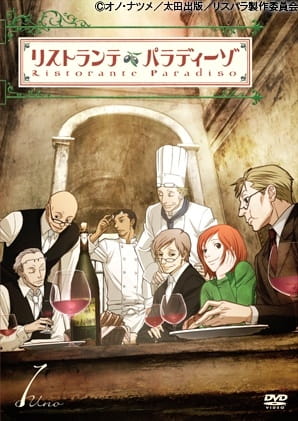
The Hataraki Man cultural question, then, is not whether the franchise had reach — it clearly did — but whether the anime itself earned any of it. On the rubric, the answer is a cold 5.0. Small international footprint, modest domestic fanbase, no lasting discourse. Licensed in North America by Maiden Japan and functionally invisible in every "best josei" conversation that has happened since. This is the same problem Ristorante Paradiso's 5.5 exposes on a differently textured scorecard: the josei demographic keeps producing intelligent adult work that nobody outside the demographic bothers to remember.
Where the scorecard actually earns its keep
Strip the cultural line off and Hataraki Man is a defensible 7.5-ish show. The themes score of 8.0 is the load-bearing beam. The interrogation of what it costs a woman to "switch on" a masculine work persona to survive a Tokyo magazine editorial floor is specific, uncompromising, and refuses the tidy reconciliation an American writers' room would have imposed by episode nine. Hiroko Matsukata does not learn to love softer. She does not choose her boyfriend Shinji over the deadline. The show lets that stand.
The world-building score of 7.5 comes from the same source Anno drew from — the actual texture of the weekly-magazine editorial grind, internal politics, the deadline crunch, the way work colonizes the apartment. It's narrow — the canvas rarely leaves the office and a few interiors — but within that narrowness it is authentic in a way most workplace anime, which reach for hospitals or high schools instead, cannot approach. Character sits at 7.5 for a related reason: the show's decision to rotate perspective off Hiroko onto Sugawara the salaryman, Tanaka the editor, and the side-cast women navigating sexism and marriage pressure gives an eleven-episode run genuine ensemble weight. The strongest emotional beats in the show are not Hiroko's — they are the burnt-out reporter's, the women's compromise episodes.
Story lands at 7.0 and that is where the internal problems begin, before we even get to cultural. The vignette structure works for thematic breadth and fails for dramatic momentum. Eleven episodes is not enough runway to resolve Hiroko's central tension between career and romance, and the show ends abruptly rather than concluding. This is a truncation issue, not a design triumph — the manga went on hiatus in 2008 with the arc unfinished, and the anime inherited that incompleteness.
Gallop, and why the animation floor sits at 5.5
The animation score of 5.5 is where the rubric turns cold. Gallop's production is functional and nothing else. Flat character designs, limited movement, muted palette. The direction leans almost entirely on internal monologue and static two-shot dialogue, which is a defensible choice for a talk-driven adult drama but a choice that leaves no visual signature. The "Hataraki Man mode" transition — the show's one available stylistic hook, the moment where Hiroko literally switches on — is treated as a repeated stinger rather than developed into a directorial idea. Compare that to what Madhouse did with the classical-music interior in Nodame Cantabile or what J.C. Staff extracted from watercolor palettes in Honey and Clover, both roughly contemporaneous josei productions, and the ceiling on what Gallop delivered here becomes clear. This is the same studio whose budget limits Eyeshield 21's scorecard on a much larger canvas — the Eyeshield 21 rubric read walks through that same production ceiling in detail. Gallop can execute a workplace drama. It cannot elevate one.
Why 5.0 on cultural is doing the heaviest damage
A 5.0 cultural score under josei weights does not just remove a criterion — it caps how the other criteria are read in retrospect. Themes at 8.0 land differently in a show people cite versus a show people cannot name. World-building at 7.5 becomes anthropological documentation rather than genre-shifting texture when nobody built anything on top of it. This is the mechanism that lets Sailor Moon's 9.5 cultural score rewrite an otherwise mid-range scorecard upward — and the same mechanism, inverted, is what pulls Hataraki Man down.
Anno's manga has a legacy. The 2007 live-action drama has a legacy. The Gallop anime has neither, and pretending otherwise would be dishonest to the rubric. The 5.0 is not a punishment — it is a description.
The strongest defense, taken seriously
The honest counter is this: Hataraki Man was never trying to be a cultural landmark. It was trying to be a faithful adaptation of a specific manga about specific working women in specific mid-2000s Tokyo, and it succeeded at that. Judging a small, contained josei drama on cultural weight is a category error — the demographic doesn't produce cultural landmarks often, and holding an eleven-episode office drama to the standard of a franchise engine punishes the show for being modest.
That defense is real, and the rubric partially accepts it — this is why the show scores 7.10 and not 6.4. Josei weights already reduce the pressure cultural applies compared to shonen or kodomomuke. But the rubric doesn't grade intent. It grades footprint. A show that was never trying to matter widely still, in the end, did not matter widely, and the score has to reflect that.
Hataraki Man is a genuinely intelligent workplace josei that lost the argument for its own relevance the moment it ended without resolving Hiroko's tension and without giving Gallop's animators anything to build a signature around. The 7.10 is the correct number for a show whose themes deserved better remembering than its cultural score records. Watch it for the side-character episodes; do not expect the industry to have watched it with you.
Featured in the Codex






More from The Codex
The Seven Deadly Sins Is a 6.60 Wearing a 7.60 Costume: A One-Point Gap Earned by Groping Gags and Convenient Flashbacks
The Seven Deadly Sins scores 6.60 on the Codex against MyAnimeList's 7.60 because the crowd is grading a Netflix breakout and a Ban-and-King friendship, not the 24 episodes A-1 Pictures actually broadcast in 2014.
The 10.0 That Built a Sunday: How Sazae-san's Cultural Score Carries a 6.58 Scorecard
Sazae-san is a case study in how a single criterion — cultural — can define how a show is remembered, and the 10.0 the Codex hands Eiken's 1969 institution is doing every bit of the heavy lifting its other five scores refuse to.
The Sebastian Problem: Why Black Butler Sits 1.10 Below Its MAL Line and the Crowd Refuses to Notice
Black Butler (Kuroshitsuji) posts a 1.10-point gap between MyAnimeList's 7.65 and the Codex 6.55 because the crowd is grading Sebastian's silhouette and a Phantomhive aesthetic, not the anime-original finale A-1 Pictures actually shipped in 2009.
Discussion
Set a display name above to post.
Loading discussion…