The 9.5 That Built the Genre: How Sailor Moon's Cultural Score Rewrote a 7.15 Scorecard
Sailor Moon is a case study in how a single criterion — cultural — can define how a show is remembered, and a 1992 Toei production whose 9.5 footprint outran the rest of its own rubric.
Sailor Moon is a case study in how a single criterion — cultural — can define how a show is remembered, and a 1992 Toei production whose 9.5 footprint outran the rest of its own rubric.
Sailor Moon codified the team-based magical-girl genre before Toei's animators had solved the problem of drawing Usagi's face consistently across two adjacent cuts. That contradiction is the show — a 9.5 cultural score sitting on top of a scorecard where nothing else clears 7.5, and yet a work whose fingerprints are on Pretty Cure, on Madoka, on every henshin sequence that treats transformation as ritual rather than mechanics. The Codex weighted score lands at 7.15. The question isn't whether that's fair. It's whether cultural weight, on its own, is enough to justify the reverence.
The Sailor Moon cultural argument the MyAnimeList crowd can't quite make
The MyAnimeList consensus scores Sailor Moon at 7.75 — a respectable number, half a point above the Codex 7.15, and a figure that mostly reflects a crowd grading nostalgia and footprint as if they were structural virtues. The gap isn't outrageous, but it's diagnostic. The MAL number treats the 46-episode 1992 Toei run as a coherent whole. The Codex rubric refuses that shortcut. Story sits at 6.5. Animation sits at 6.0. Those are the numbers the crowd is politely declining to grade, because grading them means admitting that the Dark Kingdom filler stretch is a slog and that the recycled transformation cuts, iconic as they are, exist because Toei couldn't afford otherwise.
The Sailor Moon cultural score of 9.5 is doing something the other criteria simply cannot do on their own: it's converting a mid-tier 1992 TV production into a foundational text. That's a rare move on the Codex rubric, and it puts Sailor Moon in the same structural conversation as Lupin III Part 1 and Futari wa Precure — shows whose cultural criterion outran their own scorecard by decades.
What the 9.5 actually pays for
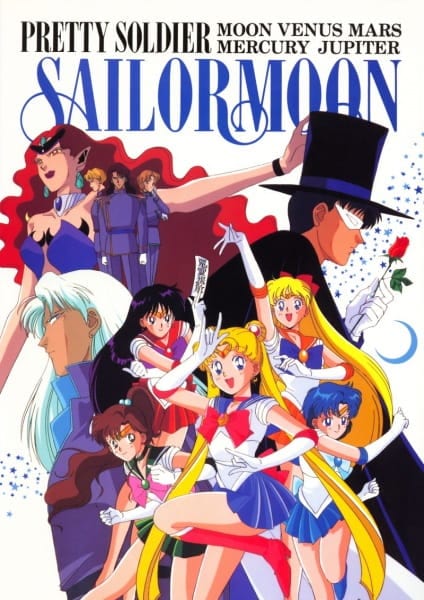
The cultural score isn't a participation trophy for being old and famous. It's the rubric acknowledging that Naoko Takeuchi's Nakayoshi serialization, filtered through Toei and directors Kunihiko Ikuhara and Junichi Sato, produced the template every subsequent magical-girl team has either honored or rebelled against. Five color-coded guardians. A transformation sequence treated as sacrament. Attack names shouted with the seriousness of Buddhist mantras. The astrology-and-planetary conceit tying each senshi to a celestial body — Mercury's cerebral coldness in Ami, Mars's flame-and-intuition friction in Rei, Jupiter's storm-and-strength contradictions in Makoto — is world-building that doubled as merchandising blueprint and never once felt like it.
The 9.5 also pays for the global broadcast. Sailor Moon was, for a generation of Western viewers, the gateway. Not one of the gateways. The one. Shoujo's international reach starts here, and the later seasons' queer-coded representation — which the Codex catalogue flags but which sits outside the 46-episode first-series scope — extended that footprint into territory the medium hadn't seriously touched at scale.
Where the rubric refuses to look away
Here's the honest part. Story at 6.5 is not a rounding error. The first season builds toward the Silver Millennium reveal and the Princess Serenity–Prince Endymion reincarnation payoff, and that finale genuinely lands — the memory-and-rebirth beats carry real weight for a Nakayoshi title, and the Beryl confrontation earns its stakes. But the show takes too long to get there. The mid-season monster-of-the-week Dark Kingdom episodes are episode-engines, not narrative. Beryl's generals — Jadeite, Nephrite, Zoisite, Kunzite — cycle through as antagonist-of-the-week fuel more than as a developed power structure. The pacing sags. The rubric notices.
Animation at 6.0 is the other cost. Ikuhara and Sato inject directorial flair — the ritual rhythm of the transformation sequences is theirs, and it's genuinely inventive staging — but the 1992 Toei production budget shows in inconsistent character drawings, flat backgrounds during routine episodes, and the famous stock footage that let the show survive its own schedule. That stock footage is culturally iconic. It's also, mechanically, a labor-saving device. Both things are true.
Character at 7.5 is where the show earns real credit. Usagi is a genuinely flawed shoujo lead — lazy, cowardly, weepy — and her gradual acceptance of responsibility gives the season the growth arc it needs. The supporting Guardians are drawn distinctly enough that fifteen minutes in you can tell Rei's prickliness from Makoto's tenderness-behind-toughness. But Mamoru is a placeholder for most of the run, and the Usagi–Mamoru romance leans on destiny rather than earned chemistry — which is a shoujo convention, but conventions get graded too.
The tonal whiplash problem
Themes at 7.5 is the criterion that most rewards Sailor Moon's ambition and most exposes its lack of discipline. Friendship, sacrifice, and the argument that an ordinary imperfect girl can be heroic — these resonate, and they're the reason the show became genre-defining rather than just genre-founding. The finale's treatment of love transcending death is not something a Nakayoshi comedy series was structurally obliged to attempt, and it works.
But the show routinely undercuts its own gravity with comedic tonal whiplash — Usagi crying into her test scores in one scene, delivering a speech about protecting her friends' souls in the next, with no transitional grammar. Toei's later magical-girl productions learned to modulate this. Sailor Moon is still figuring it out on air. The rubric credits the reach and marks down the control.
The counter-argument worth taking seriously
The strongest opposing case — the one the MAL 7.75 is implicitly making — is that cultural criteria and structural criteria aren't actually separable when a show is this foundational. If Sailor Moon invented a genre's visual grammar, then the recycled transformation cuts aren't a budget compromise; they're the ritual language the genre would inherit. If the Dark Kingdom filler cycle established the monster-of-the-week structure that Pretty Cure and its descendants would refine, then grading it against modern pacing standards is a category error.
This is a real argument, and it's the one the Crayon Shin-chan cultural case also has to answer. The Codex response is that the rubric grades the artifact, not the influence of the artifact. Foundational works don't get retroactive credit on animation or story lines because their weaknesses became conventions. They get credit on the cultural line — which is why that criterion exists, and why Sailor Moon's 9.5 there is doing exactly the work it's supposed to do.
Verdict
The 7.15 is honest. Sailor Moon is not a masterpiece of story construction or a triumph of 1992 Toei production values, and pretending otherwise flattens what actually happened here — a shoujo work whose cultural footprint is among the largest ever produced, resting on a scorecard the rubric grades soberly. Watch it for the 9.5. Understand that the rest of the numbers are the price of admission, and that the price is fair.
Featured in the Codex



More from The Codex
The Seven Deadly Sins Is a 6.60 Wearing a 7.60 Costume: A One-Point Gap Earned by Groping Gags and Convenient Flashbacks
The Seven Deadly Sins scores 6.60 on the Codex against MyAnimeList's 7.60 because the crowd is grading a Netflix breakout and a Ban-and-King friendship, not the 24 episodes A-1 Pictures actually broadcast in 2014.
The 10.0 That Built a Sunday: How Sazae-san's Cultural Score Carries a 6.58 Scorecard
Sazae-san is a case study in how a single criterion — cultural — can define how a show is remembered, and the 10.0 the Codex hands Eiken's 1969 institution is doing every bit of the heavy lifting its other five scores refuse to.
The Sebastian Problem: Why Black Butler Sits 1.10 Below Its MAL Line and the Crowd Refuses to Notice
Black Butler (Kuroshitsuji) posts a 1.10-point gap between MyAnimeList's 7.65 and the Codex 6.55 because the crowd is grading Sebastian's silhouette and a Phantomhive aesthetic, not the anime-original finale A-1 Pictures actually shipped in 2009.
Discussion
Set a display name above to post.
Loading discussion…