The 5.5 That Keeps Ristorante Paradiso a Manga Reader's Footnote: How Cultural Weight Caps a 7.12 Scorecard
Ristorante Paradiso is a case study in how a single criterion — cultural — can define how a show is remembered, a David Production adaptation whose warmth outran its own footprint by fifteen years.
Ristorante Paradiso is a case study in how a single criterion — cultural — can define how a show is remembered, a David Production adaptation whose warmth outran its own footprint by fifteen years.
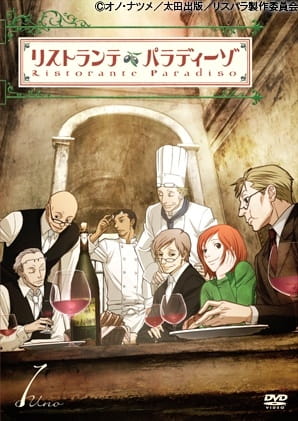
Casetta dell'Orso is one of the most specific fictional restaurants in anime — a Roman trattoria staffed exclusively by bespectacled older men because the proprietor's wife likes glasses on gentlemen — and almost no one under thirty has heard of it. That gap between what Ristorante Paradiso puts on screen and what it managed to plant in the wider culture is the whole argument. The Codex weighted score lands at 7.12; the cultural criterion drags in at 5.5. Everything else is doing more work than that number rewards.
The Ristorante Paradiso cultural problem, stated plainly
The MyAnimeList crowd scores it 7.29, and the framing there is usually some variation of "underrated hidden gem for adult viewers." That framing is not wrong on taste. It is wrong on math. A hidden gem, by definition, does not accumulate the cultural weight the rubric measures — reach, discourse, downstream influence, the number of shows that borrow its DNA. Ristorante Paradiso is the exact case where the community score and the Codex score converge in aggregate (7.29 versus 7.12) while disagreeing about why. The MAL number rewards a small devoted following. The Codex number penalizes exactly that smallness on the cultural axis, and then credits the world-building and themes back into a similar neighborhood.
This is not a hit piece. The show earns its 8.0 on world-building and its 7.5 on themes. But the criterion that would elevate it from "quiet niche" to "must-watch josei touchstone" is the one it fails. Natsume Ono's manga readership carries the property forward more than Mitsuko Kase's 11-episode adaptation ever did, and that is a diagnosis, not an opinion.
What the 8.0 world-building actually buys you
Casetta dell'Orso is a genuine achievement. The conceit — Lorenzo hires only bespectacled older men because his wife Olga finds them attractive — is committed to as both aesthetic and thematic engine. David Production, still early in its life as a studio in 2009, leans into the gentlemanly-spectacled character designs with affection rather than caricature, and the amber lighting of the dining room does load-bearing emotional work across all eleven episodes. Nicoletta's kitchen apprenticeship gives the setting a plausible internal economy: this is not a café where nobody works, it is a restaurant where service rhythms structure the drama.
The setting is the reason the show exists at all. It is also, quietly, the reason the cultural score can't recover. A world this specific — Roman trattoria, aging waitstaff, Ono's spidery character designs translated into soft animation — is definitionally illegible to a mass audience. The 9.0 cultural score that made Futari wa Precure an empire came from punches-and-kicks choreography a seven-year-old could copy in the schoolyard. Ristorante Paradiso is a show about Claudio's marriage. There is no schoolyard version of that.
The 7.5 themes score is where the show is most adult, and least exportable
The thematic work is the strongest thing here after the world-building. Nicoletta arrives in Rome intending to sabotage the mother who abandoned her fifteen years ago; the revenge frame is dismantled within the first two episodes and replaced by a mosaic of adult longing, second chances, and quiet reconciliation. The Nicoletta-Olga thread is handled with a restraint almost no other 2009 romance was capable of. Vito's lovesickness, Luciano's estranged daughter, Claudio's marital limbo — these are grown-up problems handled at a grown-up register.
That register is exactly what limits the cultural footprint. There is no viral moment. There is no cathartic peak the way Bokura ga Ita's finale detonates, and unlike Bokura ga Ita's refusal to fix its male lead, Ristorante Paradiso doesn't even offer the frisson of a difficult central relationship — Claudio is married, gentle, unavailable, and the show treats his dignity as terminal condition rather than dramatic problem. The themes simmer. They never boil. Simmering does not travel.
The 6.8 story is the load-bearing weakness the cultural score exposes
Eleven episodes is not enough runway for a vignette structure, and the show knows it. Nicoletta's arc from resentment to belonging is real but underdramatized — Kase's direction lets conversations breathe to the point of inertness, and the central romance progresses so gently that "restrained" tips into "not happening." The revenge premise is abandoned by episode two, which is the correct creative choice, but nothing structurally replaces it. The show becomes an episodic mosaic without cumulative stakes.
This is where the cultural score does its damage in retrospect. A show with weak accumulation and strong atmosphere survives on word-of-mouth. Word-of-mouth requires a footprint. Ristorante Paradiso aired on Fuji TV's late-night Noise block in spring 2009, was streamed by Crunchyroll with subtitles, and then did what most josei adaptations do — it sat there. The Gente sequel manga extended the property on the page, not on the screen. There is no second season. There is no film. There is no cosplay ecosystem. The 5.5 is measuring exactly what happened.
The steelman: this is what josei is supposed to look like
The strongest defense of the 7.29 MAL number is that penalizing josei for lacking mainstream reach punishes the genre for succeeding at its own brief. Ristorante Paradiso is not trying to be Attack on Titan. It is trying to be a quiet, character-driven, adult-audience josei about a restaurant in Rome, and by that standard it is one of the cleanest executions of the decade. Ono's fingerprints are all over the property, and within her devoted readership — the same readership that carried House of Five Leaves — this adaptation is treated as canonical.
The Codex rubric hears this argument and answers it with math. Cultural is one of six weighted criteria, not the only one. A 5.5 does not zero out the 8.0 world-building or the 7.5 themes; it simply prevents the weighted average from crossing into the 7.4-7.6 territory where world-building and themes alone would push it. The show's scorecard is honest about what it is: a distinctive, well-directed, structurally slight adaptation whose reach never matched its craft. Compare this to Lupin III Part 1's cultural score rewriting its scorecard upward by five decades of influence — Ristorante Paradiso is the inverse case, and the number reflects it.
Verdict
Ristorante Paradiso is worth watching, and worth watching precisely once — for Casetta dell'Orso's amber light, Olga's self-aware vanity, and the fifteen minutes in which Nicoletta stops wanting to burn her mother's life down. The 7.12 is the correct number and the 5.5 is the correct diagnosis: a show this specific was never going to travel, and the rubric refuses to pretend otherwise.
Featured in the Codex






More from The Codex
The Seven Deadly Sins Is a 6.60 Wearing a 7.60 Costume: A One-Point Gap Earned by Groping Gags and Convenient Flashbacks
The Seven Deadly Sins scores 6.60 on the Codex against MyAnimeList's 7.60 because the crowd is grading a Netflix breakout and a Ban-and-King friendship, not the 24 episodes A-1 Pictures actually broadcast in 2014.
The 10.0 That Built a Sunday: How Sazae-san's Cultural Score Carries a 6.58 Scorecard
Sazae-san is a case study in how a single criterion — cultural — can define how a show is remembered, and the 10.0 the Codex hands Eiken's 1969 institution is doing every bit of the heavy lifting its other five scores refuse to.
The Sebastian Problem: Why Black Butler Sits 1.10 Below Its MAL Line and the Crowd Refuses to Notice
Black Butler (Kuroshitsuji) posts a 1.10-point gap between MyAnimeList's 7.65 and the Codex 6.55 because the crowd is grading Sebastian's silhouette and a Phantomhive aesthetic, not the anime-original finale A-1 Pictures actually shipped in 2009.
Discussion
Set a display name above to post.
Loading discussion…