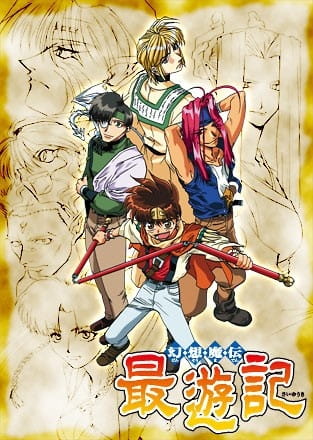
Saiyuki
Is Saiyuki worth watching?
Worth a look. Anime Codex rates Saiyuki 6.90 out of 10 — scored on six criteria (story, characters, themes, world-building, animation, and cultural impact), not crowd votes. 143rd of 226 on the Codex rubric — bottom 38% of the catalogue. The crowd rates it 0.63 higher than the rubric does — the Codex is harder on it than on 56% of the catalogue.
Where to watch
What the data says
Computed from the Codex rubric across the whole catalogue.
Summary
Saiyuki stands as a solid pillar of early-2000s josei adventure, distinguished by Kazuya Minekura's effortlessly cool reinterpretation of Journey to the West as a road trip through a demon-haunted, anachronistic fantasy world. Its greatest asset is its quartet of damaged, charismatic leads—Sanzo, Gojyo, Goku, and Hakkai—whose banter and slowly excavated traumas, particularly Hakkai's harrowing Gonou backstory and the celestial reincarnation arcs, give the show genuine emotional heft beyond its bishounen surface appeal. Thematically it explores found family, atonement, and the artificiality of the human/demon divide with welcome moral grayness, embodied in sympathetic antagonists like Kougaiji. The weaknesses are equally clear: across 50 episodes the main plot toward Gyumao's resurrection stalls under repetitive episodic encounters, the world-building's mechanics (limiters, minus-wave) stay underdeveloped, and Studio Pierrot's animation is dated and often static, with unremarkable action. Character growth tends toward backstory revelation rather than true arc transformation. Yet for its target audience it delivers exactly what it promises—attractive, wounded men, atmospheric melancholy, and durable camaraderie—and its franchise longevity confirms it resonated. It is a good, flawed entry: comfortable, character-driven, and stylish, if narratively saggy and visually unambitious for newcomers expecting a tighter ride.
Criterion breakdown
Story & narrative
The journey-west framework borrowed from Journey to the West gives the show a clear forward momentum, but the episodic monster-and-bandit encounters between major story beats often feel like padding across 50 episodes. The strongest narrative material lies in the flashback arcs—Hakkai's tragedy as Gonou and the slaughter of Kanan, and Goku's imprisonment and bond with Konzen—which carry far more weight than the main present-day plot toward Gyumao's resurrection.
Character writing & growth
The four leads are the show's core strength: Sanzo's brittle cynicism, Gojyo's flippancy masking abandonment wounds, Goku's hunger-as-metaphor backstory, and Hakkai's gentle exterior concealing genocide-level trauma are layered and play off each other with real chemistry. Growth is more revelation than transformation—the party shifts little over the run—but the gradual exposure of each member's past, especially the Hakkai/Gonou arc, rewards patience. Antagonists like Kougaiji's conflicted loyalty add welcome moral ambiguity.
Themes & emotional resonance
The show meditates on found family, sin, atonement, and the blurred line between human and demon, refusing easy good-versus-evil framing—Sanzo's priesthood is hollowed by trauma rather than piety. The reincarnation threads connecting the heavenly past to the present give emotional resonance to the bonds, though the themes are stated more often than they are deeply interrogated, and the relentless episodic pace dilutes their impact.
World-building & power system
The reimagining of Journey to the West as a demon-versus-human conflict in a vaguely modern-fantasy Shangri-La—complete with jeeps, cigarettes, and guns alongside chi-based demon powers—is a charmingly anachronistic premise. However, the setting's internal logic is thin: the rules of demon limiters, minus-wave corruption, and Gyumao's resurrection mechanics are sketched rather than rigorously built, leaving the world more atmospheric than coherent.
Animation & direction
Studio Pierrot's 2000 production is serviceable but dated, with limited animation, recycled action cuts, and inconsistent character art across the long run. The character designs—bishounen styling true to the josei readership—are appealing and the moody color palettes in flashback sequences land well, but combat is rarely fluid and the direction leans on stills and dialogue over dynamic staging.
Cultural impact
Saiyuki was a notable josei/female-targeted franchise success, spawning multiple sequels (Reload, Gunlock) and cementing Kazuya Minekura's reputation; its bishounen ensemble and homoerotic subtext built a devoted fandom. Its influence is real within the demographic but modest in the broader anime landscape compared to genre-defining titles.
Synopsis (from MAL)
Many years ago, humans and demons lived in harmony. But that unity ended when demons started attacking humans and plotted a mission to unleash Gyumao—an evil demon imprisoned for thousands of years. Now, Genjo Sanzo, a rogue priest, must team up with three demons—Sha Gojyo, Son Goku, and Cho Hakkai—and embark on a perilous journey to the west to stop these demons from resurrecting Gyumao and restore the balance between humans and demons on Earth. (Source: ANN)
Ranked nearby


Explore rankings
Discussion
Set a display name above to post.
Loading discussion…