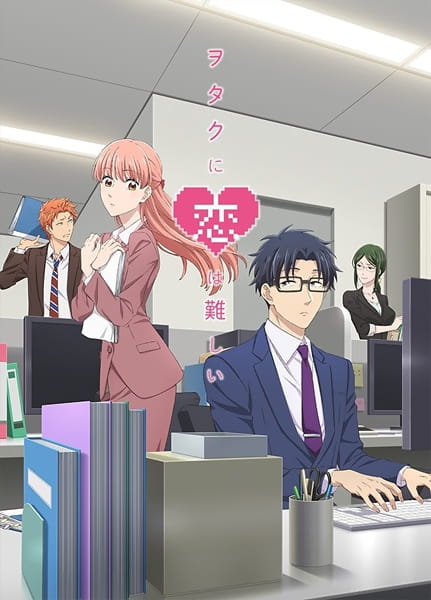
Wotakoi: Love is Hard for Otaku (Wotaku ni Koi wa Muzukashii)
Is Wotakoi: Love is Hard for Otaku (Wotaku ni Koi wa Muzukashii) worth watching?
Worth a look. Anime Codex rates Wotakoi: Love is Hard for Otaku (Wotaku ni Koi wa Muzukashii) 6.75 out of 10 — scored on six criteria (story, characters, themes, world-building, animation, and cultural impact), not crowd votes. 157th of 226 on the Codex rubric — bottom 32% of the catalogue. The crowd rates it 1.16 higher than the rubric does — the Codex is harder on it than on 79% of the catalogue.
Where to watch
Streaming availability varies by region — check your local services.
Trailer
What the data says
Computed from the Codex rubric across the whole catalogue.
Summary
Wotakoi is notable within josei for treating its adult otaku as fully employed, self-aware grown-ups whose hobbies are simply part of who they are, rather than punchlines or problems to outgrow. Its decision to pair Narumi and Hirotaka almost immediately frees it from romance's usual stalling and lets it explore the texture of an established relationship, while Hanako and Kabakura's lived-in bickering grounds the cast in something more mature than typical schoolyard romance. The depiction of Comiket, gacha despair, and co-op gaming is affectionate and specific, making the setting its strongest original element. Hirotaka's reserved devotion is the emotional anchor and the show's best-written quality. Its limitations are real: the narrative is conflict-averse and episodic, the central couple is essentially frictionless, and none of the four leads grow meaningfully across eleven episodes, leaving the show pleasant but static. The animation is clean and the OP excellent, though direction stays conservative. Judged against the best josei, it lacks the emotional depth and character evolution of the demographic's strongest work, but it succeeds admirably as a warm, validating, genuinely funny comedy about loving someone who loves what you love.
Criterion breakdown
Story & narrative
The premise of adult otaku navigating relationships is refreshingly low-stakes and grounded, sidestepping the will-they-won't-they stalling typical of romance by having Narumi and Hirotaka commit in the first episode. However, the narrative is episodic and largely conflict-averse, leaning on gaming sessions, Comiket trips, and karaoke outings rather than meaningful escalation; the secondary couple Hanako and Kabakura's bickering provides more dramatic texture than the leads' essentially frictionless coupling. The arrival of Hirotaka's brother Naoya and the gamer girl Ko Sakuragi late in the run adds welcome dynamics but arrives too thinly to reshape the structure.
Character writing & growth
Hirotaka's deadpan, hyper-competent-yet-emotionally-reserved characterization is the show's strongest writing, and his quiet devotion to Narumi gives the central pairing genuine warmth. Hanako and Kabakura are the more compelling adults, an old married-feeling couple whose history and insecurities (Hanako's self-consciousness, Kabakura's tsundere irritation) carry real friction. The weakness is stasis: none of the four undergo meaningful growth across eleven episodes, with Narumi in particular remaining a fixed bundle of fujoshi panic and clumsiness rather than developing.
Themes & emotional resonance
The show's resonant core is the validation of hobbyist adults finding partners who accept their otaku identity without shame, directly answered by Narumi's backstory of being dumped for being a fujoshi. It handles the quiet difficulty of expressing affection between emotionally awkward people with real tenderness, especially in Hirotaka's understated gestures. It stops short of deeper emotional excavation, though, keeping things comfortable rather than probing loneliness or identity in the way the best josei dramas do.
World-building & power system
The otaku-workplace setting is its most original asset, depicting Comiket, gacha frustration, co-op gaming, and doujinshi culture with affectionate, knowing specificity rather than as broad stereotype. The internal consistency of these adults treating gaming and conventions as the load-bearing structure of their social lives feels authentic and lived-in. It remains a fairly narrow slice, however, rarely venturing beyond the office, bar, and apartment to flesh out a fuller world.
Animation & direction
A-1 Pictures delivers clean, bright character art with expressive comedic faces and well-staged otaku iconography, and the OP 'Fiction' by sumika is a standout that captures the upbeat tone. The direction is competent and pleasant but visually conservative, relying on standard shot-reverse-shot dialogue framing with little inventive composition. The in-game and chibi gag sequences add charm, though the overall look prioritizes likability over directorial ambition.
Cultural impact
Wotakoi enjoyed strong mainstream recognition as a popular adult-otaku romance, drawing a large MAL membership and benefiting from a relatable, meme-friendly premise during its 2018 airing. It became a reference point for the 'otaku finding love' niche but did not reshape the josei landscape or spawn significant lasting influence beyond its own franchise OVAs.
Synopsis (from MAL)
Having slept through all four of her alarms, the energetic Narumi Momose finds herself running late for her first day of work at a new office. As she races to catch her train, she makes a promise to herself that none of her coworkers will find out about her dark secret: that she is an otaku and a fujoshi. Her plan goes instantly awry, though, when she runs into Hirotaka Nifuji, an old friend from middle school. Although she tries to keep her secret by inviting him out for drinks after work, her cover is blown when he casually asks her whether or not she will be attending the upcoming Summer Comiket. Luckily for her, the only witnesses—Hanako Koyanagi and Tarou Kabakura—are otaku as well. Later that night, the pair go out for drinks so that they can catch up after all the years apart. After Narumi complains about her previous boyfriend breaking up with her because he refused to date a fujoshi, Hirotaka suggests that she try dating a fellow otaku, specifically himself. He makes a solemn promise to always be there for her, to support her, and to help her farm for rare drops in Monster Hunter. Blown away by the proposal, Narumi agrees immediately. Thus the two otaku start dating, and their adorably awkward romance begins. [Written by MAL Rewrite]
Ranked nearby


Explore rankings
Discussion
Set a display name above to post.
Loading discussion…