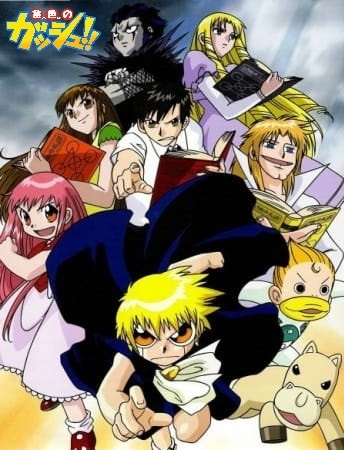
Konjiki no Gash Bell!! (Zatch Bell)
Is Konjiki no Gash Bell!! (Zatch Bell) worth watching?
Worth a look. Anime Codex rates Konjiki no Gash Bell!! (Zatch Bell) 7.48 out of 10 — scored on six criteria (story, characters, themes, world-building, animation, and cultural impact), not crowd votes. 89th of 226 on the Codex rubric — top 39% of the catalogue. The crowd rates it 0.10 higher than the rubric does — the Codex is harder on it than on 22% of the catalogue.
Where to watch
Streaming availability varies by region — check your local services.
What the data says
Computed from the Codex rubric across the whole catalogue.
Summary
Zatch Bell stands out among mid-2000s shonen for marrying a clean battle-royale premise to a power system that literally measures strength in friendship: spellbooks grow stronger as human and mamodo partners deepen their bond. Its greatest asset is sincerity — Kiyomaro's transformation from cynic to protector, Gash's earnest kindness against Zeon's resentment, and a string of genuinely tearful farewells when defeated mamodo's books burn forever give the long run real emotional stakes that elevate it above kid-oriented fare. The themes of courage and compassion are delivered with conviction, and the late Faudo and Clear Note arcs escalate the stakes effectively. Its weaknesses are typical of its length and studio: a saggy, filler-prone middle, repetitive book-hunting setups, an underexplored demon world, and budget-limited Toei animation that only occasionally rises to its biggest moments. Some rival mamodo remain thin archetypes. Yet the strongest relationships — Gash and Kiyomaro, Brago and Sherry — earn their payoffs, and the show's heart never feels cynical. It is a warm, well-structured, emotionally honest shonen that excels at character and theme while falling short on visual polish and setting depth — a beloved cult classic rather than a top-tier titan.
Criterion breakdown
Story & narrative
The battle-royale premise of 100 demon children fighting to become king is a clean, propulsive structure that the show escalates smoothly from monster-of-the-week skirmishes into the sprawling Faudo arc and the climactic war against Clear Note. The pacing sags in its mid-section with filler and repetitive 'find the next book-owner' setups, but the willingness to weave genuine tragedy into opponents — Zofis exploiting the resurrected ancient mamodo, Brago's relentless pursuit — keeps stakes meaningful. The decision to make every defeated mamodo's burned spellbook a permanent loss gives the long-running format unusual weight for its era.
Character writing & growth
Kiyomaro's arc from a cynical, isolated genius who looks down on others into someone who fights for friends is one of the more convincing protagonist transformations in mid-2000s shonen, and Gash's amnesiac kindness contrasted with his ruthless twin Zeon gives the duo real thematic spine. The supporting cast — Kanchome's growth from coward to genuinely brave, Ponygon, Tia, and especially the Brago/Sherry pairing rooted in Sherry's bond with Koko — receive surprisingly complete emotional arcs. Some rivals remain flat archetypes, but the core relationships earn their payoffs.
Themes & emotional resonance
The repeated message that 'kindness is strength' is delivered with unusual sincerity, anchored by spells like Baou Zakeruga and the recurring image of mamodo who fight not for power but to protect their partners. The Sherry-Koko backstory and Zeon's resentment of Gash's privileged birth give the friendship-and-courage themes a darker counterweight than typical kids' shonen, and tearful book-burning farewells (Wonrei and Li-en, Kolulu) land genuine emotional weight. It occasionally over-explains its morals, but the resonance is real.
World-building & power system
The spellbook system — partners reading escalating spells whose words and power grow as the bond deepens — is a distinctive and internally consistent mechanic that ties power directly to the human-mamodo relationship rather than raw talent. Each mamodo's element and signature spell family (Gash's lightning, Brago's gravity, Kanchome's illusions) offers good variety. The demon world itself stays underdeveloped as a setting for most of the run, explored only late, which caps the world-building's depth even as the power system shines.
Animation & direction
Toei's production is functional and bright with consistent character designs, but it is visibly budget-conscious across 150 episodes, relying on still frames, recycled spell-casting cut-ins, and limited motion in lesser fights. Marquee clashes like the final Clear Note battle and Gash versus Zeon get noticeably more fluid animation and dramatic direction, but the overall visual ceiling is modest even by 2003 standards. Solid voice work and an energetic score do more emotional lifting than the artwork.
Cultural impact
A solid Shonen Sunday hit with a successful manga, video games, and a recognizable Western dub presence in the mid-2000s, Zatch Bell earned a devoted following without reaching the cultural ubiquity of its bigger contemporaries. Its legacy endured enough to justify the 2022 sequel manga Konjiki no Gash!! 2, signaling lasting fan affection. It remains a fondly remembered cult favorite rather than a genre-defining landmark.
Synopsis (from MAL)
Takamine Kiyomaro, a depressed don't-care-about-the-world guy, was suddenly given a little demon named Gash Bell to take care of. Little does he know that Gash is embroiled into an intense fight to see who is the ruler of the demon world. All of the demons have to pick a master on Earth and duke it out with other demons until one survives. Needless to say, Kiyomaro becomes Gash's master, and through their many battles, Kiyomaro learns the importance of friendship and courage.
Ranked nearby
Explore rankings
Discussion
Set a display name above to post.
Loading discussion…