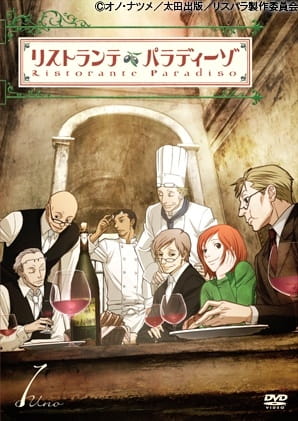
Ristorante Paradiso
Is Ristorante Paradiso worth watching?
Worth a look. Anime Codex rates Ristorante Paradiso 7.12 out of 10 — scored on six criteria (story, characters, themes, world-building, animation, and cultural impact), not crowd votes. 121st of 226 on the Codex rubric — bottom 47% of the catalogue. The crowd rates it 0.17 higher than the rubric does — the Codex is harder on it than on 26% of the catalogue.
Where to watch
What the data says
Computed from the Codex rubric across the whole catalogue.
Summary
Ristorante Paradiso is a quietly distinctive josei piece that trades the genre's usual melodrama for adult restraint. Its premise—a young woman arriving to ruin her estranged mother, only to be disarmed by a Roman trattoria staffed by mature, bespectacled gentlemen—is both charming and unusually grown-up in its concerns: second chances, family reconciliation, and the dignity of older characters' desires. Natsume Ono's sensibility, faithfully rendered in David Production's warm amber palette and unhurried direction, gives the show a cozy, lived-in atmosphere few romances achieve. The ensemble, particularly the self-aware Olga and the dignified Claudio, carries genuine maturity. Its weaknesses are real: with only 11 episodes the narrative stays episodic and slight, the central romance is so understated it borders on inert, and several staff remain charming archetypes rather than fully developed people. Animation is modest in motion, prioritizing mood over spectacle. The result is a gentle, atmospheric work that rewards viewers seeking quiet adult character drama and a uniquely realized setting, but may frustrate those wanting stronger dramatic momentum. Within its demographic it is a small, accomplished gem—not definitive, but a memorable counterpoint to flashier romance fare.
Criterion breakdown
Story & narrative
The premise of Nicoletta arriving to sabotage Olga before being disarmed by Casetta dell'Orso is a quietly clever inversion, and the show wisely abandons the revenge framing early to become an episodic mosaic of the restaurant's regulars and staff. However, the narrative is structurally slight: with only 11 episodes it sketches vignettes (Vito's lovesickness, Luciano's estranged daughter, Claudio's marital troubles) without ever building cumulative dramatic stakes, and the central Nicoletta-Claudio romance progresses so gently it can feel inert rather than restrained.
Character writing & growth
The ensemble is the show's strongest asset: Olga as a vain but self-aware matriarch, Lorenzo the proprietor who hires only bespectacled gentlemen to please her, and the contrast between Nicoletta's hardened resentment and her gradual softening are handled with adult nuance rare in romance anime. Claudio's quiet dignity and the older waiters' lived-in weariness give the cast genuine maturity. The limitation is that several staff remain charming archetypes more than fully developed figures, and Nicoletta's growth, while sincere, is gentle to the point of being underdramatized.
Themes & emotional resonance
The show meditates thoughtfully on second chances, the reconciliation between Nicoletta and Olga, and the idea that adult longing and unfinished family wounds can coexist with everyday warmth. Its treatment of aging, desire among mature people, and the comfort of belonging to a place is refreshingly grown-up. The emotional resonance is real but muted; the show rarely pushes its quietest insights into fully cathartic moments, keeping feelings at a pleasant simmer rather than a peak.
World-building & power system
The conceit of a Roman trattoria staffed entirely by older men in glasses is a wonderfully original premise, and the show commits fully to it as both visual signature and thematic engine. The depiction of Italian culinary life, the rhythms of service, and Nicoletta's apprenticeship under chef training lend the setting tangible texture and internal consistency. It is a small, self-contained world, but a richly realized and distinctive one.
Animation & direction
Early-era David Production delivers a warm, soft palette and unusual character designs that lean into the gentlemanly-spectacled aesthetic with affection rather than caricature. The direction is calm and assured, letting conversations breathe and using the restaurant's amber lighting to evoke comfort. Animation is modest in motion and the budget shows in static framing, but the gentle pacing and tasteful color work suit the material well.
Cultural impact
Adapted from Natsume Ono's manga, it stands as a recognizable entry in the quiet adult-josei niche and gained a small devoted following, later complemented by the Gente sequel manga. Its niche premise and lack of mainstream reach limit its broader footprint, but it remains a touchstone for fans of Ono's distinctive style and unhurried, character-driven storytelling.
Synopsis (from MAL)
When Nicoletta was a little girl, her mother, Olga, abandoned her and ran off to Rome to remarry. Now, 15 years later and a young woman, she travels to Rome with the intention of ruining her mother's life. She tracks Olga down to a restaurant called Casetta dell'Orso, but the second Nicoletta steps through its door, everything changes. It's a peculiar place staffed entirely by mature gentlemen wearing spectacles, and like their clientele, she is helpless against their wise smiles and warm voices. Before Nicoletta realizes it, her plans for vengeance start to fade, and she's swept up in the sweet romance of everyday Italian life. (Source: Right Stuf)
Ranked nearby





Explore rankings
Discussion
Set a display name above to post.
Loading discussion…