Eyeshield 21 Review: A 7.33 That Earns Its Character Score and Pays for It on Gallop's Budget
Judged against one consistent rubric, Eyeshield 21 is best understood by which criteria carry it and which drag it down — not by a single number.
Judged against one consistent rubric, Eyeshield 21 is best understood by which criteria carry it and which drag it down — not by a single number.
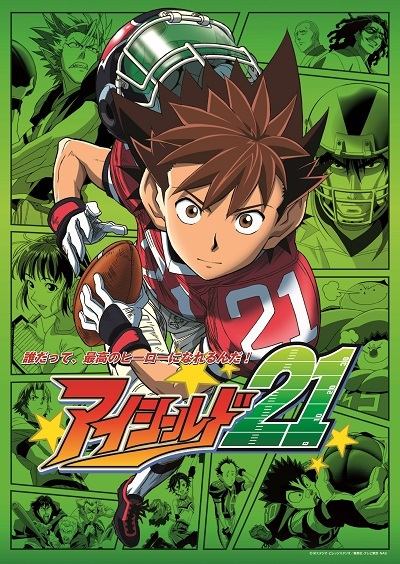
Sena Kobayakawa is the rare shonen protagonist whose escape reflex is more convincing than his finishing move. That's the compliment and the problem: Gallop's 145-episode adaptation runs on characterization sharp enough to survive production shortcuts, and on a football-as-mechanics premise that stays legible even when the in-between frames don't. It earns a 7.33 on the Anime Codex, and every point above and below that number has a specific address.
Where the Consensus Sits, and Where It's Wrong
MyAnimeList lands Eyeshield 21 at 7.93. The Anime Codex reads it at 7.33 — a 0.60-point gap that isn't hostility, it's a rubric doing its job. The crowd is grading a memory: Hiruma's grin, the Devil Bat Ghost, the novelty of American football breaking into Weekly Shōnen Jump in 2002. That memory is real. It's also selective. It doesn't hold Gallop accountable for the reused stock animation, doesn't dock the show for an anime ending that never adapts the manga's full conclusion, and doesn't weigh the cultural footprint against the peers the show actually competes with — Slam Dunk, Haikyuu, Captain Tsubasa.
Any honest Eyeshield 21 review has to name the criteria doing the lifting (character, story, world-building) and the ones being carried (animation, cultural impact). The rubric doesn't average feelings. It scores what's on screen.
Character at 8.0: The Highest Number on the Card, and It's Earned
Sena's arc is the spine. He begins as an errand boy conditioned into flight, and the show is disciplined about the conversion — his running isn't reframed as courage until he chooses, on the field, to face opponents rather than evade them. That progression is one of the more convincing confidence-building arcs in sports shonen because the anime resists collapsing it into a single triumph. It stretches across the Deimon Devil Bats' entire tournament calendar.
Hiruma is the standout, and not for the reasons the fandom cites. The blackmail book and the assault rifles are surface. Underneath is a quarterback who reads people with the same precision he reads defenses — a genuine tactician wearing a gunslinger's costume. The show's best scenes are Hiruma diagramming an audible, not Hiruma threatening a referee. Kurita's gentleness against his lineman bulk, Monta's monomaniac catching obsession, Shin's Spear Tackle rigidity mirroring Sena's speed as a competitive philosophy rather than a rival gimmick, Agon's contempt for effort as a worldview — these are drawn, not stated. The 8.0 is the highest number on the card. It's earned by writing, not by volume of screen time. A roster this size does have thin patches; some Devil Bats never resolve beyond a running joke, and minor teams register as puzzles to solve rather than opponents with interior lives.
Story at 7.5 and World at 7.5: The Football Actually Means Something
Sports shonen usually runs on willpower. Eyeshield 21 runs on schemes. Downs, blocking assignments, route trees, special teams — the show teaches them with a rigor the genre rarely bothers with, and the strategic exposition holds up because Hiruma's commentary and the on-field diagrams keep complex plays legible instead of mystifying them. That's why the Deimon vs. Shinryuuji Naga game lands: it's a chess match between Hiruma and Agon where the outcome hinges on personnel packages, not spirit bombs. The signature techniques function as a power system grounded in real athletic logic — Shin's Spear Tackle and Trident Tackle are physics, not magic, and even Sena's Devil Bat Ghost is footwork before it's flourish.
The story score pays for two things. First, the "underdog out-thinks the titan" formula, engaging for forty episodes, gets predictable over 145. Second, the Christmas Bowl against Teikoku — the arc the entire series builds toward — suffers pacing bloat and lands on an anime ending that doesn't adapt the manga's full conclusion. That's a real deduction. The world score gives back a little for the exaggerated feats (the light-speed running gag stops being a joke and starts being a physics violation), but the football-as-mechanics framework is distinctive enough within the demographic to hold at 7.5. This is the same design instinct that keeps Dr. Stone's world-building at the top of the rubric — a shonen that respects the mechanics of its premise scores higher than one that waves them through.
Themes at 7.0: Effort Over Talent, Delivered Without Catharsis
The message is unambiguous and consistently held: ordinary players close the gap on prodigies through preparation. Sena, Monta, and the offensive line are explicitly framed as the counter-argument to Shin's discipline and Agon's genius. Komusubi's lineman pride, the Ha-Ha Brothers' redemption from hallway bullies into functional teammates — these are earnest and they land. What the show can't do is transcend. The register stays comedic and motivational; it never reaches the gut-punch catharsis of the genre's heaviest dramas. A 7.0 is honest work — the theme is delivered without cynicism and without the emotional escalation that would push it into the eights.
Animation at 6.5: Where Gallop's Budget Shows
This is where the score bleeds. Gallop's production is functional and inconsistent across 145 episodes. Key plays get dynamic speed lines and legitimate motion — Sena's sprints have real velocity when the budget arrives — but game sequences routinely rely on static panels, reused stock cuts, and still frames that hold too long. The direction handles strategic exposition cleanly, which is its own achievement; the diagrams and Hiruma's play calls stay readable when they could have collapsed into noise. But the choreographic polish isn't there. Contemporary sports anime of the era outpaced it visually, and Haikyuu later rewrote the ceiling entirely. Yusuke Murata's original character designs survive — Hiruma's elf-grin, Kurita's silhouette — because they're strong on paper, not because the in-between work honors them.
Cultural at 6.0: The Number That Explains the Gap
This is the criterion the MyAnimeList crowd doesn't weigh honestly. Eyeshield 21 is widely credited with popularizing American football in Japan, spawned real promotional ties, and put Sena and Hiruma into the Jump-era canon. Genuine footprint. But the rubric compares it to Slam Dunk, Haikyuu, and Captain Tsubasa, and the comparison is not close. The incomplete anime ending blunted franchise momentum at the exact moment it should have consolidated. A 6.0 isn't dismissal — it's placement. The show didn't cross generations the way sports shonen's canonical titles did. This is a familiar pattern on the Codex, where a single cultural score can rewrite how a scorecard reads in either direction — here it drags rather than lifts.
The Steelman: The Manga Is Better, So the Anime Should Be Graded Higher
The strongest defense of the 7.93 consensus is that Inagaki and Murata's manga is a genuinely great sports comic, and the anime is the closest most viewers will get to it. Fair — the source material is stronger than the adaptation. But the rubric grades the adaptation. Gallop's still frames don't become dynamic because Murata's paneling was. The truncated anime ending doesn't become a full conclusion because volume 37 exists. Grading the manga through the anime is exactly the pedigree bias the Codex catches on shows like Bakuman — a crowd rewarding what a title is adjacent to rather than what it delivers.
Eyeshield 21 is a character-driven sports shonen with a genuinely original premise and a production floor that never rises to meet its ceiling. The 7.33 is where a rubric lands when Sena and Hiruma have to carry Gallop's budget across 145 episodes and an ending that isn't one. That's the show. That's the score.
Featured in the Codex
More from The Codex
The Seven Deadly Sins Is a 6.60 Wearing a 7.60 Costume: A One-Point Gap Earned by Groping Gags and Convenient Flashbacks
The Seven Deadly Sins scores 6.60 on the Codex against MyAnimeList's 7.60 because the crowd is grading a Netflix breakout and a Ban-and-King friendship, not the 24 episodes A-1 Pictures actually broadcast in 2014.
The 10.0 That Built a Sunday: How Sazae-san's Cultural Score Carries a 6.58 Scorecard
Sazae-san is a case study in how a single criterion — cultural — can define how a show is remembered, and the 10.0 the Codex hands Eiken's 1969 institution is doing every bit of the heavy lifting its other five scores refuse to.
The Sebastian Problem: Why Black Butler Sits 1.10 Below Its MAL Line and the Crowd Refuses to Notice
Black Butler (Kuroshitsuji) posts a 1.10-point gap between MyAnimeList's 7.65 and the Codex 6.55 because the crowd is grading Sebastian's silhouette and a Phantomhive aesthetic, not the anime-original finale A-1 Pictures actually shipped in 2009.
Discussion
Set a display name above to post.
Loading discussion…