Death Note
Is Death Note worth watching?
Yes, it's worth watching. Anime Codex rates Death Note 8.28 out of 10 — scored on six criteria (story, characters, themes, world-building, animation, and cultural impact), not crowd votes. 33rd of 226 on the Codex rubric — top 15% of the catalogue. The crowd rates it 0.34 higher than the rubric does — the Codex is harder on it than on 36% of the catalogue.
Where to watch
Trailer
What the data says
Computed from the Codex rubric across the whole catalogue.
Summary
Death Note is a landmark psychological thriller that proves Weekly Shonen Jump can produce something cerebral rather than combat-driven, replacing fistfights with deductive duels of staggering tension. Its first half — Light versus L — is among the finest battles of wits in anime, sustained by Madhouse's operatic direction, theatrical lighting, and a score that makes a teenager eating a potato chip feel apocalyptic. Light Yagami's descent from righteous idealist into self-deluding god is a genuinely great character study, and L is an unforgettable foil. The show's central weakness is structural: L's death roughly two-thirds through removes its most compelling dynamic, and the Near/Mello successors never recapture that chemistry, leaving the final arc feeling like a diminished echo until its strong warehouse finale. Misa and the broader supporting cast are thin, serving plot mechanics more than themselves, and the thematic exploration of justice, while unusually mature for the demographic, is ultimately thriller-flavored rather than truly philosophical. Even so, its premise, craft, and cultural footprint are enormous. As a shonen, it stands as a definitive demonstration that the demographic can deliver tense, morally murky, intellectually engaging drama — flawed in its back half, but essential viewing.
Criterion breakdown
Story & narrative
The first half is a near-perfect cat-and-mouse thriller, peaking in the Yotsuba arc and the confined-surveillance gambit where L handcuffs himself to Light. The plotting around the notebook's rules — the false-rule trick, the fake-13-day deception, and Light's manipulation of Rem to kill L — is genuinely ingenious. However, the post-L arc collapses noticeably: Near and Mello are pale L substitutes, and the final stretch coasts on momentum until the Warehouse confrontation in episode 37 delivers a strong payoff.
Character writing & growth
Light's gradual corruption from idealistic student to messianic narcissist is one of shonen's best character arcs, anchored by the famous potato-chip and 'I am justice' moments. L is a magnetic foil whose eccentricities (sitting posture, sugar obsession) never undercut his menace, and his death mid-series is a bold structural choice. The weakness is the supporting cast: Misa is reduced to a devoted plot device, and Near/Mello lack the dimensionality to fill L's vacuum.
Themes & emotional resonance
The interrogation of justice, power, and moral absolutism is unusually sophisticated for Weekly Shonen Jump, refusing to let Light be a simple villain or hero. The show's nihilistic coda — Ryuk writing Light's name and the meaningless ascension of a new Kira — reinforces its bleak thesis. It stops short of true philosophical depth, more thriller dressing than rigorous ethical argument, but the emotional resonance of Light's pathetic, sobbing death lands hard.
World-building & power system
The Death Note's rule system is the premise's masterstroke — internally consistent, endlessly exploited for tension, and original in its bureaucratic-mundane treatment of death. The Shinigami realm as a bored gambling den is a clever inversion, though it's underexplored beyond Ryuk and Rem. The setting is otherwise grounded contemporary Japan, so the worldbuilding lives almost entirely in the notebook's mechanics rather than any broader lore.
Animation & direction
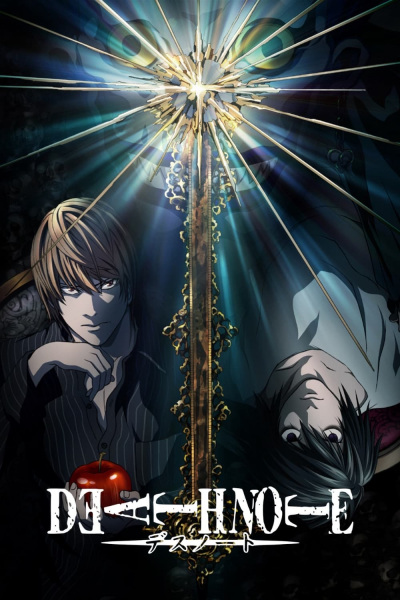
Madhouse and director Tetsuro Araki elevate a fundamentally dialogue-and-thinking show through expressionist direction: dramatic lighting, Caravaggio-esque framing, and the iconic gothic-religious imagery of Light eating an apple like a sacrament. Sound design and the Hideki Taniuchi/Yoshihisa Hirano score (the operatic 'L's Theme' and choral 'Kyrie') turn deductions into setpieces. Some later episodes show flatter, more static animation, but the visual ambition rarely falters.
Cultural impact
Death Note is a global gateway anime and one of the most recognized titles outside Japan, spawning live-action films, a Netflix adaptation, and pervasive meme culture (the 'writing names' format, the apple imagery). Light and L are icons referenced far beyond the medium, and the series remains a default recommendation for newcomers nearly two decades on.
Synopsis (from MAL)
Brutal murders, petty thefts, and senseless violence pollute the human world. In contrast, the realm of death gods is a humdrum, unchanging gambling den. The ingenious 17-year-old Japanese student Light Yagami and sadistic god of death Ryuk share one belief: their worlds are rotten. For his own amusement, Ryuk drops his Death Note into the human world. Light stumbles upon it, deeming the first of its rules ridiculous: the human whose name is written in this note shall die. However, the temptation is too great, and Light experiments by writing a felon's name, which disturbingly enacts his first murder. Aware of the terrifying godlike power that has fallen into his hands, Light—under the alias Kira—follows his wicked sense of justice with the ultimate goal of cleansing the world of all evil-doers. The meticulous mastermind detective L is already on his trail, but as Light's brilliance rivals L's, the grand chase for Kira turns into an intense battle of wits that can only end when one of them is dead. [Written by MAL Rewrite]
Ranked nearby
Explore rankings
Discussion
Set a display name above to post.
Loading discussion…