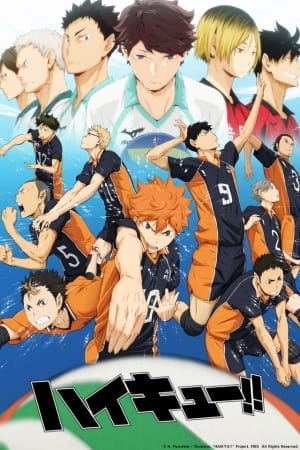
Haikyuu!!
Is Haikyuu!! worth watching?
Yes, it's worth watching. Anime Codex rates Haikyuu!! 8.27 out of 10 — scored on six criteria (story, characters, themes, world-building, animation, and cultural impact), not crowd votes. 34th of 226 on the Codex rubric — top 15% of the catalogue. The crowd rates it 0.16 higher than the rubric does — the Codex is harder on it than on 25% of the catalogue.
Where to watch
Trailer
What the data says
Computed from the Codex rubric across the whole catalogue.
Summary
Haikyuu!!'s first season is one of the strongest entry points in modern sports shonen, succeeding through disciplined pacing, authentic volleyball mechanics, and an exceptional central partnership between the undersized, relentless Hinata and the prodigy setter Kageyama. Rather than inventing spectacle, it earns tension from rotations, blocking reads, and the trust required for the synchronized quick attack, making each rally legible and emotionally charged. Production I.G's direction shines in its decisive-point camerawork and sound design, while the ensemble—Daichi's leadership, Asahi's arc against Date Tech, Tsukishima's detachment—is unusually well-rounded for so early in a long franchise. Its themes of connection over individual talent are dramatized literally and effectively. The chief weaknesses are structural and conceptual: the season follows the familiar underdog-climbs-the-ladder template without subverting it, ends on a defeat that makes the arc feel like a prologue, and leaves several roster members underdeveloped. Animation quality is also uneven outside its set-piece rallies. Judged against the best of its demographic, it falls just short of definitive within season one alone but stands as a benchmark for the genre, with cultural influence that helped revive sports anime for a worldwide audience and inspire real interest in the sport.
Criterion breakdown
Story & narrative
Season one is structurally disciplined for a sports shonen, building from the Hinata-Kageyama rivalry into the Interhigh qualifiers with the practice match against Aoba Johsai and the climactic loss to Seijoh anchoring the back half. The pacing wisely treats early matches against Tokonami and the rematch with Date Tech (the 'Iron Wall' arc) as escalating tests rather than filler, though the first season ends on a defeat rather than a triumph, which is brave but leaves the arc feeling like a prologue rather than a complete narrative. The reliance on the standard 'underdog team climbs the ladder' template keeps it from full originality.
Character writing & growth
The Hinata-Kageyama dynamic—the 'freak quick' partnership born from forcing two incompatible egos to synchronize—is among the genre's best central duos, and the show extends real growth to supporting players like Tsukishima's prickly detachment, Nishinoya and Tanaka's energy, and especially Daichi and Sugawara's quiet senior leadership. Asahi's arc of overcoming his fear of being blocked, paid off against Date Tech, is a standout emotional beat. The large roster occasionally leaves players like Ennoshita underdeveloped this early, but the ensemble is unusually well-balanced.
Themes & emotional resonance
The core thesis—that height and individual talent mean nothing without trust and connection—is dramatized literally through the volleyball quick attack requiring Hinata to swing blind. The recurring motif of the 'crows' regaining flight and the Seijoh loss reframing growth as a process rather than a destination give the season genuine emotional weight beyond simple wins. It stops short of deeper thematic ambition, staying firmly within feel-good sports inspiration.
World-building & power system
Read as setting depth and premise originality, Haikyuu!! is rigorous in its volleyball mechanics—rotations, blocking reads, libero rules, and the synchronized attack are explained without dumbing down, lending the matches real internal consistency. Rival schools are characterized through distinct play styles (Seijoh's Oikawa-led precision, Date Tech's wall). It is grounded high-school realism rather than invented world-building, so its uniqueness lies in execution and authenticity rather than novel concept.
Animation & direction
Production I.G renders volleyball with strong spatial clarity, using dynamic camera sweeps across the net and slow-motion at key spikes to make rallies legible and tense. Susumu Mitsunaka's direction excels in the sound design and the 'time freeze' on decisive points, particularly during the Seijoh match. Some still-frame reuse and limited movement appear in less critical rallies, and the animation peaks unevenly, but the highlight sequences are consistently kinetic.
Cultural impact
Haikyuu!! revitalized the sports anime genre for a global audience and is frequently cited as a gateway title, driving a measurable surge of interest in volleyball among fans. Its massive, enduring fandom and the franchise's continued top-tier popularity through later seasons and films cement its lasting influence within and beyond shonen.
Synopsis (from MAL)
Ever since having witnessed the "Little Giant" and his astonishing skills on the volleyball court, Shouyou Hinata has been bewitched by the dynamic nature of the sport. Even though his attempt to make his debut as a volleyball regular during a middle school tournament went up in flames, he longs to prove that his less-than-impressive height ceases to be a hindrance in the face of his sheer will and perseverance. When Hinata enrolls in Karasuno High School, the Little Giant's alma mater, he believes that he is one step closer to his goal of becoming a professional volleyball player. Although the school only retains a shadow of its former glory, Hinata's conviction isn't shaken until he learns that Tobio Kageyama—the prodigy who humiliated Hinata's middle school volleyball team in a crushing defeat—is now his teammate. To fulfill his desire of leaving a mark on the realm of volleyball—so often regarded as the domain of the tall and the strong—Hinata must smooth out his differences with Kageyama. Only when Hinata learns what it takes to be a part of a team will he be able to join the race to the top in earnest. [Written by MAL Rewrite]
Ranked nearby
Explore rankings
Discussion
Set a display name above to post.
Loading discussion…