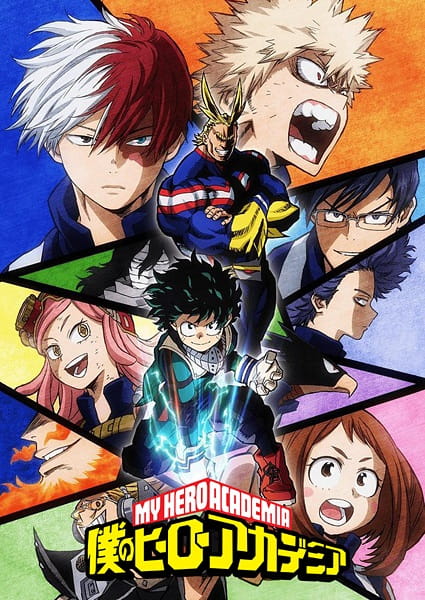
My Hero Academia
Is My Hero Academia worth watching?
Yes, it's worth watching. Anime Codex rates My Hero Academia 8.40 out of 10 — scored on six criteria (story, characters, themes, world-building, animation, and cultural impact), not crowd votes. 27th of 226 on the Codex rubric — top 12% of the catalogue. The Codex rates it Δ +0.35 above its MAL score — more underrated than 94% of the catalogue.
Where to watch
Trailer
What the data says
Computed from the Codex rubric across the whole catalogue.
Summary
My Hero Academia's second season represents the franchise at its narrative peak, anchored by the Sports Festival arc—a tournament structure that, unusually for shonen, mines its drama from classmates rather than villains. The Midoriya-Todoroki duel is a high watermark of the demographic, pairing spectacular Bones sakuga with a genuinely moving thesis about reclaiming one's identity from an abusive parent. The ensemble matures considerably: Todoroki, Bakugo, and Iida all receive arcs with real psychological weight, elevating the cast beyond standard shonen archetypes. The introduction of Stain expands the show's thematic ambitions, questioning the commercialization of heroism. Weaknesses are present but modest: the post-festival arcs (Stain, Final Exams) lose the momentum and emotional focus the festival built, the season occasionally over-explains its themes through Midoriya's monologues, and animation quality dips in lower-stakes early rounds. The world-building, while textured, is intentionally derivative of Western superhero conventions, so its strength lies in synthesis rather than originality. Judged against the best of battle shonen, this is a top-tier entry—not quite reaching the genre-defining heights of its longest-running peers, but executing its competitive-school premise with discipline, heart, and standout visual craftsmanship that few contemporaries match.
Criterion breakdown
Story & narrative
Season 2's Sports Festival arc is a masterclass in tournament-arc structure, using the festival framework to escalate stakes between classmates rather than external villains, with Midoriya vs. Todoroki standing as one of shonen's best-written single fights. The pacing falters slightly in the back half as the Hero Killer Stain arc shifts tone abruptly, and the final stretch (Final Exams) loses momentum compared to the festival's emotional peak. Still, the season's central conceit—competition as a vehicle for character revelation—is executed with rare discipline.
Character writing & growth
This is the season where MHA's ensemble crystallizes: Todoroki's confrontation with his fire quirk and the trauma of Endeavor transforms him from a cold rival into the show's most compelling figure, and Midoriya's choice to push him toward using his full power is genuinely cathartic. Bakugo's hollow victory and refusal of the medal demonstrates sophisticated handling of a character who could have been a flat bully. Even side characters like Iida, given real grief and recklessness in the Stain arc, get meaningful arcs rather than filler.
Themes & emotional resonance
The season interrogates what heroism means more pointedly than season one, contrasting Stain's purist ideology against the commercialized hero industry, and questioning inherited legacy through Todoroki's rejection of his father. The 'it's your power, not his' beat in the Todoroki fight lands as a genuine emotional thesis about self-determination. It occasionally states its themes too plainly via Midoriya's internal monologues rather than trusting the imagery.
World-building & power system
The quirk system gains texture here, with the Sports Festival showcasing creative applications—Ojiro's tail, Tokoyami's Dark Shadow, Aoyama's navel laser—and the recruitment/agency framework grounds the superhero society in believable institutional logic. The hero-industry economy and the existence of villain ideologies like Stain's add welcome depth to what could be a simple powers-and-school premise. It remains derivative of Western superhero comics by design, so 'uniqueness' is more in synthesis than invention.
Animation & direction
Bones delivers standout sakuga in the Midoriya-Todoroki duel, where the clashing ice and fire is choreographed and colored with thrilling clarity, and Yamashita's direction uses freeze-frames and impact lighting to punctuate emotional beats. The Stain fight features grittier, shadow-heavy compositions that distinguish it tonally from the festival's bright spectacle. Some lower-budget episodes in the tournament's earlier rounds show flatter animation, but the peaks are exceptional.
Cultural impact
MHA became a defining shonen of its generation, and season two cemented that status by delivering the Sports Festival, which is widely cited as the franchise's high point and drove massive Western fandom growth. Its characters—particularly Todoroki and Bakugo—became merchandising and cosplay staples, and the series helped sustain Shonen Jump's flagship lineup post-Naruto. Its impact is significant though not yet medium-redefining at the level of Dragon Ball or One Piece.
Synopsis (from MAL)
At UA Academy, not even a violent attack can disrupt their most prestigious event: the school sports festival. Renowned across Japan, this festival is an opportunity for aspiring heroes to showcase their abilities, both to the public and potential recruiters. However, the path to glory is never easy, especially for Izuku Midoriya—whose quirk possesses great raw power but is also cripplingly inefficient. Pitted against his talented classmates, such as the fire and ice wielding Shouto Todoroki, Izuku must utilize his sharp wits and master his surroundings to achieve victory and prove to the world his worth. [Written by MAL Rewrite]
Ranked nearby
Explore rankings
Discussion
Set a display name above to post.
Loading discussion…