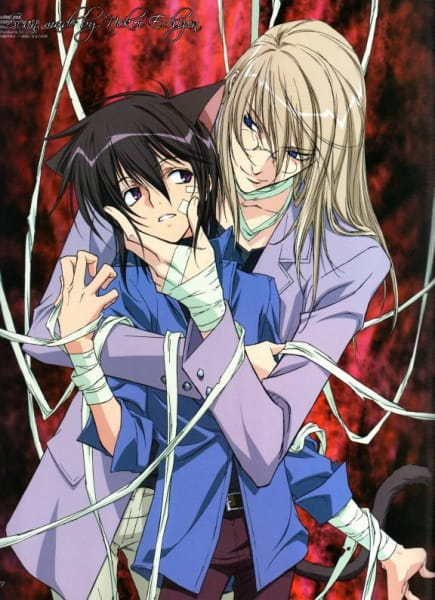
Loveless
Is Loveless worth watching?
Mixed — depends what you want. Anime Codex rates Loveless 6.33 out of 10 — scored on six criteria (story, characters, themes, world-building, animation, and cultural impact), not crowd votes. 193rd of 226 on the Codex rubric — bottom 16% of the catalogue. The crowd rates it 0.37 higher than the rubric does — the Codex is harder on it than on 38% of the catalogue.
Where to watch
Streaming availability varies by region — check your local services.
What the data says
Computed from the Codex rubric across the whole catalogue.
Summary
Loveless stands out in the josei space for its inventive premise — virginity made literally visible through cat ears, and combat staged as name-bound spell duels between a Sacrifice and a Fighter — which Yun Kouga uses as a sustained metaphor for innocence, abuse, and emotional codependency. Ritsuka is a notably prickly, wounded protagonist whose abusive home life gives the drama real weight, and the series is willing to let its central relationship feel uncomfortable rather than tidy. Its themes of who absorbs pain in a bond, and the longing to be loved unconditionally, resonate when the show slows down. The weaknesses are significant, however. The 12-episode adaptation halts mid-mystery, resolving neither Seimei's death nor the Seven Moons, so it functions as an unfinished prologue. The spell battles are visually flat and inconsistently ruled, and the adult-child dynamic at the story's core is raised provocatively but never ethically examined. The animation is atmospheric but static. As a mood piece and a showcase for an original premise it is memorable and worth experiencing, but as a complete narrative it is frustratingly truncated — a flawed but distinctive entry rather than a definitive one.
Criterion breakdown
Story & narrative
The mystery surrounding Seimei's death and the Seven Moons offers a compelling hook, and the spell-battle premise is woven decently into the central investigation, but the 12-episode run ends with almost nothing resolved — Seimei's true nature and the organization's motives remain dangling threads. Because the manga was ongoing, the anime stops rather than concludes, leaving the Zero pair arc and Ritsuka's amnesia as unpaid setups. The pacing is also uneven, alternating slow psychological interludes with abrupt battle confrontations that lack stakes.
Character writing & growth
Ritsuka's wariness, his abusive home life with a mother who only accepts the 'old' Ritsuka, and his guarded intelligence make him a more textured 12-year-old protagonist than the genre norm. Soubi is deliberately written as evasive and damaged, and the discomfort the show stages around his devotion is intentional rather than romanticized clumsiness. However, secondary figures like Kio and the Zero boys are underdeveloped within the short run, and Ritsuka's growth stalls because the story stops before his arc matures.
Themes & emotional resonance
The ears-as-innocence conceit is a genuinely pointed metaphor for the violation of childhood, and the Sacrifice/Fighter dynamic literalizes themes of emotional codependency, control, and who absorbs pain in a relationship. The show is at its strongest when probing Ritsuka's need to be loved unconditionally against a backdrop of maternal abuse. Yet it raises the troubling power imbalance between an adult and a child without ever fully interrogating it, leaving its central relationship ethically muddled rather than resolved.
World-building & power system
The premise — cat ears and tails as visible markers of virginity, and combat conducted through spell-word duels by name-bound pairs — is strikingly original and thematically integrated rather than decorative. The naming system (Beloved, Zero, Loveless) and the idea that one partner takes damage while the other casts is internally clever. The drawback is that the rules of the spell battles are never explained with enough consistency, so confrontations feel arbitrary about who wins and why.
Animation & direction
J.C.Staff delivers a restrained, muted palette and some atmospheric direction in quiet domestic and butterfly-motif scenes that suit the melancholic tone. Character designs are elegant but the animation is largely static, relying on held shots and limited movement, and the spell battles in particular are visually flat — abstract effects standing in for genuinely staged action. It is competent but rarely distinctive, and the OP is more memorable than most of the episode-to-episode visuals.
Cultural impact
Yun Kouga's source manga has a durable cult following and the series is frequently cited in discussions of early-2000s shounen-ai/josei boundary works, with its symbolism widely referenced. However, the anime's failure to conclude blunted its broader reach, and it never achieved the mainstream footprint of its better-known contemporaries. Its impact is real but niche, sustained more by the manga than the adaptation.
Synopsis (from MAL)
In the world of Loveless, each person is born with cat ears and a tail, which disappear only if that person engages in a sexual intercourse. Because of this, they have come to symbolize virginity and innocence. Additionally, fighting is only done by "fighting pairs" or couples, where one is known as the Sacrifice and the other as the Fighter. The first receives the damage while the latter attacks. Ritsuka Aoyagi is a 12-year-old boy, who for some unknown reason suffers from amnesia. His brother got killed recently, and as if his life has not been hard enough lately, on his first day at the new school he gets approached by a stranger called Agatsuma Soubi, who claims to have known his late brother. Ritsuka finds out that Agatsuma and his brother used to be a fighting pair, and that Agatsuma has inherited Ritsuka now that his brother is gone. Together, they try to find the truth behind his brother's death and the organization known as the "Seven Moons," which may have been responsible for it. All the while, it seems that Ritsuka and Agatsuma are becoming closer than they intended to be…
Ranked nearby



Explore rankings
Discussion
Set a display name above to post.
Loading discussion…