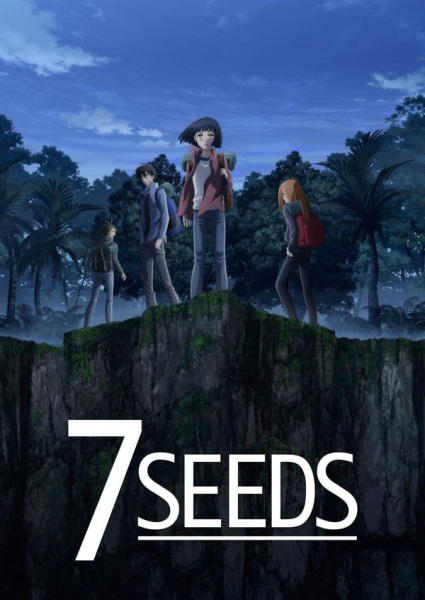
7 Seeds
Is 7 Seeds worth watching?
Mixed — depends what you want. Anime Codex rates 7 Seeds 6.03 out of 10 — scored on six criteria (story, characters, themes, world-building, animation, and cultural impact), not crowd votes. 207th of 226 on the Codex rubric — bottom 9% of the catalogue. The crowd rates it 0.54 higher than the rubric does — the Codex is harder on it than on 49% of the catalogue.
Where to watch
Trailer
What the data says
Computed from the Codex rubric across the whole catalogue.
Summary
7 Seeds is notable within josei for taking a hard survival-fiction premise — cryogenically preserved youths awakening into a hostile post-apocalyptic Japan — and grounding it in distinctly josei concerns: trauma, survivor's guilt, consent, and the quiet reclamation of self-worth through Natsu, a heroine defined by perceived uselessness. Yumi Tamura's source manga is acclaimed for its sprawling ensemble and patient psychological depth, and the anime preserves the strength of that premise and its thematic ambitions. Unfortunately, the 12-episode adaptation is its own worst enemy. It compresses an enormous, branching narrative into a breakneck runtime, leaving character arcs like Semimaru's and the Ryugu survivors' underdeveloped and major mysteries unresolved, so it reads as a hurried prologue rather than a satisfying whole. The production compounds this: Gonzo's awkward CGI and inconsistent animation sap the survival horror of its needed visceral tension and atmosphere. The result is a show with a fascinating skeleton and genuine emotional intentions that the execution repeatedly fails to honor. For josei fans drawn to its themes, it functions best as a gateway to the superior manga rather than a definitive work in its own right.
Criterion breakdown
Story & narrative
The cryogenic survival premise adapted from Yumi Tamura's manga is genuinely strong, opening with Natsu's group on the sinking boat and gradually revealing the '7 Seeds' project's scope through scattered teams and Ryugu Shelter flashbacks. However, the 12-episode adaptation compresses far too much, jumping between Team Summer A, Team Summer B, and the Ryugu children with disorienting speed, leaving major reveals underweighted and the pacing lurching rather than building tension. It introduces compelling mysteries but resolves almost none, functioning as a truncated prologue rather than a complete arc.
Character writing & growth
Natsu's arc from paralyzed timidity toward tentative agency is the emotional spine, and characters like the abrasive Semimaru, stoic Arashi, and the traumatized Ryugu survivors carry real depth in the source. But the rushed runtime flattens these into sketches; Semimaru's softening and the guide characters' burdens get gestured at rather than earned. The ensemble is large and the anime rarely gives any individual enough sustained screen time for their growth to land with full impact.
Themes & emotional resonance
Strong josei thematic core: survivor's guilt, the cruelty of being 'chosen' without consent, and finding worth in a person society deemed useless (Natsu) resonate well beyond typical disaster fiction. The Ryugu children's psychological scarring and the ethics of forcibly preserving humanity give it weight. Emotional resonance is real but blunted by the adaptation's haste, which undercuts the slow-burn dread and grief the manga cultivates.
World-building & power system
The post-apocalyptic Japan reclaimed by mutated megafauna and toxic flora is imaginative and internally consistent, with the multi-team structure and Ryugu Shelter's underground bunker adding layers to the premise's originality. The survival logistics and the deliberate selection of skill sets per team show thoughtful design. Less developed onscreen is the deeper science of the project, again a casualty of compression.
Animation & direction
This is the production's glaring failure. Gonzo's heavy reliance on stiff CGI for creatures and crowd scenes clashes badly with the 2D character work, and overall fluidity is poor, undercutting the survival horror that demands visceral impact. Directorial choices rarely elevate the atmosphere, and the dated, uneven visuals are a primary reason the adaptation is held in lower regard than its acclaimed source.
Cultural impact
The manga is a celebrated, award-winning josei work (Shogakukan Manga Award), but the Netflix-distributed anime adaptation drew lukewarm reception and is widely viewed as having squandered the material. Its main cultural footprint is introducing the property to a wider international audience, even if disappointingly.
Synopsis (from MAL)
Imagine this: you are living a normal day in your life. Maybe you are out with friends, eating your family's home-cooked meal or spending time with your girlfriend. When you next wake up, you are suddenly thrust into a strange, new world, surrounded by five strangers on a rapidly sinking boat in the middle of a storm. For Natsu Iwashimizu, this is her new reality. Humanity has perished, and all that remains of the Japanese population are five groups of men and women who were chosen to be sent to the future in hopes of continuing mankind's existence. While every other person chosen has a useful talent such as martial arts, knowledge, or architecture, Natsu is a shy high school girl who cannot even raise her voice to shout. The new world is dangerous beyond imagination, and although Natsu seems to lack helpful skills, she must go with the others making their way to the "Seven Fuji" in order to survive. [Written by MAL Rewrite]
Ranked nearby

Explore rankings
Discussion
Set a display name above to post.
Loading discussion…