Karneval
Is Karneval worth watching?
Mixed — depends what you want. Anime Codex rates Karneval 5.91 out of 10 — scored on six criteria (story, characters, themes, world-building, animation, and cultural impact), not crowd votes. 215th of 226 on the Codex rubric — bottom 6% of the catalogue. The crowd rates it 1.16 higher than the rubric does — the Codex is harder on it than on 79% of the catalogue.
Where to watch
Streaming availability varies by region — check your local services.
What the data says
Computed from the Codex rubric across the whole catalogue.
Summary
Karneval is a visually sumptuous josei adaptation whose greatest strengths are aesthetic and relational: the ornate Circus premise—a government agency that performs literal circus shows to soothe a traumatized public—is genuinely original, and Gareki's grudging, well-paced bond with the guileless Nai gives the series real emotional warmth. Manglobe's decorative art direction, ribbon motifs, and strong ensemble charm (Hirato, Yogi, Tsukumo) make it pleasant viewing for fans of bishounen-driven mystery-adventure. Its weaknesses, however, are structural. Thirteen episodes are far too few to service the missing-friend quest, the varuga threat, and the Kafka conspiracy simultaneously, so the show functions as a handsome prologue rather than a complete story—the central mysteries around Nai, Karoku, and Kafka remain almost entirely unresolved, and no sequel ever materialized. Tonal swings between whimsical candy-coloring and grim body horror sometimes undercut its themes of exploited children and the need to be needed, and Nai stays static while the large cast lacks room to grow. Measured against the best of its demographic, Karneval is an above-average but unfinished entry: lovely to look at and emotionally sincere at its core, yet hampered by overstuffed plotting and an adaptation that stops just as its world becomes interesting.
Criterion breakdown
Story & narrative
The narrative juggles a missing-friend quest, the varuga/Kafka conspiracy, and Circus's institutional intrigue, but never commits to any of them within 13 episodes—the Kafka plot in particular is barely scratched, leaving the series feeling like an extended prologue. The early Mine/mansion arc and the Smoky Mountain Hospital arc generate genuine tension, yet the adaptation's pacing rushes connective tissue and ends on an unresolved note that assumes a sequel that never arrived. Mystery is teased competently around Nai's origins but resolution is perpetually deferred.
Character writing & growth
Gareki's prickly self-reliance slowly thawing toward Nai is the show's emotional anchor, and his decision to leave for school to become useful is a rare moment of earned growth. Nai, however, remains static—wide-eyed innocence that functions as a plot device more than an arc—and the large Circus ensemble (Hirato, Tsukumo, Yogi's split personality) is introduced with charm but given little room to develop in so few episodes. Karoku and the antagonists stay frustratingly opaque.
Themes & emotional resonance
Found-family, the value of being needed, and the trauma of exploited children (Nai, Gareki's backstory, Yogi's 'silver case') are sincere thematic threads, and Gareki's arc about wanting to matter to someone lands emotionally. But the show rarely lets these themes breathe under the weight of unfinished plotting, and the tonal whiplash between candy-colored whimsy and body-horror varuga dilutes resonance rather than deepening it.
World-building & power system
The 'Circus' conceit—a state defense agency that stages literal circus shows to comfort civilians after monster cleanups—is a genuinely distinctive premise with strong aesthetic identity, and Sheep robots and ID-bracelet tech give the setting texture. However, the varuga biology and Kafka's goals are left under-explained, and the internal logic of how Circus operates politically is asserted more than demonstrated, leaving the worldbuilding decorative rather than rigorous.
Animation & direction
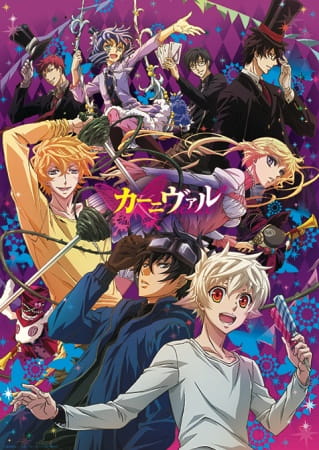
Manglobe delivers a lush, ornate visual palette—elaborate costuming, the ribbon-and-card motifs, and ED imagery are striking and very much in the decorative shoujo/josei tradition. Action choreography is serviceable but occasionally stiff, and the show leans on still frames and reused varuga designs in later episodes; the gorgeous character art is the stronger asset over consistent fluid motion.
Cultural impact
Touya Mikanagi's manga retained a dedicated fanbase and the anime drew solid streaming attention (over 226k MAL members), buoyed by its bishounen-heavy cast and atmospheric soundtrack. But it left little lasting footprint on the broader medium, never received a second season to capitalize on momentum, and is now largely remembered as an attractive but incomplete adaptation.
Synopsis (from MAL)
While in search of his precious friend, a young boy named Nai falls captive to a beautiful woman, whose looks are matched only by her taste for human flesh. Meanwhile Gareki, a clever thief, is in the midst of robbing her luxurious home. After causing a distraction, Gareki agrees to help Nai escape, but they are discovered upon the woman's return. As she transforms into a ghoulish monster, the boys flee. On the run, Nai and Gareki are found by "Circus," a government defense agency that deals with criminal activity too difficult for the police to handle and protects civilians from "varuga"—terrible monsters that devour humans for sustenance. In the hope that it will lead Nai to his missing friend, he and Gareki decide to join Circus. On their perilous journey, they face dangerous varuga and begin to uncover the secrets behind a shadowy organization known as Kafka. [Written by MAL Rewrite]
Ranked nearby



Explore rankings
Discussion
Set a display name above to post.
Loading discussion…